
Streamlining Complexity: How Primavera P6 Transforms Project Management
Handling large projects is rarely straightforward. Multiple dependencies, tight deadlines, shifting budgets, and diverse teams can quickly create confusion. Without the right system, managers often struggle to maintain clarity and control. This is why many industries—construction, IT, oil and gas, and manufacturing—turn to specialized Primavera P6 Project Management. Among them, Primavera P6 stands out as a robust solution.
Designed for scalability and precision, Primavera P6 provides project managers with advanced scheduling, resource allocation, and reporting capabilities. Its ability to simplify complexity makes it an essential platform for organizations dealing with high-stakes, multi-phase projects. By enabling accurate forecasting, better collaboration, and improved risk management, Primavera P6 ensures that projects stay on track from start to finish.
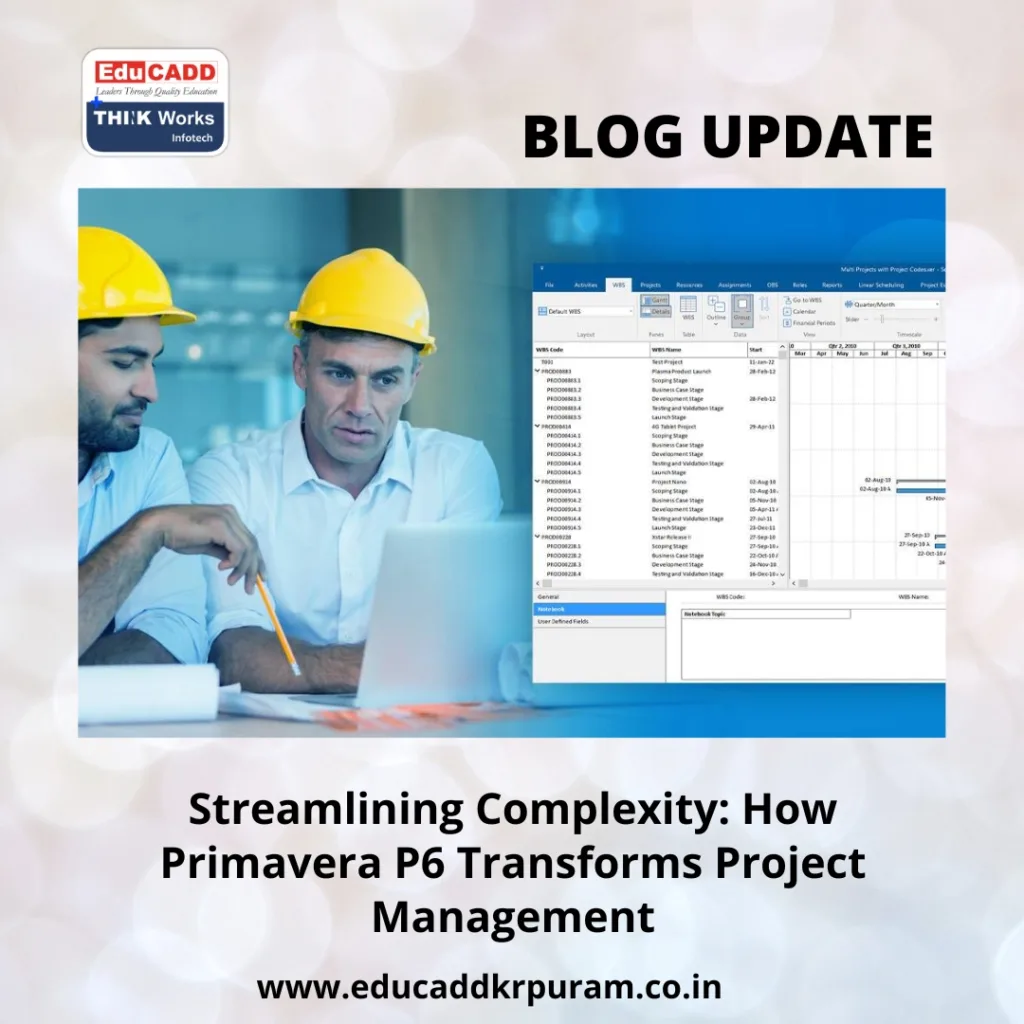
Primavera P6 Project Management
In this blog, we will examine how Primavera P6 helps in complex project management, highlighting its features that empower teams to deliver projects more efficiently.
1. Detailed Scheduling for Better Clarity
Complex projects often involve thousands of activities linked by critical dependencies. Primavera P6 helps managers break down these complexities with structured scheduling. By creating a work breakdown structure, every task is mapped clearly with defined timelines and dependencies.
Visual tools like Gantt charts and critical path analysis highlight high-priority activities. This gives teams visibility into what must be completed on time to avoid delays. Moreover, schedules can be adjusted easily whenever project requirements change. With this flexibility, Primavera P6 ensures that even the most intricate timelines remain manageable and aligned with business goals.
2. Efficient Resource Management and Budget Alignment
Projects often fail because resources are misallocated or budgets spiral out of control. Primavera P6 solves this by offering resource management tools that align manpower, equipment, and materials with project needs. Managers can track resource utilization, monitor availability, and adjust allocations to avoid conflicts or overuse.
Cost management is integrated within the system. As resource usage changes, Primavera P6 updates budget forecasts, helping managers maintain financial discipline. Workload balancing features ensure that teams are neither underutilized nor overburdened, ultimately improving efficiency and reducing costs.
3. Risk Mitigation Through Scenario Analysis
Uncertainty is a constant in large projects. Supply disruptions, labor shortages, or technical failures can derail progress. Primavera P6 addresses this by providing “what-if” analysis, enabling managers to simulate different risk scenarios.
By forecasting how potential risks impact schedules and budgets, the software helps create contingency plans in advance. It also links risk evaluation to scheduling, making it clear which activities are most vulnerable. This proactive approach allows project leaders to act before risks escalate into serious problems.
4. Collaboration Across Stakeholders and Teams
Large-scale projects typically involve multiple stakeholders—from contractors and engineers to investors and regulators. Communication gaps between them can create delays and misunderstandings. Primavera P6 eliminates this challenge by serving as a centralized hub for project data.
All stakeholders can access up-to-date information in real time. When progress updates are entered, the system instantly reflects them across the project. Role-based permissions ensure that each participant sees the information most relevant to their responsibilities. Additionally, integration with ERP and financial systems strengthens coordination across departments.
This seamless collaboration not only improves efficiency but also builds transparency and accountability within the project team.
5. Real-Time Monitoring and Corrective Control
Tracking performance is crucial in complex projects, and Primavera P6 excels in this area. It provides dashboards that display key metrics such as earned value, cost variance, and schedule adherence. Managers can instantly see how well the project is performing compared to the original plan.
The software also generates professional, customized reports, which are especially useful for stakeholder communication. Beyond reporting, Primavera P6 empowers managers to take corrective actions. If a task falls behind schedule or a cost exceeds estimates, adjustments can be made quickly—whether through rescheduling, reassigning resources, or modifying budgets.
This continuous monitoring ensures that projects remain on track despite unexpected changes.
Conclusion: The Strategic Edge of Primavera P6
Modern projects are more demanding than ever, requiring precision and adaptability. Primavera P6 provides both. Its strengths in scheduling, resource allocation, risk management, collaboration, and monitoring make it an invaluable tool for handling project complexity.
By using Primavera P6, organizations gain a competitive advantage. They can complete projects within deadlines, stay within budget, and maintain high levels of efficiency. More importantly, they can approach complex initiatives with confidence rather than uncertainty.
Ultimately, how Primavera P6 helps in complex project management is straightforward: it transforms overwhelming challenges into manageable workflows, guiding projects from initiation to successful delivery.

