
From Blueprint to Building: Experiencing Real-Life BIM Projects at EduCADD
In today’s architecture, engineering and construction world, the digital transformation of workflows is no longer optional. The paradigm has shifted: professionals must not only conceptualize designs but also simulate, coordinate and manage complex systems using digital tools. This means that theoretical learning alone will not suffice — what truly matters is hands-on experience. At EduCADD, students engage in real-life BIM projects that mirror industry demands, enabling them to move from classroom to construction site in readiness.
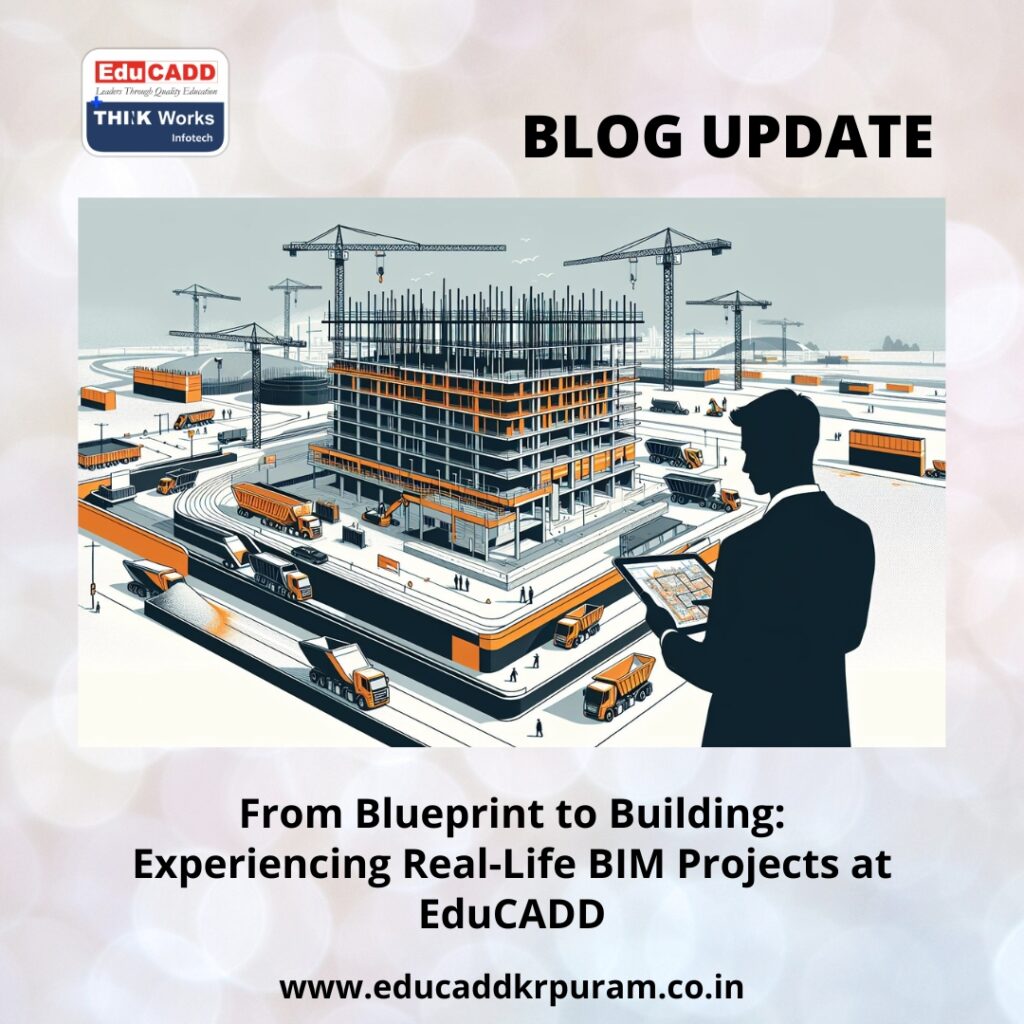
Real-Life BIM Projects
These experiences do more than teach software commands — they immerse learners in dynamic workflows where architecture, structure and building systems interact in 3D and beyond. By practising in this environment, learners develop coordination, communication and problem-solving skills that employers seek. Over the program’s span, students at EduCADD tackle a variety of scenarios, each reflecting a genuine construction challenge and rooted in the real demands of the built environment.
This blog explores how EduCADD structures these real-life BIM projects across different typologies — residential, commercial, infrastructure and facility management — and how each project trains students for successful futures in BIM-driven AEC (architecture, engineering, construction) industries.
1. Understanding the Power and Why Real-Life BIM Projects Matter
Before engaging in real-life BIM projects, it is essential to understand what BIM (Building Information Modeling) truly signifies and why its application matters so much in the field. BIM is not merely 3D models. It is a process of creating intelligent digital representations of built assets, linking geometry, time, cost, materials and lifecycle data into one shared environment.
In conventional workflows, designers, engineers and contractors work in silos. Hand-offs, mismatches and coordination gaps often lead to errors, delays and cost over-runs. In contrast, BIM fosters collaboration across disciplines, enables early detection of design conflicts (“clashes”), streamlines scheduling and cost estimation, and supports facility operations long after construction completes
This makes the simulation of real-life BIM projects at EduCADD all the more relevant. By working on authentic, industry-scaled scenarios, students internalize the importance of integrated workflows, cross-discipline coordination and lifecycle thinking. They gain not just technical proficiency in tools like Revit, Navisworks, and AutoCAD, but also adopt a construction-aware mindset: “How will this structure be built? How will its systems be maintained? How can design changes impact cost or schedule?” When students move into the workforce, employers will expect this fluency. The samples of real-life BIM projects they complete during training act as strong evidence of that readiness.
2. Project Phase One: Smart Residential Design – The First Real-Life BIM Project
The first practical challenge that EduCADD students engage with is the design of a smart residential building. This project acts as an immersive introduction to the world of real-life BIM projects and sets the tone for deeper workflows ahead.
Architectural Modeling and Design
Learners begin by creating a multi-unit residential layout. They develop floor plans, elevations and sections in a realistic time-bound scenario. The focus lies on space efficiency, user experience and code compliance. They employ Revit families to add doors, windows, fixtures and furniture, simulating real architectural workflows.
Integrating Structure, MEP and Coordination
Once the architecture is modelled, students layer structural components — beams, slabs, columns — and then mechanical, electrical and plumbing (MEP) systems. This is where the value of real-life BIM projects becomes evident. Students must coordinate across systems. For example, a duct cannot collide with a beam or conflict with the electrical conduit. They use clash detection tools in Navisworks to identify and resolve such issues at the digital stage, avoiding costly mistakes that would occur on site. This coordination practice immerses them in industry norms.
Sustainability and Smart Systems
The project also introduces green building considerations, including daylight modelling, solar orientation, energy-efficient HVAC design and water recycling systems. By simulating these within the digital model, students appreciate the direct link between design decisions and sustainability outcomes. Because the project is structured as a real-life BIM project scenario, learners deal with realistic constraints: budget limits, client expectations, buildability issues and site conditions.
By completing this residential project, students develop three core competencies: the ability to build an intelligent digital model, coordinate multi-discipline input and ensure that design decisions align with broader sustainability and construction goals. They emerge ready to tackle more complex real-life BIM projects with confidence.
3. Project Phase Two: Commercial Complex Development – Scaling Up the Challenge
After mastering the residential model, EduCADD students advance to a more complex and demanding scenario: creating a commercial complex. This mirrors the workflows seen in large-scale industry projects and provides hands-on experience with multiple systems, heavy data coordination and teamwork.
Data-Rich Modeling and Functional Zones
Students design a commercial building comprising offices, retail units, service spaces and perhaps mixed-use elements. They build models where every element is linked to data: material types, performance metrics, cost parameters and maintenance schedules. This level of detail trains them in data-driven design and reflects how real-life BIM projects operate at scale.
Interdisciplinary Collaboration and Clash Management
In a team setup, students assume roles (architect, structural engineer, MEP specialist) and collaborate in a simulated project environment. Real-life BIM projects demand coordination between all disciplines. Students use a common data environment, review models together, conduct coordination meetings and perform clash detection. They use Navisworks Manage to detect conflicts between structural and MEP systems, for example. By resolving issues digitally, they avoid the rework and delays typical of traditional workflows.
Time and Cost Integration (4D/5D BIM)
This project introduces 4D (time) and 5D (cost) elements. Students link schedule tasks and cost data to their digital models. They simulate construction sequences, review budget implications of design changes and make decisions that reflect the realities of construction management. By engaging with this dimension of real-life BIM projects, students learn how BIM helps reduce risk, accelerate delivery, control cost and support more sustainable outcomes.
By the end of this commercial complex project, learners emerge equipped with actionable experience in high-stakes coordination, data-driven decision-making and multi-discipline collaboration. They are unlikely to be intimidated when they enter real job environments.
4. Project Phase Three: Infrastructure & Urban Planning – Broadening the Horizon
While buildings dominate much BIM discourse, modern BIM applications extend deeply into infrastructure, urban design and planning. Recognizing this, EduCADD presents students with a third major scenario: an infrastructure/urban planning project. This marks their transition into even higher complexity and broader impact.
Terrain, Site and GIS Integration
Students start by importing terrain and site data from GIS sources. They model road alignments, bridges, drainage systems or utility corridors. This approach immerses them in large-scale, outdoor construction logic, where layered disciplines and long-term operation become critical. Real-life BIM projects in infrastructure demand this context.
Smart Infrastructure Design & Simulation
Learners design roads, public utilities and urban zones. They simulate construction sequences, traffic movement, phasing and environmental impact. They integrate BIM with smart-city concepts: sensor systems, real-time monitoring and sustainable infrastructure components. By building these models, students understand how BIM delivers value beyond bricks and mortar — it shapes cities, infrastructure, and the future of our built environment.
Connecting with Sustainability and Urban Lifecycle
The focus here is not just design, but lifecycle thinking. Students consider how infrastructure will be maintained, how urban systems will interact, and how data will evolve after construction. By engaging with infrastructure-scale real-life BIM projects, learners gain a broad, systems-level awareness that sets them apart in the market.
This project challenges students intellectually and technically. They learn to think beyond building envelopes and consider how entire networks, cities and systems are digitally managed. By completing this phase, they stand ready for roles in infrastructure firms, urban planning consultancies or large interdisciplinary project teams.
5. Project Phase Four: Facility Management & Lifecycle Maintenance – Completing the Circle
The final stage ofEduCADD’s curriculum centers on facility management (FM) and the lifecycle of built assets. Many programs stop at construction, but real-life BIM projects continue into operations. EduCADD ensures its students appreciate this entire cycle.
Digital Twins and Asset Management
Students learn how to evolve a BIM model into a digital twin—a live model representing the building as it operates. Individual elements carry data such as installation dates, maintenance history and component performance. This capability supports facility managers in tracking assets, planning maintenance and optimizing operations.
IoT Integration and Predictive Maintenance
When students link Internet of Things (IoT) sensors and real-time data to their models, they simulate predictive maintenance workflows. For example: a HVAC unit sends performance data that triggers alert in the BIM model, prompting preventive maintenance before failure occurs. This reflects the high-value nature of real-life BIM projects in operations.
Long-Term Optimization and Sustainability
In this phase, learners also reflect on how design decisions made earlier affect operations: energy consumption, space utilization and carbon footprint. They use the digital model to test optimization strategies, engage in cost-benefit evaluations and develop protocols for long-term sustainability. This lifecycle approach completes their understanding of what it means to work on real-life BIM projects from inception to demolition.
By the end of this facility management phase, EduCADD students are not only designers or modelers—they are asset managers, systems optimisers and digital construction professionals. They understand the full value chain and are ready to lead or contribute in professional environments.
Conclusion: Launching Your Career Through Real-Life BIM Projects
At EduCADD, the emphasis is clear: you don’t simply learn tools—you perform in settings that simulate industry demands. Through four progressive project types—residential, commercial, infrastructure and facility management—you engage with authentically scaled Real-Life BIM Projects that prepare you for the workforce day one.
These immersive experiences build far more than software competence. They cultivate collaboration, coordination, lifecycle awareness and digital fluency. Graduates of the program are not just BIM-capable—they are BIM-ready. In an industry increasingly centred around integrated digital workflows, sustainability and data-driven decisions, this readiness matters. Employers recognise it. Projects demand it.
If you are seeking a training path that equips you with practical skills and authentic project experience, EduCADD’s approach to real-life BIM projects delivers. Your transition from student to professional is smooth, direct and assured. Step into the future of the built environment by mastering how to turn blueprint into building, and building into a managed asset—beginning with real-life BIM projects under your belt.

