
Precision Unlocked: The Complete Guide to Mastering CAM Programming with Siemens NX for Modern CNC Manufacturing
Manufacturing has entered a new era driven by digital intelligence, automation, and advanced machining strategies. Industries no longer rely on traditional processes alone. Instead, they depend on integrated systems that link design, simulation, and production. In this evolving space, one skill stands out as a powerful advantage: the ability to Siemens NX CAM Programming.
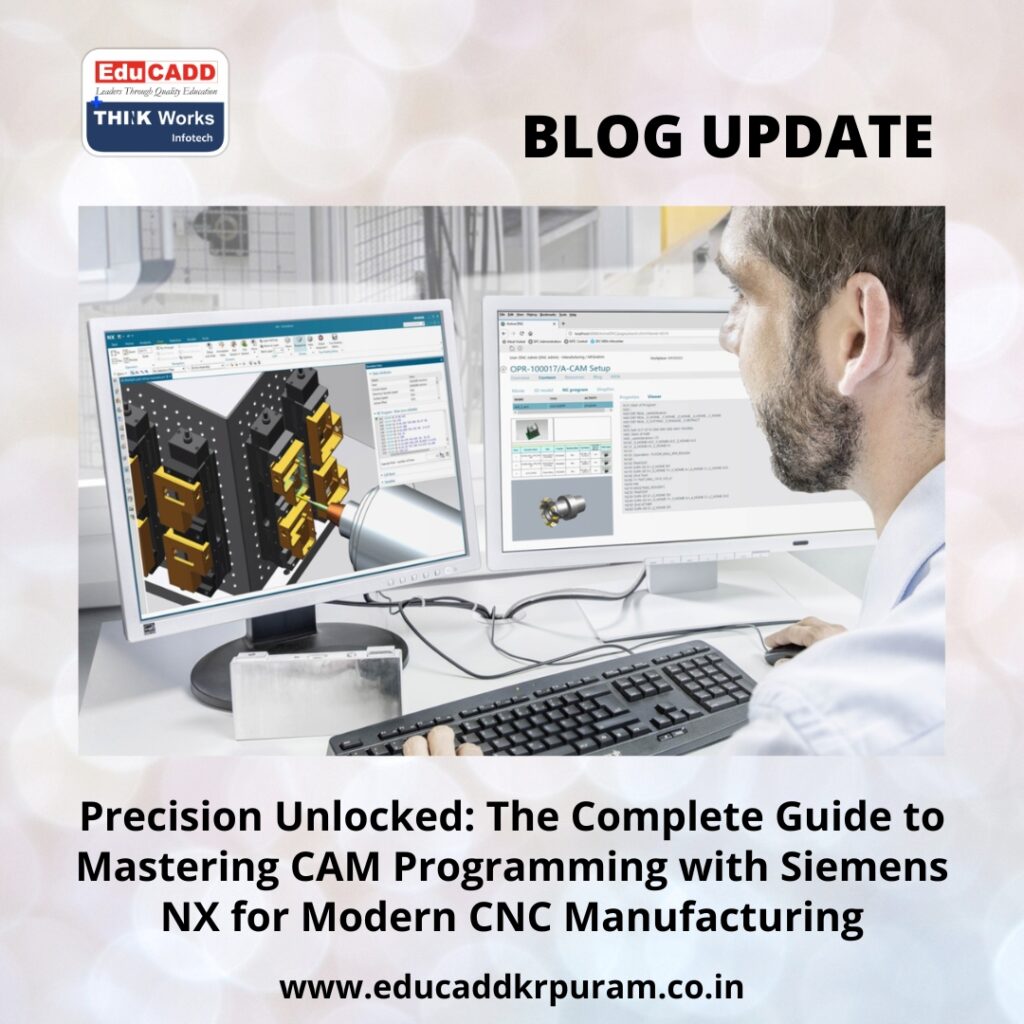
Siemens NX CAM Programming
Siemens NX CAM Programming has become a global standard for high-performance manufacturing. It gives engineers and machinists a single environment to design parts, plan machining operations, and generate safe, efficient toolpaths. Mastering this platform strengthens your ability to convert complex designs into accurate, optimized CNC programs.
This comprehensive guide explores the digital transformation shaping today’s manufacturing world, the strengths of Siemens NX, the essential skills you gain through CAM learning, and the ways this knowledge transforms real workshop productivity. You’ll also find a step-by-step learning approach that helps you grow into a confident and capable CAM professional.
1. Manufacturing in the Digital Age: Why CAM Skills Matter More Than Ever
Modern machining no longer depends only on manual knowledge or individual machine skills. Instead, production environments now rely on advanced software, intelligent controls, and data-driven decision making.
The Shift Toward Digital Production Systems
Factories worldwide are adopting digital workflows that unite design, simulation, machining, and inspection. Engineers create accurate CAD models, while machinists use CAM systems to generate toolpaths and simulate operations. Managers rely on digital dashboards to track the entire manufacturing process.
This transformation eliminates delays and reduces human error. Tasks that once required separate tools now merge into one streamlined digital environment. As a result, the demand for professionals with Siemens NX expertise continues to grow.
How Digital Workflows Boost Precision and Efficiency
With a digital workflow, issues surface long before machining starts. Engineers can validate geometry, machinists can predict tool behavior, and quality teams can plan inspection strategies.
Simulation tools allow teams to test operations virtually, saving time and material. This leads to higher accuracy, reduced scrap, and more stable machining results. Companies now expect programmers to use advanced CAM systems to maintain productivity without increasing costs.
Growing Industry Demand for Skilled CAM Professionals
Industries such as aerospace, automotive, medical devices, heavy engineering, and precision tooling depend heavily on skilled CAM programmers. These professionals bridge the gap between design intent and actual machining capability.
Those who Siemens NX CAM Programming become valuable assets because they:
-
Optimize cycle time
-
Reduce programming errors
-
Improve part quality
-
Support complex machining
-
Ensure data consistency across teams
As companies expand automation, the need for trained CAM experts becomes even stronger.
2. Why Siemens NX CAM Stands Above Other CNC Programming Tools
With several CAM solutions available, Siemens NX remains the preferred platform for companies aiming for precision, speed, and reliability. Its power comes from its integrated ecosystem and advanced machining intelligence.
A Unified Environment for CAD, CAM, and Simulation
Unlike many standalone CAM systems, Siemens NX offers a fully connected environment. CAD, CAM, and CAE tools operate together without data translation.
This eliminates geometry errors, reduces file conversion effort, and ensures that design updates reflect instantly in manufacturing operations.
Advanced Toolpath Strategies for Every Machining Need
Siemens NX supports a wide range of machining capabilities, including:
-
2½-axis milling
-
3-axis milling
-
4-axis and 5-axis multi-surface machining
-
High-speed cutting
-
Drilling and hole-making cycles
-
Adaptive roughing
-
Rest machining
These strategies help programmers build efficient paths that reduce tool wear and enhance surface quality. This gives users who learn CAM programming with Siemens NX for CNC applications a major advantage.
High-Fidelity Machine Simulation and Collision Protection
One of NX’s strongest features is its realistic simulation environment. Programmers can load machine models that include spindle heads, tool changers, fixtures, and rotary axes.
The simulation checks for:
-
Tool collisions
-
Over-travel
-
Holder interference
-
Unsafe movements
This ensures safe machining and prevents costly errors. It also boosts the confidence of programmers handling multi-axis machines.
Flexible Post-Processing for Any CNC Machine
Siemens NX supports a vast library of post-processors that convert toolpaths into machine-specific G-codes. Programmers can customize outputs for different machine brands and controllers.
This flexibility makes NX suitable for workshops with mixed CNC equipment.
3. The Essential Skills You Gain When Learning Siemens NX CAM
Mastering Siemens NX CAM builds a strong foundation of technical, analytical, and machining-related skills. These skills combine digital understanding with real machining knowledge.
Understanding Part Geometry and Manufacturing Features
Before toolpath creation, programmers must study the geometry of a part. Siemens NX helps users identify important features such as pockets, surfaces, and edges.
Learners quickly understand:
-
How geometry affects tool selection
-
How features influence strategy
-
How model preparation improves results
When you learn CAM programming with Siemens NX for CNC applications, you also learn how to convert geometry into efficient manufacturing logic.
Mastering Tool Libraries and Cutting Parameters
Siemens NX allows users to build detailed tool libraries with accurate cutting data. Programmers learn about:
-
End mills, ball mills, lollipops, and special tools
-
Holder dimensions and clearance
-
Feed rates and spindle speeds
-
Material-based cutting strategies
This skill helps maintain tool life and prevents damage during machining.
Creating Efficient and Reliable Toolpaths
Toolpath creation is the core of CAM programming. Siemens NX provides a wide range of operation types that help programmers handle everything from roughing to finishing.
Learners explore:
-
Toolpath strategy selection
-
Step-down and step-over adjustments
-
Approach and retract motions
-
Tool engagement optimization
These techniques help users minimize unnecessary motion and reduce cycle time.
Simulation, Verification, and Machine Safety
Simulation is a crucial step before generating CNC code. Learners analyze toolpaths visually to catch mistakes early.
They review:
-
Material removal
-
Collision risks
-
Axis movements
-
Tool engagement
This process creates confidence and leads to safer, more efficient machining outcomes.
G-Code Generation and Post-Processing
Once the toolpath is validated, Siemens NX generates machine-specific G-code.
Learners develop a clear understanding of how G-code commands control motion. This knowledge improves communication with machinists and helps troubleshoot issues on the shop floor.
4. How Siemens NX CAM Improves Real Manufacturing Efficiency
Siemens NX is trusted by leading manufacturers because it offers direct, measurable benefits that transform workshop performance.
Reduced Programming Time and Faster Turnaround
NX automates repetitive tasks and uses intelligent logic to produce toolpaths quickly. This reduces programming time even for complex parts.
Faster programming leads to quicker job delivery and improved shop productivity.
Higher Quality and Greater Consistency
Manufacturing often requires repeatable, identical results. Siemens NX allows teams to store templates, strategies, and tooling standards that ensure every program follows a consistent method.
This reduces errors and maintains quality across multiple parts and batches.
Better Collaboration Between Design and Manufacturing Teams
Because Siemens NX integrates all stages of production, teams work more smoothly.
Design changes instantly reflect in CAM operations. Manufacturing teams then update toolpaths without recreating entire programs. This eliminates miscommunication and prevents delays.
Support for Complex, High-Precision Machining
Industries with demanding geometries trust Siemens NX because it delivers reliable performance on advanced machines.
NX excels in:
-
5-axis machining
-
Aerospace part milling
-
Mold and die finishing
-
High-speed cutting
-
Multi-surface machining
This capability makes NX ideal for companies requiring tight tolerances and excellent surface finish.
Reduced Waste and Lower Production Costs
Simulation, optimized toolpaths, and accurate G-codes help reduce scrap and tool breakage.
With reduced waste and controlled machining behavior, companies save significant production costs.
5. The Smartest Path to Learn Siemens NX CAM with Confidence
A structured approach helps students and professionals learn efficiently and grow their technical expertise step by step.
Start with the NX User Interface and Workflow Basics
Beginners should explore the manufacturing interface, including operation browsers, view controls, geometry selection tools, and program structure.
A strong foundation helps learners navigate complex features easily.
Follow Tutorials and Practice with Realistic Models
Hands-on learning builds confidence. Start with basic parts and progress toward complex ones. Each practice teaches something new about strategy, simulation, and optimization.
Study CNC Machine Fundamentals Along the Way
Understanding CNC machine movement helps create smarter toolpaths. Learn about spindle rotation, axis limits, feed rates, cutter engagement, and basic G-code.
This knowledge improves decision-making inside the CAM environment.
Use Simulation to Validate Every Operation
Simulation shows how the tool interacts with the workpiece. Analyzing collisions, clearance, and material removal ensures accuracy and safety.
Regular simulation builds professional habits that protect machines and tools.
Grow from 3-Axis to 4-Axis and 5-Axis Machining
Once you grasp 3-axis operations, you can expand into indexing and full multi-axis machining.
These skills open higher-paying roles and advanced career opportunities.
Conclusion
Modern manufacturing depends on strong digital workflows, advanced machining, and skilled professionals who can merge design intent with real workshop capabilities. When you Siemens NX CAM Programming, you gain a powerful, future-ready skill that supports precision, speed, and innovation. Siemens NX offers a unified environment for design, simulation, and toolpath creation, giving programmers full control over machining results.
With continuous practice and a structured learning path, you can master Siemens NX CAM and become an essential part of any manufacturing team. This knowledge improves productivity, reduces errors, and opens exciting opportunities across global industries. As technology continues to evolve, CAM expertise will remain one of the most valuable skills in the world of modern engineering.

