
Engineering the Skies Digitally: How CAD for Aerospace Components Unlocks Next-Generation Careers
Aerospace engineering represents one of the most advanced and demanding fields in modern technology. Every aircraft, satellite, rocket, and defense system must perform flawlessly under extreme conditions where even minor errors can lead to serious consequences. Behind this precision-driven industry stands a powerful digital backbone—CAD Aerospace Component Design. Computer-Aided Design has transformed how aerospace products are imagined, tested, and manufactured, making it a cornerstone of innovation and safety.
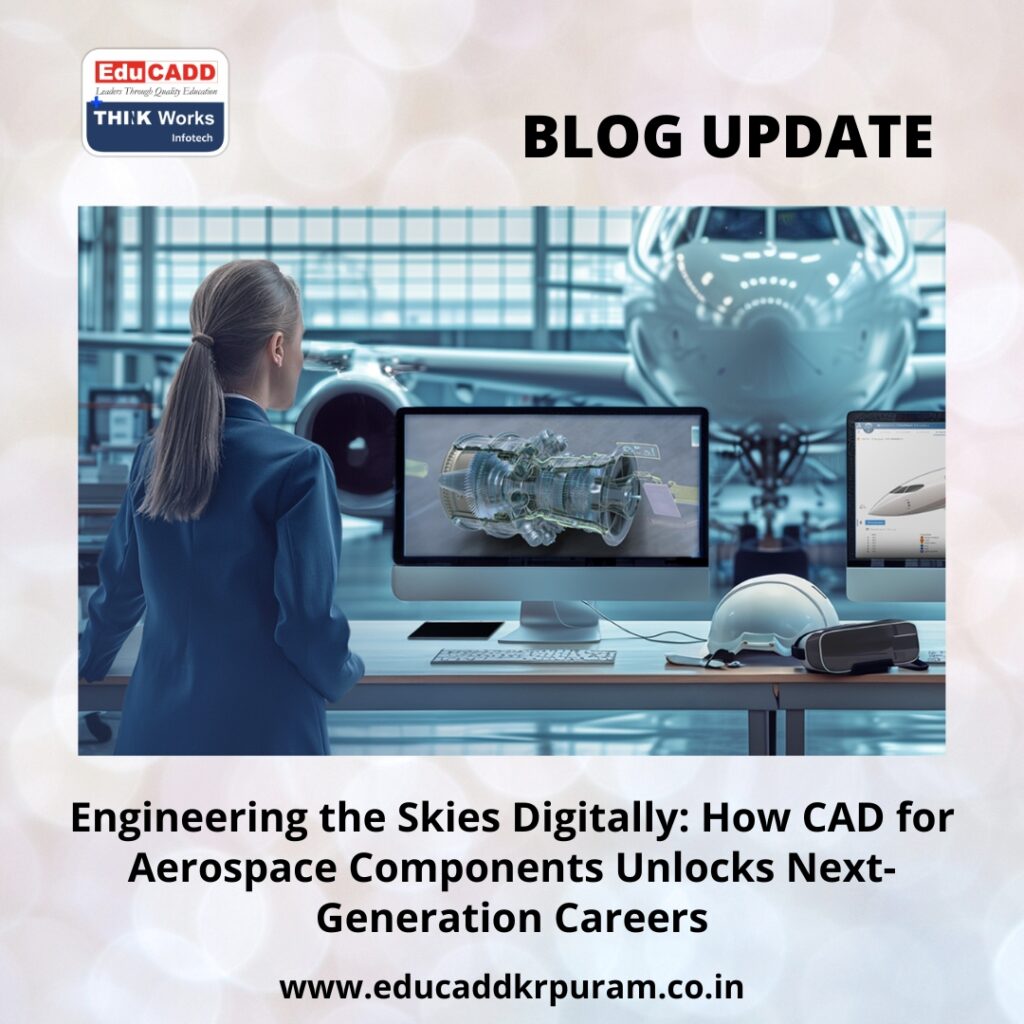
CAD Aerospace Component Design
Today, aerospace companies no longer rely on physical prototypes alone. Instead, they use advanced CAD platforms to design, simulate, and refine components long before production begins. This digital-first approach reduces risk, shortens development cycles, and ensures compliance with global standards. At the same time, it has created strong demand for skilled professionals who can design complex aerospace components with confidence and accuracy. This blog explores the role of CAD in aerospace engineering, the tools and skills involved, and how mastering this domain leads to high-tech, future-proof careers.
1. CAD as the Foundation of Modern Aerospace Design
CAD Aerospace Component Design forms the backbone of contemporary aerospace development. Unlike conventional mechanical design, aerospace CAD focuses on extreme precision, structural efficiency, and system integration. Every component must withstand intense pressure, vibration, thermal variation, and long operational lifespans.
Engineers begin by developing detailed 3D models that define geometry, dimensions, tolerances, and material properties. These digital models act as the single source of truth across design, analysis, and manufacturing teams. As a result, errors get identified early, which significantly reduces costly redesigns.
Another defining feature of aerospace CAD lies in its ability to manage complexity. Aircraft and spacecraft contain thousands of interconnected parts. CAD platforms allow engineers to assemble these components digitally and test how they interact. This capability ensures proper alignment, movement, and clearance before production begins.
Weight optimization also plays a vital role. Aerospace engineers constantly aim to reduce mass while maintaining strength and durability. CAD tools support this goal by enabling precise material distribution and geometry refinement. Consequently, aircraft achieve better fuel efficiency and performance.
Through these capabilities, CAD transforms aerospace ideas into reliable, manufacturable, and high-performance components.
2. Why the Aerospace Industry Relies Heavily on CAD
The aerospace sector operates under strict safety and regulatory frameworks. CAD systems help organizations meet these requirements with consistency and accuracy. Digital design ensures repeatability, traceability, and compliance throughout the product lifecycle.
One of the strongest advantages of CAD lies in precision control. Parametric modeling allows engineers to define relationships between features. When one parameter changes, related elements update automatically. This approach maintains design integrity across revisions and reduces human error.
CAD also supports extensive documentation. Aerospace certification authorities require detailed drawings, part histories, and revision records. CAD platforms generate this documentation directly from the model, simplifying audits and approvals.
Collaboration represents another critical benefit. Aerospace projects often involve global teams. CAD enables multiple stakeholders to work on shared digital models in real time. This transparency improves coordination and accelerates decision-making.
Because of these factors, CAD has become indispensable in aerospace engineering. Professionals who understand its role within regulated environments bring significant value to employers.
3. Specialized CAD Tools Used in Aerospace Engineering
The aerospace industry relies on advanced CAD software capable of handling large assemblies and complex geometries. These tools differ from entry-level design platforms due to their scale, accuracy, and integration capabilities.
CATIA remains one of the most widely used aerospace CAD tools. Large aircraft manufacturers depend on it for surface modeling and full-aircraft assemblies. Its ability to manage complex shapes and massive datasets makes it ideal for aerospace structures.
Siemens NX offers a unified environment that integrates design, simulation, and manufacturing. This digital continuity reduces data loss between stages and improves efficiency. Aerospace companies value NX for its robustness and scalability.
SolidWorks plays a significant role among aerospace suppliers and component manufacturers. It supports detailed part design and rapid development cycles. While more general in scope, its precision suits many aerospace applications.
PTC Creo and Autodesk Fusion contribute to specialized workflows. These tools support parametric modeling, generative design, and collaborative development. Their flexibility allows teams to adapt quickly to design changes.
Proficiency in these platforms enhances employability. Employers prioritize candidates who can contribute immediately within existing design ecosystems.
4. Simulation and Analysis Integration in Aerospace CAD
One of the most powerful aspects of CAD Aerospace Component Design lies in its integration with simulation and analysis tools. Modern aerospace design relies heavily on virtual testing to ensure safety and performance.
Engineers use CAD models as the basis for structural, thermal, and aerodynamic analysis. Finite Element Analysis evaluates stress and deformation under load. Computational Fluid Dynamics studies airflow behavior around wings and fuselages.
This integration allows designers to test multiple scenarios without physical prototypes. As a result, development costs decrease while design confidence increases. Engineers can refine components based on real-world conditions simulated digitally.
Thermal analysis also plays a critical role. Aerospace components often face extreme temperature variations. CAD-based simulations help predict material behavior and prevent failure.
By combining design and analysis, aerospace CAD supports informed decision-making. Professionals who understand this workflow gain a competitive advantage in advanced engineering roles.
5. Manufacturing and CAD in Aerospace Production
CAD for aerospace components extends beyond design and analysis into manufacturing. Aerospace production requires tight tolerances and repeatable quality, which CAD helps achieve.
CAD models feed directly into CAM systems used for machining and fabrication. This digital connection reduces interpretation errors and improves accuracy. Toolpaths, fixtures, and molds derive from the same model used in design.
Additive manufacturing also benefits from CAD integration. Aerospace companies increasingly use 3D printing for lightweight and complex parts. CAD enables designers to create geometries that traditional methods cannot produce.
Assembly planning represents another key area. CAD models help engineers visualize assembly sequences and identify potential issues. This planning improves efficiency and reduces downtime during production.
Through these applications, CAD ensures that aerospace designs transition smoothly from digital models to physical components.
6. Career Opportunities Enabled by Aerospace CAD Expertise
Mastering CAD for aerospace components opens access to a wide range of high-tech careers. These roles exist across commercial aviation, defense, space exploration, and emerging aerospace technologies.
CAD design engineers focus on creating detailed models for aerospace systems. Structural designers specialize in safety-critical components. Tooling engineers design fixtures and molds for production.
Research and development teams rely on CAD professionals to explore new materials and configurations. Space agencies and private space companies require designers for satellites, launch vehicles, and exploration systems.
Unmanned aerial vehicle manufacturers also create growing demand. Drones used for defense, logistics, and research depend on lightweight and precise designs.
Beyond full-time employment, experienced CAD professionals pursue consulting and freelancing opportunities. Global collaboration enables designers to work on international aerospace projects remotely.
These career paths offer strong compensation, stability, and long-term growth.
7. Essential Skills for Aerospace CAD Professionals
A successful aerospace CAD career requires a combination of technical, analytical, and practical skills. Software proficiency alone does not ensure success in this demanding field.
Engineering fundamentals form the foundation. Knowledge of materials, mechanics, and aerodynamics supports effective design decisions. Understanding how components behave in real conditions improves model accuracy.
Aerospace standards knowledge also proves critical. Familiarity with GD&T, tolerance analysis, and certification requirements ensures compliance. These skills differentiate aerospace designers from general CAD users.
Problem-solving ability plays an important role. Aerospace projects often involve tight constraints and complex challenges. Designers must balance performance, safety, and manufacturability.
Continuous learning remains essential. Emerging technologies such as digital twins, model-based definition, and generative design reshape aerospace workflows. Professionals who adapt remain relevant and competitive.
8. Learning Pathway for Aspiring Aerospace CAD Designers
Aspiring professionals should follow a structured learning path to enter aerospace CAD roles successfully. This journey begins with education and progresses through practical experience.
Formal education in mechanical or aerospace engineering provides a strong base. However, specialized CAD training accelerates readiness. Industry-focused courses introduce aerospace standards and workflows.
Hands-on projects play a critical role. Practical exposure builds confidence and demonstrates capability to employers. Internships and simulations bridge the gap between theory and application.
Certifications from recognized software providers enhance credibility. They validate technical proficiency and commitment to professional growth.
By combining education, training, and experience, learners position themselves for successful aerospace CAD careers.
Conclusion
CAD Aerospace Component Design stands at the core of modern aerospace innovation. It enables engineers to design, analyze, and manufacture complex systems with unmatched precision and confidence. As aerospace technology continues to evolve, the importance of CAD expertise only grows stronger.
For individuals seeking high-tech, future-ready careers, aerospace CAD offers a clear and rewarding path. Those who invest in developing strong technical foundations, software proficiency, and industry knowledge gain access to one of the most advanced engineering sectors in the world. Through continuous learning and practical application, CAD professionals play a vital role in shaping the future of aviation and space exploration.

