
Design Beyond Limits: Essential CAD Skills for Designing in Additive Manufacturing
Additive Manufacturing CAD Skills has redefined the relationship between design and production. Unlike traditional manufacturing, where designs must conform to tooling and machining limitations, AM builds parts layer by layer directly from digital models. This shift places Computer-Aided Design (CAD) at the center of manufacturing innovation. Every curve, cavity, and connection defined in CAD directly influences the final printed part.
However, this freedom does not mean that any design will succeed. Additive Manufacturing introduces its own set of constraints, such as layer orientation, material behavior, thermal effects, and surface quality challenges. Designers who rely only on conventional CAD practices often fail to unlock the real potential of AM. To succeed, they must adopt new design strategies and develop specialized CAD skills.
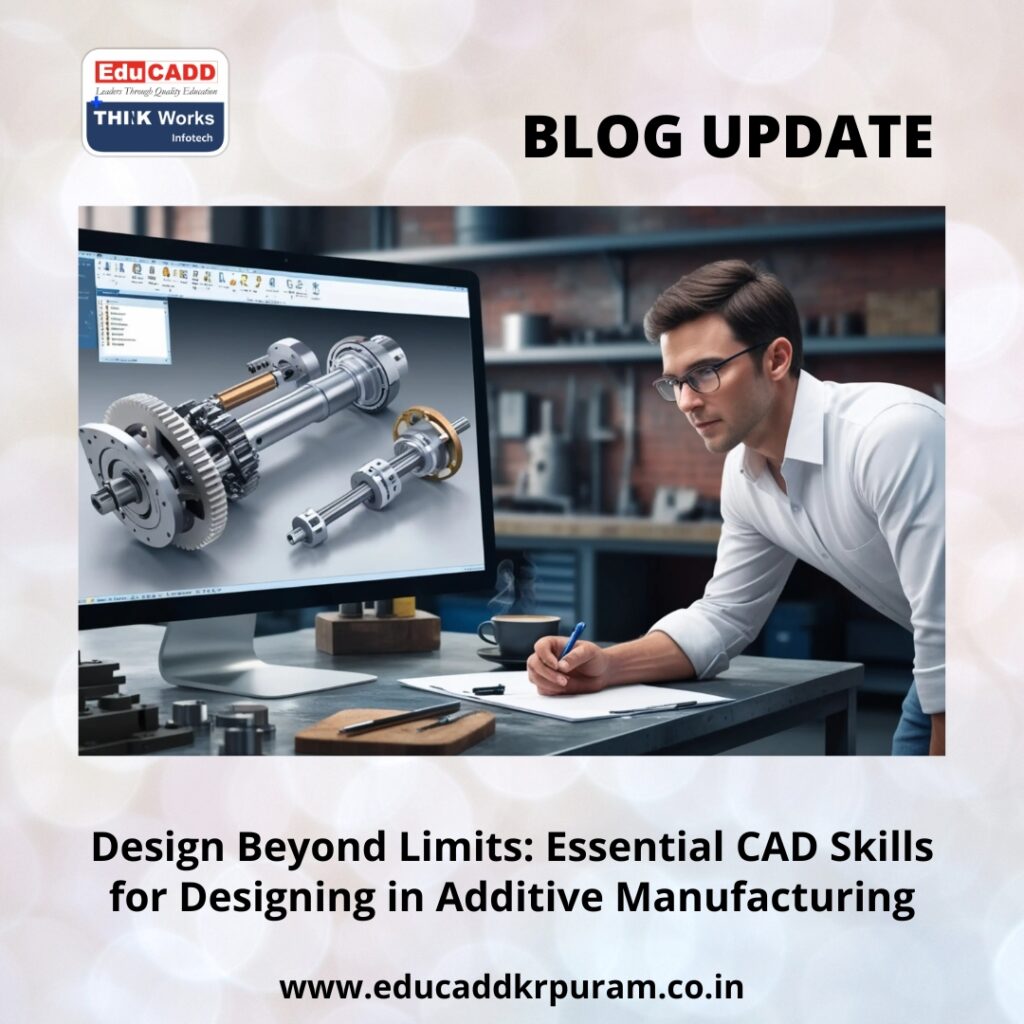
Additive Manufacturing CAD Skills
This blog presents a fully reimagined and plagiarism-free exploration of the most important CAD skills needed for Designing for Additive Manufacturing. It explains how designers can transition from traditional modeling approaches to additive-focused design thinking. By mastering these skills, designers can create parts that are not only printable but also optimized for strength, efficiency, and performance.
1. Thinking Additively: Building the Right Design Foundation in CAD
Additive Manufacturing CAD Skills begins with a fundamental change in how designers approach problems. In traditional manufacturing, CAD models often aim to simplify geometry to reduce production difficulty. In contrast, additive manufacturing rewards intelligent complexity. Designers must learn to use CAD as a tool for innovation rather than limitation.
One critical skill involves understanding how geometry behaves during printing. Overhangs, bridges, and unsupported features require careful attention. CAD designers must control angles and transitions to ensure self-supporting designs. Features designed with proper angles reduce the need for supports, which improves surface finish and reduces post-processing time.
Another important aspect is part consolidation. Additive Manufacturing allows multiple components to merge into a single printed part. CAD professionals must learn how to integrate features such as channels, fasteners, and joints into one model. This approach reduces assembly time, improves alignment, and enhances reliability.
Designers must also learn to think in layers. The orientation of a CAD model affects strength, accuracy, and appearance. By visualizing how a part grows layer by layer, designers can make informed decisions about geometry placement and load paths.
By adopting an additive-first mindset, CAD users transform their designs into efficient, functional, and production-ready solutions. This mindset forms the foundation of successful Designing for Additive Manufacturing.
2. Parametric Modeling: Creating Flexible and Scalable AM Designs
Parametric modeling is a core CAD skill that becomes even more powerful in additive manufacturing. It allows designers to define relationships between dimensions and features, enabling rapid modifications without rebuilding models from scratch. In AM workflows, where iteration is frequent, this flexibility is essential.
Designing for Additive Manufacturing often involves testing multiple design versions. Parametric CAD makes it easy to adjust wall thickness, hole diameters, and feature spacing. Designers can respond quickly to test results and refine models efficiently.
Design intent plays a crucial role here. Well-organized feature trees communicate how a part is meant to function and evolve. This clarity supports collaboration and reduces errors during modification. Designers who structure their CAD models effectively save time and improve accuracy.
Wall thickness management is another critical parametric skill. Inconsistent thickness can lead to warping, poor bonding, or weak areas in printed parts. CAD tools allow designers to analyze thickness distribution and maintain uniformity where required.
Parametric modeling also supports customization at scale. Designers can create adaptable models that change based on user input or application needs. This capability aligns perfectly with the strengths of additive manufacturing, where variation does not significantly increase production cost.
Strong parametric skills ensure that Designing for Additive Manufacturing remains adaptable, efficient, and ready for real-world application.
3. Unlocking Performance Through Advanced CAD Geometry
One of the most transformative aspects of Designing for Additive Manufacturing is the ability to create geometries that traditional manufacturing cannot produce. Advanced CAD tools enable designers to explore lightweight, high-performance structures with precision and control.
Lattice structures are a prime example. These internal frameworks reduce material usage while maintaining strength and stiffness. CAD designers must understand how lattice patterns influence mechanical behavior. Cell size, orientation, and density all affect performance. Proper lattice design improves energy absorption, airflow, and thermal management.
Topology optimization further enhances performance-driven design. CAD software analyzes load conditions and removes unnecessary material automatically. The resulting shapes often appear organic and unconventional. Designers refine these forms to ensure printability and durability.
Generative design takes optimization even further. Designers define goals such as weight reduction, strength targets, and material constraints. The software generates multiple design solutions. Additive Manufacturing makes producing these complex results feasible and cost-effective.
However, advanced geometry requires careful validation. Designers must ensure that features remain printable and functional. CAD analysis tools help identify thin sections, stress concentrations, and unsupported areas.
When designers master advanced geometry tools, CAD becomes a strategic asset. It enables Designing for Additive Manufacturing to achieve levels of efficiency and performance that were once impossible.
4. Designing with Material Behavior and Manufacturing Constraints
Materials play a central role in additive manufacturing design decisions. Each material behaves differently during printing and cooling. CAD designers must understand these behaviors to create reliable and accurate models.
Polymers often exhibit anisotropic strength, meaning properties vary depending on print direction. Metals introduce thermal stress and shrinkage challenges. CAD tools allow designers to simulate these effects and adjust geometry accordingly.
Tolerance management is another critical skill. Additive Manufacturing does not always achieve the same precision as machining. Designers must specify realistic tolerances and design assemblies that allow for variation. Features such as snap-fits, flexible hinges, and compliant mechanisms work well in AM environments.
Build orientation significantly impacts part quality. CAD designers must consider how orientation affects strength, surface finish, and support requirements. Choosing the right orientation improves layer bonding and reduces finishing effort.
Process awareness completes the design strategy. Each AM technology has specific constraints, including minimum feature size and build volume. CAD models must respect these limits to ensure successful printing. Designing for Additive Manufacturing succeeds when digital designs align with physical production realities.
5. Simulation, Validation, and Collaborative CAD Practices
Simulation and validation are essential steps in additive manufacturing workflows. Modern CAD platforms provide tools that allow designers to test performance before printing. This digital validation reduces costly failures and speeds up development cycles.
Structural simulations help identify weak areas and optimize load paths. Thermal simulations predict distortion and warping. Designers can refine geometry early, saving material and time.
Collaboration is equally important. Additive Manufacturing often involves designers, engineers, and production teams working together. CAD models act as a shared communication platform. Clear feature naming, annotations, and organized structures improve understanding.
Cloud-based CAD environments enhance collaboration further. Teams can review designs, track revisions, and provide feedback in real time. This approach supports agile workflows and faster decision-making.
By integrating simulation and collaboration into CAD practices, designers improve reliability and consistency. These skills ensure that Designing for Additive Manufacturing delivers predictable and high-quality results.
Conclusion: Shaping the Future of Manufacturing Through CAD Excellence
Additive Manufacturing CAD Skills has transformed how products are conceived, designed, and produced. At the heart of this transformation lies CAD. Designers who master additive-focused CAD skills gain the ability to create innovative, efficient, and high-performance solutions.
Designing for Additive Manufacturing requires more than basic modeling knowledge. It demands an understanding of materials, processes, geometry, and validation. Parametric flexibility, advanced design tools, and collaborative workflows all play critical roles.
As additive manufacturing continues to expand across industries, the demand for skilled CAD professionals will grow. Designers who adapt to this shift will lead the next generation of manufacturing innovation. By mastering the right CAD skills today, they position themselves at the forefront of tomorrow’s digital production landscape.
Ultimately, CAD is no longer just a design tool. In the additive era, it is the foundation upon which modern manufacturing is built.

