
From Code to Cloud Mastery: A Complete DevOps Journey with Docker & Kubernetes
Software no longer exists in isolation. Today, applications must scale instantly, remain highly available, and update without disrupting users. Traditional development models struggle to meet these demands. Long release cycles, manual deployments, and environment inconsistencies slow innovation and increase failure rates. This gap created the need for DevOps with Docker Kubernetes.
DevOps represents a shift in how software is built, deployed, and maintained. It combines cultural change with automation and modern tooling. At the center of this transformation are Docker and Kubernetes. These technologies enable teams to build portable applications and manage them reliably at scale.
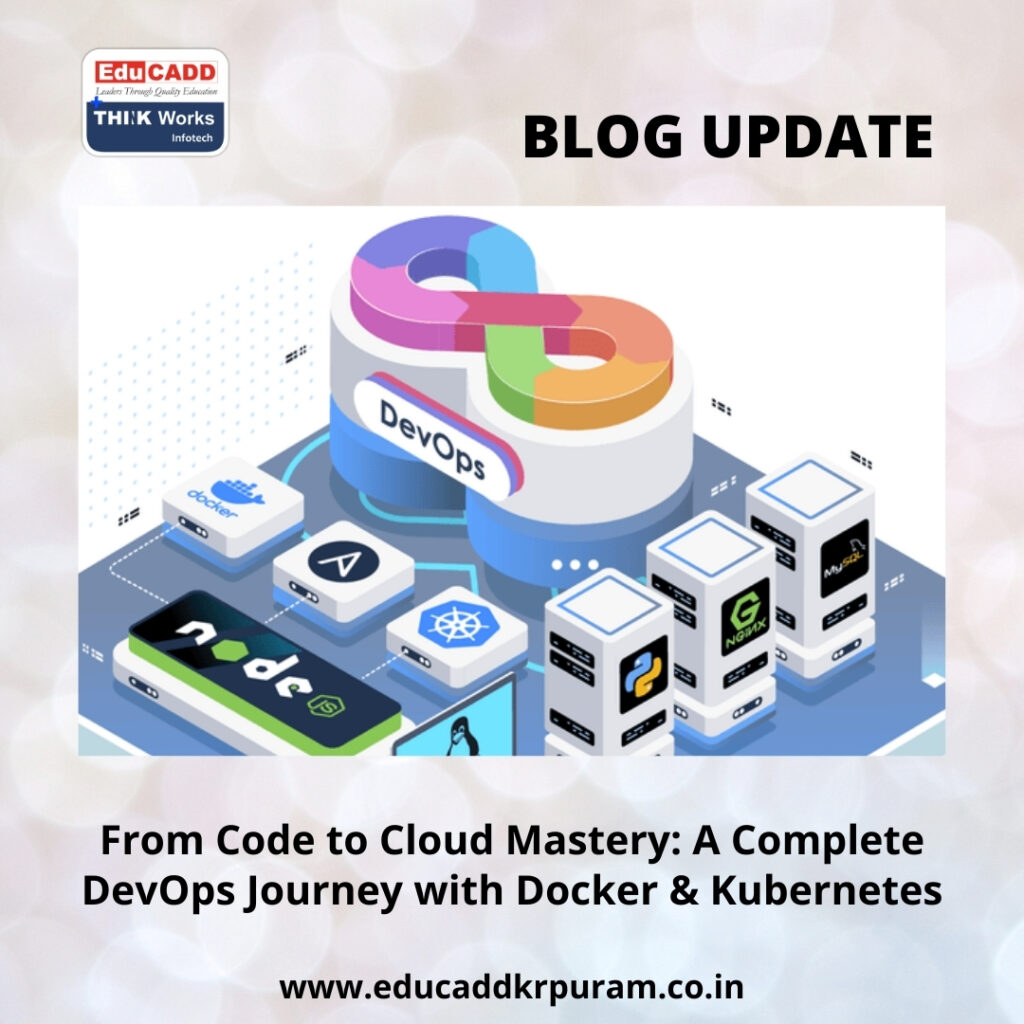
DevOps with Docker Kubernetes
When professionals master DevOps with Docker and Kubernetes, they gain control over the entire application lifecycle. They move faster, reduce risk, and deliver consistent value. This blog explores that journey in depth, from core concepts to real-world practices and career impact.
DevOps Explained: More Than Tools, It Is a Mindset
DevOps is often misunderstood as a collection of tools. In reality, it is a philosophy focused on collaboration, ownership, and continuous improvement. Development and operations teams once worked separately. This separation caused delays, miscommunication, and unstable releases.
DevOps removes these barriers. Teams share responsibility for code quality, deployment, and performance. Automation replaces repetitive manual tasks. Feedback flows quickly between systems and people.
This mindset encourages experimentation. Teams deploy smaller changes more frequently. They learn from failures and improve processes continuously. Docker and Kubernetes support this mindset by enforcing consistency and automation across environments.
Without cultural alignment, tools fail. With DevOps principles in place, Docker and Kubernetes become powerful enablers of speed and reliability.
The Evolution of Software Deployment Before Containers
Before containers, applications depended heavily on the underlying server. Each environment required manual configuration. Differences between development, testing, and production caused frequent failures. The phrase “it works on my machine” became common for a reason.
Virtual machines improved isolation but introduced overhead. They consumed significant resources and took time to start. Scaling systems became expensive and complex.
These limitations slowed innovation. Teams spent more time fixing environment issues than delivering features. The industry needed a lighter, faster solution that ensured consistency without sacrificing performance.
This challenge led directly to container technology, which reshaped modern DevOps practices.
Containerization: The Foundation of Modern DevOps
Containers package an application with everything it needs to run. This includes libraries, dependencies, and configuration files. The container runs the same way on any system that supports a container runtime.
Docker made containerization accessible. It simplified image creation and container management. Developers could now build once and run anywhere. This consistency eliminated environment-related failures.
Containers start quickly and use fewer resources than virtual machines. This efficiency enables rapid scaling and efficient infrastructure usage. For DevOps teams, containers bring predictability and speed.
Learning containerization is the first major step toward mastering DevOps with Docker and Kubernetes.
Docker in Depth: How It Transforms Application Delivery
Docker provides a complete platform for building and running containers. Developers define application environments using Dockerfiles. These files act as blueprints for creating images.
Docker images are immutable. Once created, they do not change. This immutability ensures predictable behavior and simplifies version control. Teams can trace issues back to specific image versions.
Docker registries store images centrally. Teams pull the same image across all environments. This approach eliminates configuration drift and reduces deployment errors.
By standardizing how applications are packaged, Docker creates a strong foundation for automation and orchestration.
Core Docker Components Every DevOps Engineer Must Know
Docker introduces several essential concepts. Containers isolate applications. Images define those containers. Dockerfiles automate image creation. Volumes manage persistent data. Networks allow containers to communicate securely.
Docker Compose extends these ideas by managing multi-container applications. Teams define entire application stacks in a single file. This approach simplifies local development and testing.
Understanding these components builds confidence. It also prepares engineers for Kubernetes, which builds on the same container principles at a larger scale.
Strong Docker fundamentals make advanced DevOps workflows easier and more reliable.
The Scaling Problem: Why Kubernetes Became Essential
Running one or two containers is simple. Managing hundreds or thousands is not. Production systems require load balancing, self-healing, and automated scaling. Manual management does not work at this scale.
Kubernetes was designed to solve this problem. It acts as a container orchestration platform. It manages deployment, scaling, and health of containerized applications automatically.
Kubernetes ensures the system matches the desired state. If a container fails, it restarts it. If traffic increases, it scales workloads. This automation reduces downtime and operational stress.
For modern DevOps teams, Kubernetes is no longer optional. It is the standard for production orchestration.
Kubernetes Architecture: Understanding the Control Plane
Kubernetes uses a cluster-based architecture. The control plane manages the cluster’s state. Worker nodes run application workloads.
The control plane includes the API server, scheduler, and controller manager. These components make decisions and enforce desired state. Worker nodes run pods, which contain containers.
Pods represent the smallest deployable unit. Services expose pods to the network. This design allows flexible scaling and reliable communication.
Understanding this architecture helps engineers troubleshoot issues and design resilient systems. It is a critical step in mastering Kubernetes.
Kubernetes Objects That Power Real-World Applications
Kubernetes provides structured objects to manage applications. Pods run containers. Deployments manage replicas and updates. Services provide stable networking. ConfigMaps store configuration. Secrets handle sensitive data.
Each object has a specific role. Deployments ensure availability. Services enable discovery. ConfigMaps separate configuration from code. Secrets improve security.
This object-based model makes systems modular and scalable. Teams update components independently without affecting the entire system.
Mastering these objects is essential for managing production workloads effectively.
CI/CD Pipelines with Docker and Kubernetes
Continuous integration and continuous delivery automate the software lifecycle. CI ensures code is tested and integrated frequently. CD ensures reliable and repeatable deployments.
Docker fits naturally into CI pipelines. Pipelines build images and run tests inside containers. This ensures consistent results across environments.
Kubernetes completes the pipeline. It deploys images automatically and supports rolling updates. If issues arise, rollbacks happen quickly.
Together, Docker and Kubernetes enable fast, safe, and reliable releases. They transform DevOps from theory into daily practice.
Infrastructure as Code: Consistency Through Automation
Infrastructure as code replaces manual setup with version-controlled definitions. Kubernetes uses YAML manifests to describe desired state. These files define deployments, services, and configurations.
Version control tracks every change. Teams review and roll back updates easily. This transparency improves stability and accountability.
Terraform often complements Kubernetes. It provisions cloud resources programmatically. Together, they enable fully automated environments.
Infrastructure as code reduces errors and accelerates scaling. It is a core DevOps capability in modern organizations.
Security in Containerized and Orchestrated Systems
Security remains a top priority in DevOps. Containers introduce new attack surfaces. Insecure images and misconfigurations create risks.
Best practices reduce these risks. Teams use minimal base images. They scan images regularly. Secrets remain encrypted. Access controls limit permissions.
Kubernetes supports role-based access control and network policies. These features restrict access and traffic flow. Security becomes part of the deployment process, not an afterthought.
Strong security practices build trust and protect systems at scale.
Observability: Monitoring and Reliability at Scale
Visibility is critical in distributed systems. Teams need to understand performance, resource usage, and failures in real time.
Kubernetes exposes detailed metrics. Tools like Prometheus collect data. Grafana visualizes trends. Logging systems aggregate application logs.
Alerts notify teams before users notice issues. Engineers respond proactively instead of reactively.
Observability transforms operations. It enables continuous improvement and high availability in complex environments.
Conclusion
DevOps with Docker Kubernetes represents the future of software delivery. These technologies enable speed, resilience, and scalability. They support modern development practices and cloud-native architectures.
Professionals who master these skills become valuable assets. They understand systems end to end. They automate workflows and improve reliability. They adapt quickly to changing demands.
The learning journey requires dedication and practice. However, the rewards are significant. DevOps skills open doors to high-impact roles and long-term career growth.
By mastering Docker and Kubernetes, you do not just learn tools. You build the mindset and expertise needed to thrive in the modern technology landscape.

