
Revolutionizing Engineering Design: Advanced ANSYS Simulation Techniques for Optimal Performance
In the fast-paced world of engineering and product development, efficiency, precision, and reliability have become the most critical drivers of success. Engineers are no longer able to rely solely on intuition or traditional trial-and-error methods for creating high-performance products. Instead, they are turning to advanced digital solutions that allow for precise predictions and systematic improvements. Among these solutions, Advanced ANSYS Simulation Techniques stands out as a game-changer. By enabling engineers to model, analyze, and optimize designs virtually, ANSYS ensures that performance, safety, and cost objectives are met before a single prototype is built. In this article, we delve deep into simulation techniques for design optimization in ANSYS, exploring how they transform engineering workflows and unlock unparalleled innovation across industries.
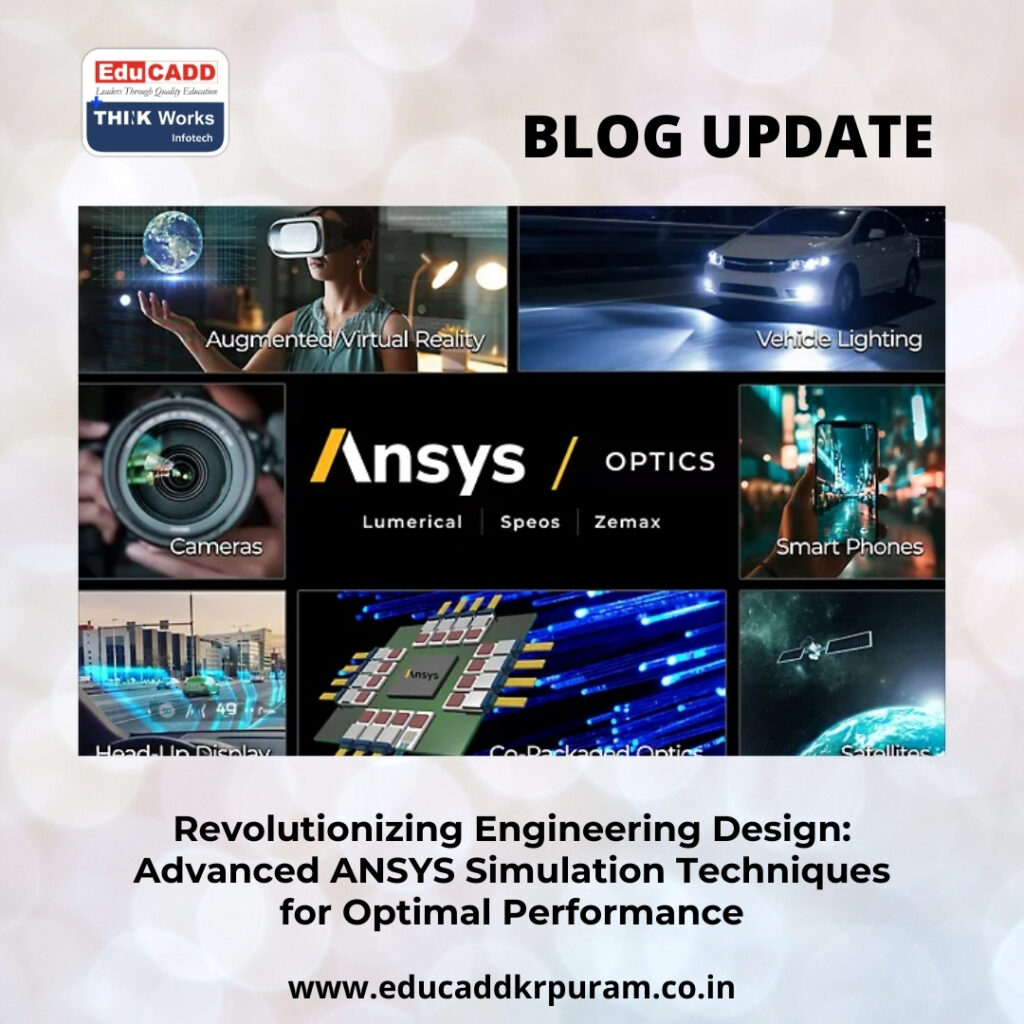
Advanced ANSYS Simulation Techniques
1. The Concept of Design Optimization in Modern Engineering
Advanced ANSYS Simulation Techniques is the structured methodology of refining a product to achieve peak performance while meeting functional, economic, and safety constraints. Unlike traditional approaches that rely on physical prototyping or guesswork, simulation-driven optimization in ANSYS allows engineers to evaluate multiple design alternatives virtually. This approach provides actionable insights into structural integrity, thermal performance, and fluid dynamics. It also allows balancing competing objectives, such as improving strength while minimizing weight or enhancing efficiency without increasing cost. The process not only accelerates development timelines but also ensures more predictable and reliable outcomes.
2. Why ANSYS is Integral to Simulation-Driven Development
ANSYS is a comprehensive simulation platform that provides tools for virtually every stage of product development. Engineers can evaluate concepts, verify designs, and optimize performance—all within a single environment. Its multi-physics capabilities enable the simultaneous analysis of structural, thermal, fluid, and electromagnetic interactions, allowing for accurate prediction of real-world behavior. As products become more complex, ANSYS ensures that engineers can manage multiple design variables efficiently, avoid costly errors, and reduce dependency on physical prototypes. This integration of simulation into development workflows significantly enhances both quality and productivity.
3. Parametric Modeling: The Backbone of Optimization
Parametric modeling lies at the heart of optimization in ANSYS. It allows engineers to define critical design variables, such as dimensions, material properties, or boundary conditions, which can be adjusted systematically. Parametric models enable automatic updates across design iterations, ensuring consistency and accuracy. By experimenting with different parameter values, engineers can explore a wide design space without repeatedly creating models from scratch. Parametric modeling not only saves time but also provides a structured approach to understanding how each variable affects product performance, which is essential for effective optimization.
4. Exploring Design Space and Sensitivity Analysis
Before initiating optimization, engineers need to understand the impact of each design variable on overall performance. Design space exploration in ANSYS allows the evaluation of multiple combinations of input variables to identify trends and patterns. Sensitivity analysis, in turn, highlights which parameters have the greatest influence on outcomes. By identifying key drivers of performance, engineers can focus their optimization efforts where it matters most. This targeted approach reduces computational overhead, eliminates unnecessary adjustments, and ensures that optimization is both precise and efficient.
5. Response Surface Methodology for Rapid Optimization
Response Surface Methodology (RSM) is a technique used to simplify complex simulation results by creating predictive mathematical models. In ANSYS, RSM generates surrogate models that approximate the relationship between input variables and system responses. These surrogate models allow engineers to predict performance outcomes without running every possible simulation scenario. RSM is particularly useful during early design stages, where rapid exploration of multiple design alternatives is necessary. It enables engineers to focus on the most promising solutions, saving both time and computational resources while maintaining accuracy.
6. Goal-Oriented Optimization for Targeted Results
Goal-oriented optimization focuses on achieving specific performance objectives while respecting design constraints. In ANSYS, engineers can define goals such as minimizing stress, reducing weight, enhancing thermal efficiency, or improving fluid flow. The software evaluates multiple design variations automatically and identifies solutions that best meet these objectives. This approach eliminates subjectivity and ensures that every design decision is data-driven. By aligning optimization efforts with predefined goals, engineers can achieve measurable improvements, enhance product quality, and ensure consistent performance.
7. Structural Optimization: Achieving Strength and Efficiency
Structural optimization is critical in industries where material efficiency and mechanical performance are paramount. ANSYS offers multiple structural optimization methods, including size, shape, and topology optimization. Size optimization adjusts component dimensions to enhance load-bearing capacity, while shape optimization refines geometrical features to reduce stress concentrations. Topology optimization identifies the most efficient distribution of material within a design space. Together, these techniques enable engineers to create lightweight, robust structures that meet performance requirements while minimizing material use and production costs.
8. Thermal and Fluid Optimization for Performance Excellence
Optimizing thermal and fluid systems is essential for product reliability and efficiency. ANSYS simulation tools allow engineers to evaluate heat transfer, temperature distribution, and fluid flow characteristics under various conditions. Thermal optimization prevents hotspots and improves energy efficiency, while fluid optimization reduces pressure losses and enhances flow performance. By simulating these interactions virtually, engineers can test multiple scenarios, select the most effective designs, and avoid costly physical testing. Integrating thermal and fluid optimization ensures products perform efficiently across a range of real-world operating conditions.
9. Multi-Physics Optimization for Complex Engineering Challenges
Modern engineering products often involve the interaction of multiple physical phenomena. Multi-physics optimization in ANSYS enables simultaneous analysis of structural, thermal, fluid, and electromagnetic effects. This capability ensures that improvements in one area do not inadvertently compromise another. For example, reducing component weight may affect thermal performance or structural integrity. Multi-physics simulations allow engineers to assess trade-offs and achieve balanced, high-performing designs. The result is a comprehensive optimization strategy that addresses real-world complexities and enhances overall product reliability.
10. Workflow Automation for Efficient Design Iterations
Automation is a vital aspect of large-scale design optimization. Advanced ANSYS Simulation Techniquesallows engineers to automate repetitive simulation tasks using scripting and built-in tools. Automated workflows reduce human error, ensure consistent execution, and accelerate the evaluation of multiple design alternatives. This approach allows engineers to focus on analyzing results and refining designs, rather than performing manual, repetitive tasks. Workflow automation is particularly valuable for extensive optimization studies, enabling the rapid exploration of hundreds of design scenarios while maintaining accuracy and repeatability.
11. Cost Efficiency Through Virtual Prototyping
Developing physical prototypes is both expensive and time-consuming. ANSYS simulation reduces reliance on prototypes by allowing virtual testing of designs under realistic operating conditions. Engineers can identify potential failures, evaluate alternative configurations, and optimize performance before manufacturing begins. Virtual prototyping not only saves costs but also shortens development timelines. It allows rapid iteration and informed decision-making, ensuring that final products are both high-performing and economically viable. This cost-efficient approach is essential in industries where innovation cycles are short and competition is intense.
12. Enhancing Reliability and Regulatory Compliance
Ensuring product reliability and compliance with industry standards is crucial. ANSYS simulation enables engineers to test designs against a range of scenarios, verifying safety and regulatory adherence. Optimization ensures that products remain within allowable limits under extreme conditions, reducing the risk of failure. Simulated testing across different operating environments improves confidence in product performance and durability. By combining simulation with optimization, engineers can create products that are not only innovative but also dependable and compliant with regulatory requirements, building trust among customers and stakeholders.
13. Real-World Applications Across Industries
Simulation-driven optimization in ANSYS is widely applied across numerous industries. In aerospace, it enables lightweight yet strong structures, enhancing fuel efficiency and safety. Automotive engineers optimize components for crashworthiness, fuel efficiency, and durability. Electronics designers improve thermal management to ensure consistent performance of chips and circuits. Industrial equipment benefits from improved efficiency, reduced wear, and longer service life. Across all sectors, ANSYS empowers engineers to tackle complex design challenges, improve performance, and deliver high-quality products with confidence.
14. Future Trends in ANSYS Simulation and Optimization
The future of design optimization lies in intelligent, AI-enhanced simulations. ANSYS is integrating machine learning and artificial intelligence into its workflows to facilitate predictive analysis and intelligent design exploration. Cloud computing allows large-scale simulations and collaborative optimization, enabling geographically distributed teams to work seamlessly. Engineers will increasingly rely on predictive models to identify optimal designs before prototypes exist. These advancements promise faster development cycles, smarter designs, and more sustainable solutions, cementing simulation-driven optimization as the cornerstone of modern engineering innovation.
Conclusion
Simulation-driven optimization has revolutionized the way engineers design, analyze, and improve products. By leveraging Advanced ANSYS Simulation Techniques, engineers can evaluate multiple design options, enhance performance, reduce costs, and ensure reliability long before physical prototypes are built. From parametric modeling to multi-physics optimization, ANSYS provides an end-to-end solution for modern engineering challenges. As industries demand faster innovation, superior performance, and cost-effective solutions, simulation-based design optimization will remain a critical enabler of engineering excellence, sustainable practices, and competitive advantage.

