
Precision to Production: Transform Your Engineering Future with CATIA Sheet Metal Design Training in KR Puram
The engineering landscape continues to evolve with remarkable speed. Industries no longer rely on traditional drafting or manual fabrication planning. Instead, they demand highly accurate digital models that integrate seamlessly with manufacturing systems. Sheet metal components play a vital role in automotive bodies, industrial machinery, aerospace structures, consumer appliances, and electrical enclosures. Because of this wide application, engineers must master advanced CAD tools that ensure accuracy, manufacturability, and efficiency. Enrolling in CATIA Sheet Metal Training – Training in KR Puram provides aspiring mechanical engineers and working professionals with a structured pathway toward industry-ready expertise.
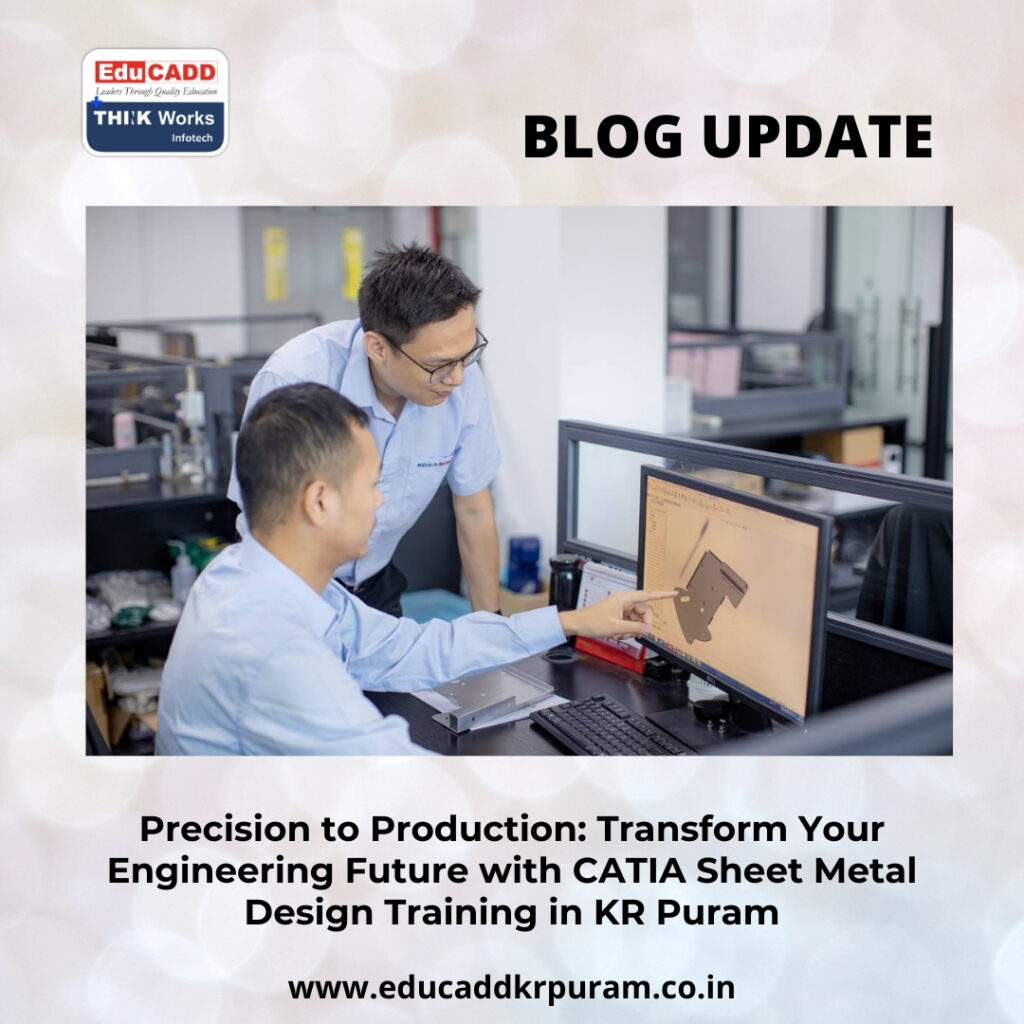
CATIA Sheet Metal Training
KR Puram, strategically located in Bangalore’s rapidly developing industrial corridor, has become a promising destination for technical education. Through comprehensive classroom instruction, hands-on modeling practice, and real-time project exposure, this specialized training equips learners with the technical competence required to thrive in competitive manufacturing environments.
The Industrial Relevance of Sheet Metal Engineering
Sheet metal engineering forms the backbone of modern product development. Manufacturers use thin sheets of steel, aluminum, and other alloys to fabricate durable yet lightweight components. These components appear in vehicle chassis systems, aircraft fuselage panels, machine guards, server racks, switchgear cabinets, and structural supports. Because sheet metal must undergo bending, cutting, punching, and forming processes, engineers must design each component with manufacturing precision in mind.
A well-designed sheet metal part balances strength, cost efficiency, and production feasibility. Designers must calculate bend allowances accurately, determine appropriate relief cuts, and maintain dimensional tolerances. Failure to account for these parameters often results in misalignment or material wastage. Through CATIA for Sheet Metal Design – Training in KR Puram, learners gain a deep understanding of how theoretical engineering principles directly influence real production outcomes. This practical alignment enhances both confidence and technical proficiency.
Why CATIA Dominates Advanced Mechanical Design
CATIA Sheet Metal Training remains one of the most trusted platforms in global product engineering. Developed by Dassault Systèmes, CATIA integrates 3D modeling, assembly design, drafting, and product lifecycle management into a unified environment. Leading automotive and aerospace companies depend on CATIA to create intricate, high-performance components.
The sheet metal workbench within CATIA offers precise control over wall thickness, bend radius, and neutral axis positioning. Designers can quickly generate flanges, hems, beads, stiffeners, and complex cutouts. Additionally, the software automatically produces flat patterns that align with manufacturing requirements. Associativity ensures that modifications in the 3D model instantly update the corresponding drawings. By enrolling in CATIA for Sheet Metal Design – Training in KR Puram, students learn to leverage these advanced features in a systematic and industry-oriented manner.
Building Strong Foundations in Sheet Metal Concepts
Every successful sheet metal designer must first understand the science behind metal deformation. During bending operations, material stretches on the outer surface and compresses on the inner surface. Engineers calculate the neutral axis and K-factor to predict dimensional changes accurately. Without this knowledge, designs may fail during fabrication.
In CATIA for Sheet Metal Design – Training in KR Puram, instructors begin with fundamental sketching techniques and parametric modeling concepts. Students learn to apply geometric constraints, dimensional parameters, and design intent logic. Once they master these basics, they progress to sheet metal-specific tools such as base wall creation, edge flanges, and bend features. Trainers emphasize logical workflow and precision at every step, ensuring that learners build a strong conceptual base before moving to advanced modules.
Mastering Core Sheet Metal Features in CATIA
After establishing foundational knowledge, learners explore essential sheet metal features in depth. They practice creating walls and defining material thickness accurately. They then add flanges with specific bend radii and angles. In addition, they apply bend reliefs and corner reliefs to prevent tearing during manufacturing.
Students also generate cutouts and holes while maintaining structural stability. By repeatedly practicing these operations, they understand how design choices affect fabrication outcomes. CATIA for Sheet Metal Design – Training in KR Puram ensures that learners develop both speed and accuracy. They become comfortable navigating the sheet metal workbench and applying appropriate parameters without hesitation.
Advanced Modeling Techniques for Complex Components
Modern industries demand complex geometries rather than simple flat panels. Therefore, advanced training becomes essential. In this stage of the program, students create joggles, hems, beads, and stiffeners. These features enhance structural strength and improve product functionality.
Learners also work with multi-body modeling and assembly integration. They convert surface models into sheet metal components when necessary. Through continuous practice, they develop the ability to design intricate parts while maintaining manufacturability. CATIA for Sheet Metal Design – Training in KR Puram provides structured exercises that simulate industrial challenges. This exposure strengthens analytical thinking and prepares learners for real production scenarios.
Real-Time Projects and Practical Exposure
Practical application distinguishes professional training from theoretical study. During the course, students design industrial components such as electrical cabinets, mounting brackets, protective covers, and machine panels. Each project reflects real-world manufacturing standards.
Participants generate flat patterns and detailed production drawings. They analyze how design modifications influence material usage and fabrication costs. Trainers demonstrate common mistakes and guide students in correcting them systematically. CATIA for Sheet Metal Design – Training in KR Puram emphasizes experiential learning, ensuring that every student graduates with tangible design experience.
The Growing Demand for Skilled CATIA Professionals
India’s manufacturing sector continues to expand across automotive, aerospace, heavy machinery, and electronics industries. Companies actively seek engineers who can create precise digital models that integrate with CNC and laser cutting systems. Proficiency in CATIA provides a significant competitive advantage.
Professionals trained in CATIA for Sheet Metal Design – Training in KR Puram qualify for roles such as CAD Engineer, Design Engineer, Mechanical Designer, and Product Development Specialist. Because CATIA enjoys global recognition, opportunities also extend beyond national boundaries. Skilled designers who demonstrate innovation and efficiency often progress rapidly into leadership roles.
KR Puram: A Strategic Learning Location
Krishnarajapuram, commonly known as KR Puram, lies within the expanding industrial and residential corridor of Bangalore. The locality offers convenient connectivity to IT parks, manufacturing units, and educational institutions. Its infrastructure supports professional development initiatives.
Training centers in KR Puram maintain updated laboratories equipped with high-performance systems and licensed CATIA software. Students benefit from structured classroom sessions combined with dedicated lab hours. The surrounding industrial environment further enhances exposure to practical engineering practices. Choosing CATIA for Sheet Metal Design – Training in KR Puram allows learners to study in a location closely connected to industry activity.
Structured Curriculum and Progressive Learning
A well-designed curriculum ensures gradual yet comprehensive skill development. Initially, learners familiarize themselves with the CATIA interface, toolbars, and design tree navigation. They practice creating sketches and applying constraints effectively.
Subsequently, they transition to sheet metal modeling, where they design base walls, flanges, bends, and relief features. As confidence grows, they undertake complex assemblies and generate detailed drafting outputs. Assignments and periodic evaluations reinforce learning. CATIA for Sheet Metal Design – Training in KR Puram culminates in a capstone project that integrates all acquired skills into a complete design solution.
Bridging the Gap Between Academia and Industry
Many engineering graduates possess theoretical knowledge but lack practical exposure. Structured training programs address this gap directly. Through real-time case studies and simulated industrial tasks, learners gain insights into production constraints and optimization strategies.
In CATIA for Sheet Metal Design – Training in KR Puram, mentors share practical experiences from manufacturing environments. They explain how to reduce material wastage, enhance structural efficiency, and streamline assembly processes. This mentorship transforms students into industry-ready professionals who understand both design theory and practical implementation.
Certification and Portfolio Development
Professional certification adds credibility to technical expertise. Upon completing CATIA Sheet Metal Training – Training in KR Puram, learners receive a course completion certificate that validates their proficiency.
Throughout the program, students compile a portfolio of sheet metal models and assemblies. This portfolio demonstrates their problem-solving capabilities and design creativity. During job interviews, practical demonstration often plays a decisive role. A strong portfolio significantly enhances employment prospects and professional confidence.
Long-Term Career Growth and Financial Potential
The demand for digital manufacturing expertise continues to rise. Engineers skilled in sheet metal design often secure competitive entry-level salaries. With experience, they advance into senior design roles, project coordination, and product development leadership positions.
Organizations value professionals who can reduce design errors and optimize production efficiency. By mastering CATIA for Sheet Metal Design – Training in KR Puram, learners position themselves for sustained career growth. Their ability to deliver accurate and manufacturable designs ensures long-term relevance in the evolving engineering sector.
Embracing Future Technologies in Manufacturing
Manufacturing industries increasingly adopt digital twins, automation, and smart production systems. Engineers must adapt to these advancements to remain competitive. Strong fundamentals in sheet metal design allow professionals to integrate seamlessly with advanced product lifecycle management systems.
CATIA continues to evolve with innovative features that support collaborative engineering and digital transformation. By completing CATIA for Sheet Metal Design – Training in KR Puram, learners build a foundation that supports continuous learning and adaptation. This forward-looking perspective ensures resilience in a rapidly changing technological landscape.
Conclusion
Precision engineering defines modern manufacturing success. Sheet metal components remain indispensable across diverse industries, from automotive and aerospace to electronics and heavy machinery. Designing these components requires a balanced understanding of material behavior, fabrication processes, and advanced CAD tools.
CATIA provides a comprehensive platform that transforms design concepts into production-ready digital models. Through structured, hands-on instruction in KR Puram, learners gain the expertise necessary to meet industry expectations confidently. They develop technical accuracy, practical insight, and professional discipline.
Choosing CATIA Sheet Metal Training – Training in KR Puram represents a decisive investment in professional advancement. It strengthens employability, enhances technical credibility, and opens pathways to rewarding engineering careers in both domestic and global markets.

