
CAD vs CADD in Mechanical Engineering: Uncovering the Technical Distinction Behind Digital Design and Drafting
Mechanical engineering has transformed dramatically with the adoption of digital tools. Today, engineers rarely rely on manual drawing boards. Instead, they develop detailed components, assemblies, and systems using advanced computer software. However, confusion often arises when two closely related terms appear in academic materials and industry discussions: CAD and CADD. Although many professionals use these terms interchangeably, subtle conceptual differences still exist. Therefore, understanding the CAD vs CADD Difference is essential for students, professionals, and organizations aiming to improve design accuracy and workflow efficiency. This comprehensive guide explores their definitions, applications, historical context, functional distinctions, and long-term significance in mechanical engineering practice.
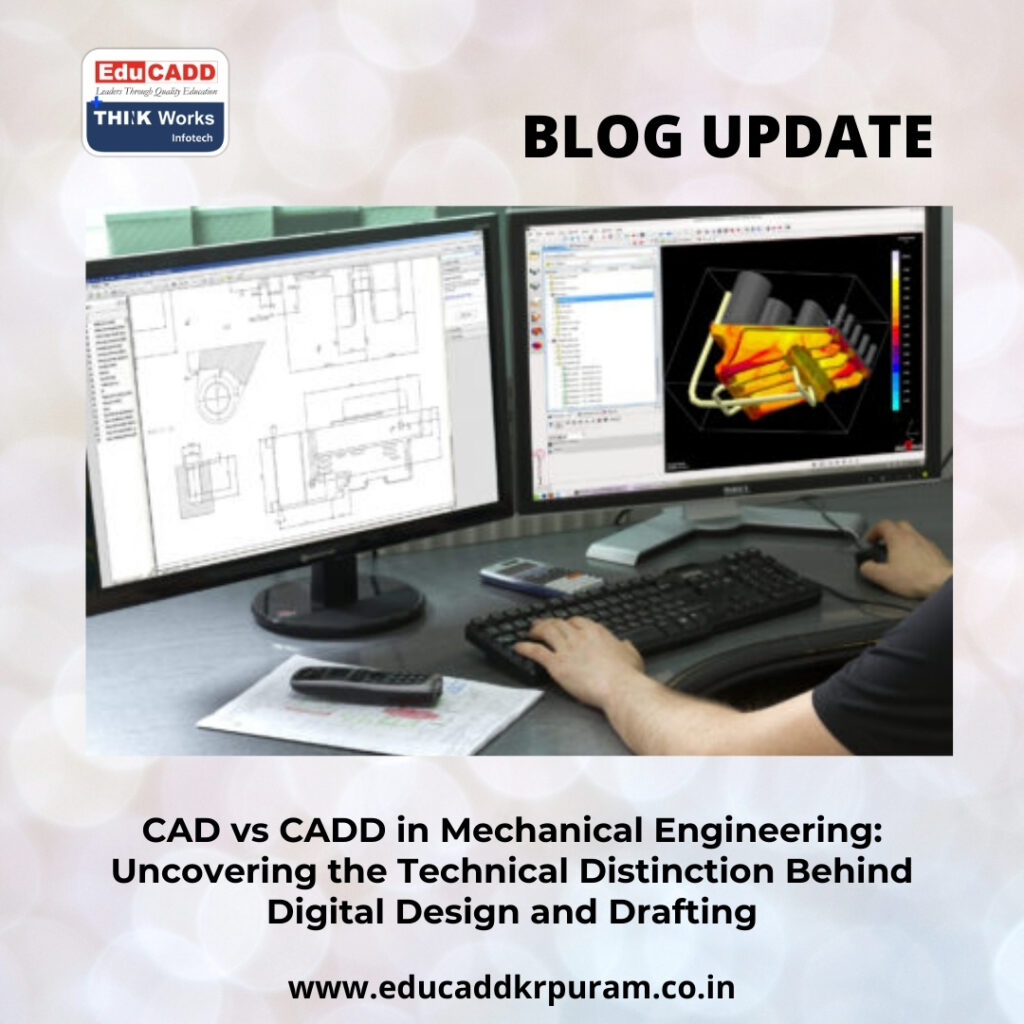
CAD vs CADD Difference
1. The Concept and Scope of CAD in Mechanical Engineering
Computer-Aided Design, commonly known as CAD, refers to the use of specialized software to create digital representations of mechanical components and systems. Engineers rely on CAD tools to generate precise 2D drawings and 3D parametric models. These digital models allow users to define dimensions, constraints, and relationships between features. When exploring the CAD vs CADD Difference it becomes clear that CAD primarily emphasizes modeling and visualization. Mechanical engineers use CAD platforms to design gears, shafts, housings, frames, and entire assemblies. Moreover, CAD systems enable engineers to conduct simulations, test structural integrity, and evaluate motion performance before physical production begins. As a result, CAD significantly reduces design errors and enhances product innovation.
2. Defining CADD and Its Emphasis on Drafting
CADD stands for Computer-Aided Design and Drafting. While it includes design capabilities similar to CAD, the addition of “Drafting” highlights a stronger focus on technical documentation. Drafting involves creating detailed engineering drawings that communicate manufacturing requirements. Therefore, the Difference Between CAD and CADD in Mechanical Engineering largely revolves around documentation emphasis. CADD systems assist engineers in preparing dimensioned drawings, sectional views, exploded diagrams, and assembly instructions. These drawings incorporate tolerances, material specifications, surface finish symbols, and industry standards. Consequently, CADD ensures that the design intent is clearly conveyed to production teams, minimizing ambiguity during fabrication.
3. Historical Evolution from Manual Drafting to Digital Platforms
To fully grasp the Difference Between CAD and CADD in Mechanical Engineering, one must consider their historical progression. Before digital tools emerged, mechanical engineers produced drawings manually using drafting boards and precision instruments. This process demanded extensive time and meticulous effort. During the late twentieth century, early computer-based drafting systems replaced manual techniques. At that stage, the focus centered on digitizing drafting tasks, which led to widespread adoption of the term CADD. As computing power advanced, software developers introduced 3D modeling and simulation capabilities. Consequently, CAD evolved into a broader design system that extended beyond drafting. Although modern tools integrate both modeling and documentation, the historical distinction between CAD and CADD continues to influence terminology today.
4. Core Functional Differences in Workflow
Although CAD and CADD share overlapping capabilities, their functional emphasis differs within engineering workflows. CAD primarily supports concept development, parametric modeling, and virtual prototyping. Engineers manipulate dimensions and constraints, and the software automatically updates the entire model. This adaptability allows rapid design iterations and experimentation. In contrast, CADD concentrates on producing standardized technical drawings derived from these models. Therefore, the Difference Between CAD and CADD in Mechanical Engineering becomes evident during documentation stages. CAD facilitates innovation and optimization, while CADD ensures that finalized designs meet documentation standards required for manufacturing and quality control.
5. Role in Mechanical Product Development
Mechanical product development progresses through multiple stages, including concept creation, detailed modeling, analysis, and production documentation. The Difference Between CAD and CADD in Mechanical Engineering influences each stage distinctly. CAD tools empower engineers to develop 3D assemblies, evaluate structural performance, and identify potential interference issues. Engineers can simulate load conditions and refine geometry to improve efficiency. Meanwhile, CADD tools generate comprehensive drawings that provide machinists and technicians with actionable instructions. These drawings include critical dimensions, tolerance zones, and assembly sequences. By combining modeling precision with drafting clarity, engineers ensure smooth transitions from design to manufacturing.
6. Accuracy, Precision, and Parametric Control
Precision is fundamental in mechanical engineering. A minor dimensional deviation can result in equipment malfunction or safety hazards. CAD systems maintain geometric accuracy through parametric modeling and constraint-based relationships. When engineers modify a single dimension, associated features adjust automatically, preserving design consistency. On the other hand, CADD ensures precision in communication by incorporating standardized dimensioning and annotation practices. Therefore, the CAD vs CADD Difference also reflects the distinction between internal model accuracy and external documentation clarity. Both aspects are essential for achieving reliable mechanical performance.
7. Software Integration in Modern Engineering Environments
Contemporary mechanical design platforms integrate modeling and drafting tools into unified environments. Engineers can seamlessly switch from 3D modeling to 2D drawing generation within the same application. Despite this integration, professionals still reference the Difference Between CAD and CADD in Mechanical Engineering to describe skill specialization. Some engineers excel in advanced modeling and simulation tasks, while others focus on drafting standards and documentation quality. Nevertheless, modern industry expectations increasingly demand proficiency in both areas. Organizations benefit when engineers understand how modeling decisions influence drafting requirements and vice versa.
8. Efficiency and Design Iteration Benefits
Digital tools have dramatically improved design efficiency. CAD enables rapid modification of components without recreating entire drawings. Engineers can test alternative configurations and immediately evaluate results. This flexibility accelerates product development cycles and reduces material waste. Meanwhile, CADD enhances workflow efficiency by automating repetitive documentation tasks. Software can generate bills of materials, revision tables, and title blocks with minimal manual input. Therefore, the Difference Between CAD and CADD in Mechanical Engineering influences productivity from both creative and administrative perspectives. When integrated effectively, these systems reduce project timelines and improve overall performance.
9. Integration with Manufacturing Technologies
Modern mechanical engineering closely connects with manufacturing technologies such as CNC machining, additive manufacturing, and automated assembly systems. CAD models often feed directly into Computer-Aided Manufacturing software for toolpath generation. Engineers export digital models for rapid prototyping and production. However, machinists frequently rely on detailed drawings for dimensional verification and inspection procedures. Thus, the Difference Between CAD and CADD in Mechanical Engineering becomes evident during production stages. CAD drives digital manufacturing processes, while CADD provides authoritative documentation for quality assurance and compliance checks.
10. Educational Importance in Mechanical Engineering Programs
Mechanical engineering curricula often distinguish between modeling and drafting to build strong foundational skills. Students typically begin with basic drafting principles, including orthographic projections and dimensioning conventions. Later, they advance to 3D parametric modeling and simulation exercises. This educational progression reinforces understanding of the Difference Between CAD and CADD in Mechanical Engineering. By mastering drafting standards alongside modeling techniques, students develop comprehensive technical competence. Academic programs emphasize both analytical reasoning and communication clarity to prepare graduates for industry challenges.
11. Collaboration and Communication in Engineering Teams
Large-scale mechanical projects involve multidisciplinary collaboration. Designers, analysts, manufacturing engineers, and quality inspectors must coordinate effectively. CAD models allow teams to visualize assemblies in three dimensions, enhancing understanding of spatial relationships. At the same time, CADD drawings serve as official documentation during design reviews and audits. Therefore, the Difference Between CAD and CADD in Mechanical Engineering affects communication strategies. While CAD supports interactive visualization, CADD ensures standardized record-keeping. Together, these tools strengthen teamwork and reduce misinterpretation across departments.
12. Addressing Misconceptions About CAD and CADD
Many individuals assume that CAD and CADD represent entirely separate technologies. In reality, modern software platforms integrate both functions seamlessly. However, the Difference Between CAD and CADD in Mechanical Engineering remains conceptually relevant. CAD emphasizes digital modeling, analysis, and visualization. CADD underscores drafting accuracy and technical documentation. Understanding this nuance helps professionals interpret job descriptions, certification programs, and academic courses accurately. Although practical differences may appear minimal in advanced software, conceptual clarity enhances professional communication.
13. Emerging Trends and Model-Based Engineering
The future of mechanical engineering continues to evolve through innovations such as generative design, digital twins, and cloud-based collaboration. Increasingly, engineers embed manufacturing data directly within 3D models, reducing dependence on separate drawings. This shift toward model-based engineering challenges traditional drafting practices. Nevertheless, the Difference Between CAD and CADD in Mechanical Engineering remains significant. Even when drawings become less central, engineers must understand drafting principles to ensure clear communication and regulatory compliance. Strong foundational knowledge supports adaptation to technological advancements.
14. Career Growth and Industry Expectations
Mechanical engineers who understand both modeling and drafting principles gain a competitive advantage in the job market. Employers seek professionals capable of designing innovative systems while producing accurate documentation. Therefore, recognizing the Difference Between CAD and CADD in Mechanical Engineering enhances employability across industries such as automotive, aerospace, heavy machinery, and renewable energy. CAD expertise demonstrates creativity and technical proficiency. CADD expertise reflects discipline and attention to detail. Together, these skills define a well-rounded mechanical engineer prepared for complex engineering challenges.
Conclusion
The CAD vs CADD Difference extends beyond terminology. It represents the balance between creative digital modeling and structured technical documentation. CAD empowers engineers to conceptualize, simulate, and refine mechanical systems with precision. CADD ensures those systems are clearly documented, standardized, and ready for manufacturing execution. Although modern tools integrate both functions, understanding their conceptual roles strengthens workflow clarity and professional competence. Ultimately, successful mechanical engineering depends on harmonizing innovation with documentation excellence, ensuring that every design moves efficiently from digital concept to physical reality.

