
Engineering Project Clarity: The Ultimate Guide to Building a Powerful Work Breakdown Structure (WBS) in Primavera P6
Large projects often fail not because of poor effort, but because of poor structure. When teams attempt to manage thousands of activities without a clear hierarchy, confusion spreads quickly. Deadlines shift, budgets fluctuate, and accountability becomes unclear. This is precisely why mastering Primavera P6 Work Breakdown is essential for serious project professionals.
Primavera P6 is not just a scheduling tool; it is a strategic project management system. However, its effectiveness depends on how intelligently the project structure is developed. A well-designed WBS serves as the architectural framework of your entire schedule. It organizes scope into logical segments, improves reporting clarity, and strengthens cost and resource control.
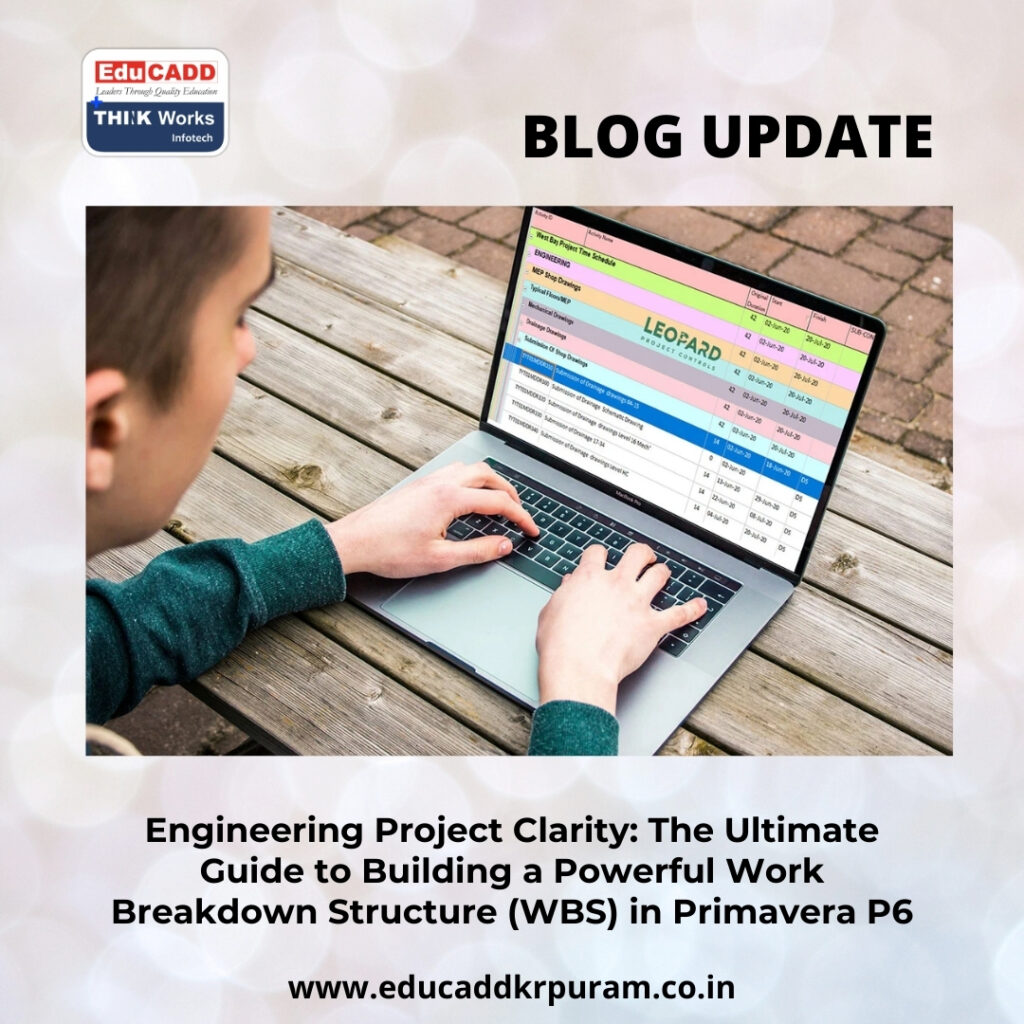
Primavera P6 Work Breakdown
In this in-depth guide, you will gain a complete understanding of Work Breakdown Structure (WBS) Creation in Primavera P6. From foundational theory to advanced strategies, this blog explores how to design, implement, and optimize a WBS that supports accurate planning and strong project execution.
1. The Strategic Role of Work Breakdown Structure in Project Management
A Work Breakdown Structure is a hierarchical representation of the total project scope. Instead of listing tasks randomly, it divides deliverables into progressively smaller components. Each level adds more detail while maintaining alignment with the overall objective.
When professionals focus on Primavera P6 Work Breakdown, they shift their attention from individual activities to structured outcomes. This distinction is important. Activities explain how work will occur, while WBS elements define what must be delivered.
The WBS acts as a control framework. It allows project managers to view performance at multiple levels. They can examine the entire project at a high level or analyze specific segments in detail. This layered visibility enhances monitoring and improves decision-making.
Moreover, the WBS builds clarity across departments. Engineers, planners, and managers all reference the same structural map. That shared understanding reduces miscommunication and strengthens coordination.
2. Why WBS Creation in Primavera P6 Is the Backbone of Scheduling
Primavera P6 organizes all schedule activities under WBS elements. Without a structured WBS, the schedule becomes difficult to navigate and nearly impossible to manage effectively. Therefore, Primavera P6 Work Breakdown forms the backbone of professional planning.
Primavera automatically aggregates durations, costs, and performance indicators from activities to their parent WBS elements. This roll-up function enables managers to review summarized data instantly. Instead of reviewing hundreds of tasks individually, they can analyze performance by phase, location, or discipline.
Additionally, a properly developed WBS supports earned value calculations. Primavera tracks planned value, earned value, and actual cost at the WBS level. This capability strengthens financial control and forecasting accuracy.
Ultimately, structured planning enhances transparency. Stakeholders gain confidence when reports follow a clear and logical hierarchy.
3. Defining Scope Before Structuring the WBS
Before beginning Work Breakdown Structure (WBS) Creation in Primavera P6, planners must define the project scope thoroughly. A WBS reflects scope. If scope remains unclear, the structure will lack direction.
Start by reviewing contractual documents, technical specifications, and stakeholder expectations. Identify major deliverables and milestones. Break these deliverables into logical components that reflect execution phases.
Avoid jumping directly into Primavera without preparation. Sketch the WBS hierarchy on paper or in a planning workshop first. Discuss the structure with discipline leads and project managers. Their input ensures alignment between planning and field operations.
Clear scope definition ensures the WBS remains stable throughout execution. Changes may occur, but a strong foundation reduces unnecessary restructuring.
4. Establishing WBS Levels That Provide Control Without Complexity
Effective Work Breakdown Structure (WBS) Creation in Primavera P6 requires balance. Too few levels reduce control. Too many levels create confusion. Most successful projects maintain three to five WBS levels.
Level one typically represents the entire project. Level two divides the project into major phases such as design, procurement, and construction. Level three often separates work by discipline or location. Level four may represent work packages or deliverables.
For example, in an industrial facility project:
-
Level 1: Manufacturing Plant
-
Level 2: Construction
-
Level 3: Mechanical Installation
-
Level 4: Piping Works
This layered structure improves clarity while maintaining simplicity. Each level adds detail without overwhelming the schedule.
5. Step-by-Step Execution of WBS Creation in Primavera P6
Work Breakdown Structure (WBS) Creation in Primavera P6 follows a systematic process. First, open the selected project within the Enterprise Project Structure. Navigate to the WBS window inside the project workspace.
The top-level WBS element appears automatically with the project name. This element represents the entire scope. Next, add major phases by selecting the “Add” option and creating child WBS elements.
Continue breaking down each phase into smaller components. Ensure each element represents a deliverable rather than an activity. Maintain logical relationships between parent and child elements.
After completing the hierarchy, review the structure carefully. Confirm that no scope overlaps and that each component fits logically within its parent. This disciplined approach strengthens structural clarity.
6. Implementing Clear Naming Conventions and Coding Standards
Professional planning demands consistency. During Work Breakdown Structure (WBS) Creation in Primavera P6, establish a structured naming and coding system.
Use numeric codes that follow a logical sequence. For instance, 1.0 may represent engineering, 2.0 procurement, and 3.0 construction. Sublevels can use formats such as 3.1, 3.2, and 3.3.
Descriptive names enhance readability. Avoid vague labels like “Miscellaneous.” Instead, use precise terms such as “Electrical Cable Installation” or “Foundation Works.”
Consistent coding simplifies sorting, filtering, and reporting. It also improves communication between departments and stakeholders.
7. Linking WBS with Organizational Responsibility
One powerful advantage of Primavera P6 lies in its ability to connect WBS elements with the Organizational Breakdown Structure (OBS). During Work Breakdown Structure (WBS) Creation in Primavera P6, assign responsible managers to each WBS element.
This assignment creates accountability. Each manager oversees performance within their designated scope. Primavera tracks progress and performance metrics accordingly.
For example, a civil manager may handle structural works, while a mechanical manager supervises equipment installation. This division clarifies ownership and improves coordination.
Responsibility alignment enhances discipline and reduces confusion during execution.
8. Aligning WBS with Cost Management Systems
Financial control improves significantly when cost tracking aligns with structure. Primavera aggregates activity-level costs to their respective WBS elements automatically. Therefore, Primavera P6 Work Breakdown directly influences budget monitoring.
A structured WBS enables phase-wise budget tracking. Managers can analyze cost performance for each discipline or location. If a cost overrun occurs, they identify the responsible segment quickly.
Additionally, earned value metrics rely on accurate WBS design. Without proper structure, performance indicators lose meaning.
Strong integration between WBS and cost systems strengthens financial governance.
9. Enhancing Resource Management Through Structured Planning
Resource planning becomes clearer when supported by a logical WBS. Primavera groups resource assignments by WBS level. This grouping provides visibility into manpower, equipment, and material distribution.
During Work Breakdown Structure (WBS) Creation in Primavera P6, organize elements in a way that reflects resource allocation patterns. For example, group all electrical activities under one WBS element to monitor labor demand effectively.
This clarity helps planners forecast workforce peaks and avoid resource conflicts. Balanced resource planning reduces delays and improves productivity.
10. Using WBS for Performance Tracking and Reporting
Reporting becomes more meaningful when built upon a structured framework. Primavera allows grouping, sorting, and summarizing data by WBS level.
Through effective Work Breakdown Structure (WBS) Creation in Primavera P6, managers generate phase-wise progress reports. They analyze schedule variance and cost variance without reviewing every activity individually.
Executives often prefer high-level summaries. Field teams require detailed insights. A layered WBS satisfies both needs simultaneously.
Structured reporting enhances communication and builds stakeholder confidence.
11. Preventing Common Errors During WBS Development
Many scheduling issues originate from structural mistakes. Avoid these errors during Work Breakdown Structure (WBS) Creation in Primavera P6.
Do not mix activities with WBS elements. Maintain a clear distinction between deliverables and tasks. Avoid excessive hierarchy levels that complicate navigation.
Ensure stakeholder involvement during development. Early feedback prevents misalignment later. Review the structure thoroughly before adding activities.
Preventive planning reduces rework and ensures long-term stability.
12. Leveraging Templates for Efficiency and Standardization
Organizations often manage multiple projects simultaneously. Standardized WBS templates accelerate setup and maintain consistency.
During Work Breakdown Structure (WBS) Creation in Primavera P6, planners can import predefined templates. These templates reflect corporate standards and reporting requirements.
Standardization improves benchmarking and performance comparison across projects. It also reduces setup time and enhances accuracy.
Templates support scalability without sacrificing structure quality.
13. Applying WBS Strategy in Real-World Infrastructure Projects
Consider a highway construction project. Major phases may include land preparation, earthworks, pavement construction, drainage systems, and finishing works.
Through careful Work Breakdown Structure (WBS) Creation in Primavera P6, planners monitor each phase independently. If delays affect pavement works, managers identify the impacted WBS segment instantly.
This visibility enables quick corrective action. Additional resources can be allocated where needed. Structural clarity supports proactive management.
Real-world application demonstrates the value of disciplined WBS design.
14. Continuous Improvement and Long-Term Project Success
A WBS should evolve when project scope changes. However, its core structure should remain stable. Regular reviews ensure alignment with execution realities.
During Primavera P6 Work Breakdown, planners should anticipate potential modifications. Flexibility within structure allows adaptation without disruption.
Continuous improvement strengthens future projects as well. Lessons learned from one WBS design can inform subsequent planning efforts.
Strong structure fosters long-term success across an organization’s project portfolio.
Conclusion
Primavera P6 Work Breakdown represents more than a scheduling task. It defines how a project will be organized, controlled, and reported from initiation to completion.
When planners invest time in building a logical hierarchy, they gain clarity over scope, cost, resources, and performance. They create accountability within teams and transparency for stakeholders.
A powerful WBS transforms complexity into structure. It turns scattered tasks into measurable deliverables. It strengthens governance and enhances confidence in every project decision.
By mastering Work Breakdown Structure (WBS) Creation in Primavera P6, project professionals position themselves for consistent, controlled, and successful project delivery in even the most demanding environments.

