
Beyond Blueprints: How Mechanical CADD Redefines Accuracy in Modern Engineering Design
Engineering design has undergone a remarkable transformation over the past few decades. What once depended on drawing boards, manual scales, and handwritten calculations now thrives in intelligent digital environments. As industries demand higher performance, tighter tolerances, and faster production cycles, accuracy has become more critical than ever. A small dimensional inconsistency can cause mechanical failure, production delays, or significant financial losses. To address these challenges, engineers rely on Mechanical CADD Engineering Accuracy as a core design solution.
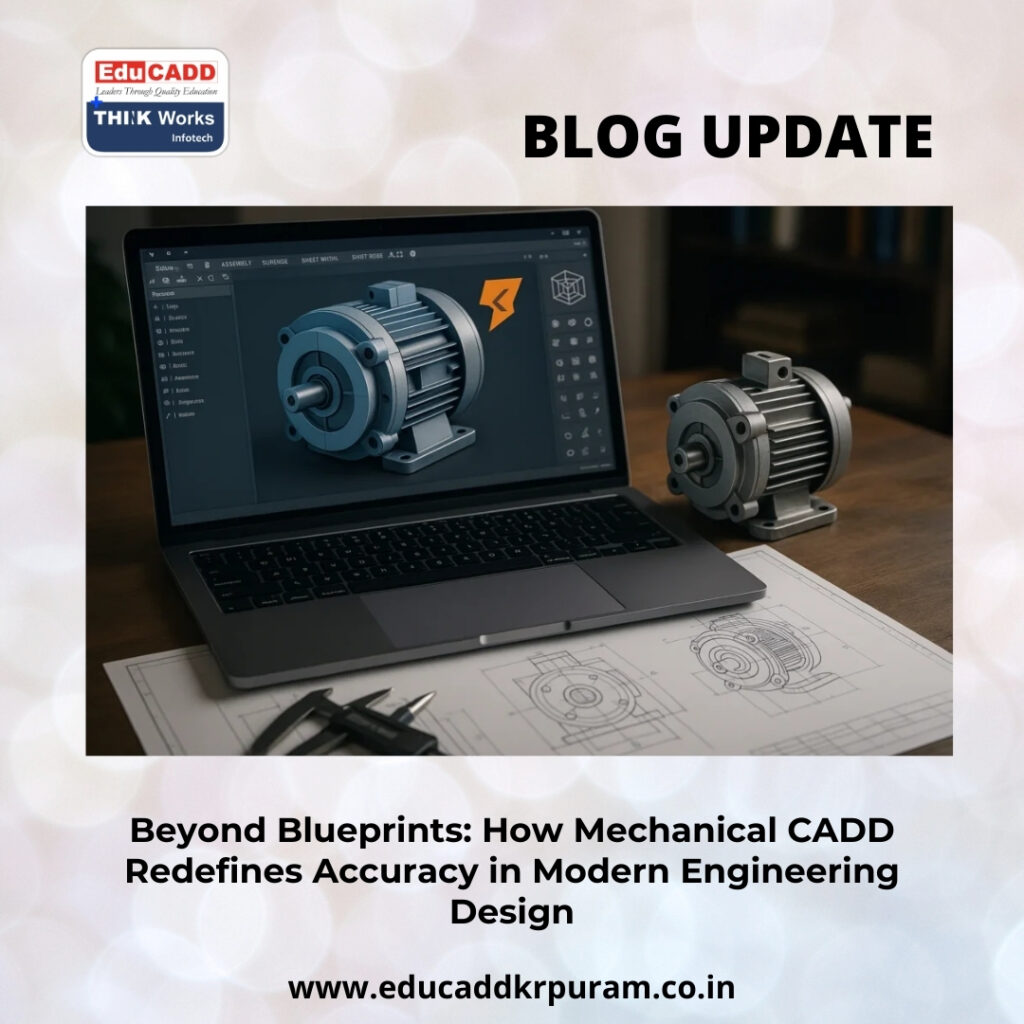
Mechanical CADD Engineering Accuracy
Mechanical CADD Engineering Accuracy, automation, and mathematical consistency into the drafting process. It empowers professionals to build reliable mechanical systems with clarity and confidence. By integrating modeling, validation, and collaboration into one platform, Mechanical CADD elevates design accuracy from a goal to a guaranteed outcome. This comprehensive discussion explores how Mechanical CADD strengthens precision at every stage of product development while supporting innovation and efficiency.
1. Replacing Manual Drafting with Algorithm-Driven Accuracy
Traditional drafting required immense skill and patience. Designers manually calculated dimensions and carefully aligned projections. Even experienced professionals occasionally encountered scaling errors or misinterpretations. Mechanical CADD eliminates these limitations by embedding accuracy within its computational framework.
In a digital environment, every line, arc, and coordinate follows exact mathematical definitions. Mechanical CADD ensures that geometric relationships remain consistent regardless of zoom level or view orientation. When engineers specify precise dimensions, the system maintains them automatically throughout the drawing. This capability prevents distortions that often occurred during manual adjustments.
Furthermore, digital drafting tools provide snapping functions, alignment guides, and constraint-based modeling. These features reduce human guesswork and strengthen dimensional integrity. As a result, Mechanical CADD minimizes revision cycles and ensures that engineering documentation reflects precise intent.
2. Parametric Intelligence Enables Seamless Modifications
Engineering projects evolve continuously. Design teams refine dimensions to optimize performance, reduce material usage, or accommodate manufacturing constraints. Without a structured system, these adjustments can disrupt the entire assembly. Mechanical CADD Engineering Accuracy addresses this complexity through parametric modeling.
Parametric modeling allows engineers to define relationships between components. When a designer changes a key dimension, related features update instantly. Mechanical CADD calculates dependencies in real time, preserving alignment and proportionality. This intelligence prevents inconsistencies that might arise during manual revisions.
Additionally, parametric tools encourage experimentation. Engineers can test variations while maintaining logical connections within the model. Instead of rebuilding parts from scratch, they modify parameters confidently. Mechanical CADD therefore supports innovation while safeguarding accuracy across every design iteration.
3. Three-Dimensional Modeling Eliminates Ambiguity
Two-dimensional drawings can sometimes lead to misinterpretation. Fabrication teams may struggle to visualize complex geometries from flat projections. Mechanical CADD resolves this challenge through advanced 3D modeling capabilities.
Engineers construct detailed three-dimensional models that represent physical components accurately. They inspect parts from multiple angles, analyze internal cavities, and verify spatial relationships. Mechanical CADD highlights potential interference issues automatically, reducing assembly conflicts before production begins.
Three-dimensional visualization strengthens communication among stakeholders. Designers, manufacturers, and clients share a unified understanding of the product. When everyone sees the same accurate representation, misunderstandings decrease significantly. Mechanical CADD thus transforms abstract drawings into realistic digital prototypes that enhance clarity and precision.
4. Integrated Tolerance Management Improves Fit and Function
Mechanical systems depend on carefully defined tolerances. Even minimal deviations can affect alignment, motion, and load distribution. Mechanical CADD integrates tolerance management directly within its drafting tools.
Engineers apply geometric dimensioning and tolerancing standards to ensure compatibility between components. Mechanical CADD evaluates tolerance stacks and identifies potential clearance problems. Designers address these issues before releasing drawings for production.
This proactive approach prevents costly manufacturing adjustments. By simulating variations digitally, engineers confirm that assemblies will function reliably under operational conditions. Mechanical CADD bridges the gap between theoretical design and real-world application, reinforcing dimensional confidence at every stage.
5. Automated Validation Strengthens Quality Control
Complex mechanical assemblies often contain hundreds of interconnected elements. Manual review processes may overlook subtle inconsistencies. Mechanical CADD incorporates automated validation features that monitor design integrity continuously.
The system identifies overlapping geometry, missing constraints, and inconsistent dimensions. When issues arise, Mechanical CADD alerts the designer immediately. This instant feedback accelerates refinement and reduces the likelihood of downstream errors.
Quality control becomes embedded within the workflow rather than treated as a final step. Engineers rely on intelligent checks to confirm that models meet defined standards. Mechanical CADD enhances reliability by combining human expertise with computational oversight.
6. Simulation Capabilities Support Performance Accuracy
Accuracy extends beyond geometry; it also includes functional performance. Mechanical CADD Engineering Accuracy integrates seamlessly with simulation tools that evaluate stress, thermal behavior, and motion dynamics.
Engineers perform virtual testing within the same environment where they design components. Mechanical CADD maintains data continuity between modeling and analysis stages. Designers adjust parameters based on simulation results, refining structural strength and durability.
Digital validation reduces dependence on physical prototypes. Teams identify weaknesses early and implement improvements efficiently. Mechanical CADD ensures that products meet performance expectations while maintaining dimensional precision.
7. Standardized Component Libraries Promote Uniformity
Mechanical projects frequently incorporate standard elements such as fasteners, couplings, and bearings. Recreating these parts manually increases the risk of measurement discrepancies. Mechanical CADD provides extensive libraries of pre-engineered components aligned with industry specifications.
Designers insert standardized elements directly into assemblies. Mechanical CADD preserves accurate dimensions and metadata for each part. This consistency simplifies procurement and manufacturing processes.
By relying on verified libraries, engineers eliminate repetitive drafting tasks. Mechanical CADD enhances efficiency while maintaining strict dimensional accuracy across projects. Standardization becomes a strategic advantage rather than a limitation.
8. Collaborative Platforms Enhance Design Consistency
Modern engineering projects involve multidisciplinary teams working across various locations. Effective collaboration plays a crucial role in maintaining accuracy. Mechanical CADD supports shared digital environments that synchronize updates in real time.
Version control systems track every modification, ensuring transparency and accountability. Mechanical CADD prevents outdated drawings from circulating within the organization. Designers add annotations and comments to clarify intent.
Because all stakeholders access a centralized model, coordination improves dramatically. Mechanical CADD reduces miscommunication and ensures that design decisions remain consistent throughout the development lifecycle.
9. Streamlined Manufacturing Integration Reduces Errors
Manufacturing technologies demand precise digital input. Mechanical CADD produces files compatible with CNC machines and additive manufacturing systems. This seamless integration minimizes data conversion errors.
Engineers export geometry while preserving coordinate accuracy and surface continuity. Mechanical CADD ensures that production teams receive reliable information aligned with the original model.
Rapid prototyping strengthens feedback loops between design and fabrication. Engineers compare prototypes with digital models to confirm precision. Mechanical CADD facilitates quick adjustments, accelerating product refinement and maintaining dimensional consistency.
10. Assembly Modeling Enhances System-Level Accuracy
Individual components rarely operate independently. Mechanical CADD enables engineers to construct comprehensive assembly models that simulate real-world interactions.
Designers analyze movement, rotation, and load transfer within assemblies. Mechanical CADD detects interference and clearance conflicts automatically. Engineers address these issues digitally, reducing costly on-site adjustments.
Exploded views and animated sequences clarify installation processes. Production teams understand assembly logic clearly. Mechanical CADD ensures that system-level accuracy matches component-level precision.
11. Data-Driven Optimization Encourages Intelligent Design
Engineering decisions benefit from measurable insights. Mechanical CADD Engineering Accuracy captures detailed data about materials, dimensions, and constraints. Optimization tools evaluate multiple design scenarios efficiently.
Engineers compare configurations to identify the most efficient solution. Mechanical CADD preserves geometric relationships during optimization. Designers achieve balanced outcomes that enhance performance without sacrificing accuracy.
This analytical approach reduces reliance on trial-and-error methods. Mechanical CADD transforms design refinement into a strategic and data-backed process.
12. Compliance Tools Ensure Regulatory Alignment
Mechanical designs must adhere to national and international standards. Mechanical CADD integrates drafting templates and annotation features that align with recognized guidelines.
Engineers apply standardized symbols and documentation practices consistently. Mechanical CADD verifies compliance automatically, reducing audit-related stress.
This integration strengthens credibility and accountability. By embedding regulatory alignment within the workflow, Mechanical CADD reinforces professional standards and protects organizations from compliance risks.
13. Scalability Supports Complex Engineering Challenges
As projects grow larger, maintaining accuracy becomes increasingly demanding. Mechanical CADD supports scalability through structured modeling and hierarchical organization.
Engineers manage extensive assemblies without compromising performance. Mechanical CADD isolates subsystems for focused modifications while preserving overall integrity.
This structured environment allows teams to tackle sophisticated mechanical systems confidently. Accuracy remains stable even as design complexity increases.
14. Continuous Skill Development Amplifies Precision
Technology evolves rapidly, and engineers must adapt to remain competitive. Mechanical CADD platforms provide training modules and professional communities that encourage continuous improvement.
As designers deepen their expertise, they unlock advanced automation features. Mechanical CADD streamlines repetitive processes and reduces potential errors.
Organizations that invest in skill development cultivate a culture of precision. Mechanical CADD becomes more than a drafting tool; it becomes a strategic asset that drives long-term engineering excellence.
Conclusion
Precision defines successful mechanical engineering. From initial sketches to final production, every dimension and tolerance influences performance. Mechanical CADD reimagines the drafting process by embedding computational intelligence, automation, and collaboration into a unified platform. Through parametric modeling, 3D visualization, simulation, and standardized workflows, Mechanical CADD Engineering Accuracy across every phase of development.
Organizations that embrace Mechanical CADD gain more than efficiency; they secure reliability and competitive advantage. Engineers create with confidence, knowing that their designs reflect exact specifications and real-world feasibility. As industries continue to advance, Mechanical CADD will remain a cornerstone of precise, dependable, and innovative mechanical design.

