
Engineering Design Revolution: Tracing Mechanical Drafting from Hand Sketches to CAD Mastery
Mechanical drafting has been the cornerstone of engineering for centuries, serving as the primary method for translating ideas into tangible technical documentation. It has enabled engineers, designers, and manufacturers to communicate complex mechanical concepts with precision and clarity. Initially, drafting was a purely manual process, requiring meticulous attention to detail, specialized tools, and a high degree of skill. Understanding the Mechanical Drafting to CAD not only highlights the history of engineering design but also underscores the transformative role of technology in improving productivity and collaboration.
Manual drafting was more than just a skill—it was a craft. Engineers spent hours creating detailed drawings using instruments like T-squares, compasses, protractors, and technical pens. Every line, curve, and dimension had to be perfectly executed to ensure the final product could be manufactured accurately. The precision required in these drawings was immense, and even small errors could lead to significant problems in production. Despite these challenges, manual drafting remained the standard for decades, shaping the way mechanical designs were visualized, documented, and communicated.
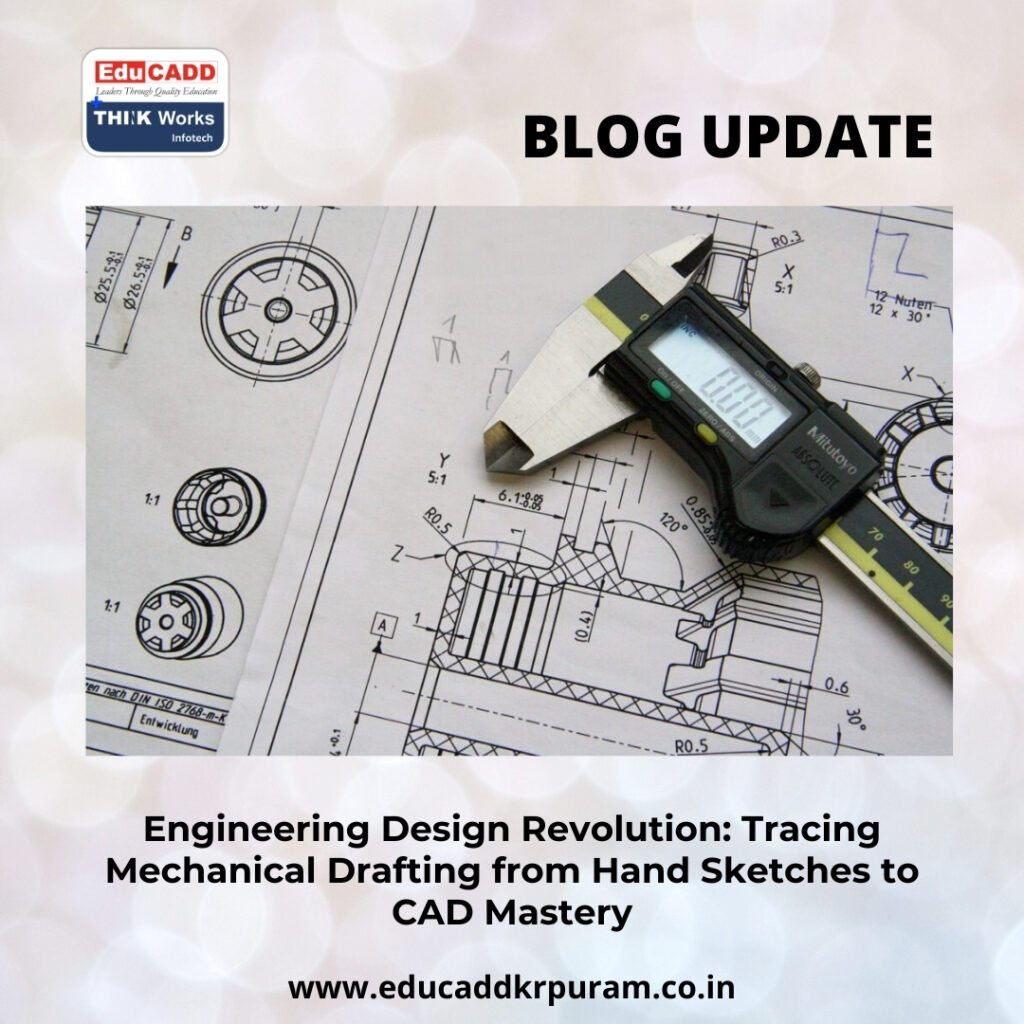
Mechanical Drafting to CAD
With industrialization and increasing complexity in machinery, the limitations of traditional drafting became more evident. Time-consuming revisions, risk of human error, and difficulty in sharing physical drawings across departments slowed down design cycles. The need for faster, more flexible solutions drove innovation in drafting methods, paving the way for early computer-based systems. Over time, the industry witnessed a paradigm shift with the introduction of computer-aided design (CAD) technology, which transformed the speed, accuracy, and capabilities of mechanical drafting. This journey from hand-drawn sketches to digital mastery represents one of the most significant technological evolutions in engineering.
The Historical Foundations of Mechanical Drafting
Mechanical drafting has deep historical roots, tracing back to the early industrial era. During this period, engineers and inventors relied primarily on rough sketches to represent mechanical ideas. These sketches were informal, often lacking standardized dimensions or symbols, yet they served as essential tools for conceptual communication. As manufacturing processes advanced and machines became more intricate, there arose a need for precise technical documentation.
The Industrial Revolution accelerated the formalization of drafting as a profession. Engineers adopted a standardized set of practices that included orthographic projections, dimensioning conventions, and symbol systems. Drafting boards, T-squares, compasses, and other specialized instruments became indispensable. These tools enabled the creation of detailed, reproducible drawings that could be interpreted consistently by machinists and manufacturers.
The Mechanical Drafting to CAD during this era was driven by industrial needs. Factories required exact documentation for components that had to fit together perfectly. Manual drafting became an essential skill for engineers, providing the foundation for modern technical communication. Students and apprentices learned the discipline through years of practice, honing their ability to visualize complex mechanical structures in two-dimensional form.
Despite its utility, manual drafting had inherent limitations. Drawing errors were common, revisions were cumbersome, and sharing designs between teams required physical transportation of documents. Yet, this period laid critical groundwork for later innovations by establishing principles of accuracy, clarity, and standardization in engineering drawings.
Tools and Techniques of Manual Drafting
Manual drafting relied heavily on a suite of specialized tools that facilitated precision. Drafting boards provided a flat, stable workspace, while T-squares and set squares ensured accurate horizontal, vertical, and angled lines. Compasses and dividers enabled engineers to create precise circles, arcs, and measurements. Pencils, pens, and technical inks of varying thickness were used to differentiate line types, with each style representing a specific element such as visible edges, hidden lines, or centerlines.
The Mechanical Drafting to CAD relied not only on tools but also on techniques. Orthographic projections allowed the representation of three-dimensional objects on a flat plane, and isometric drawings provided a pseudo-3D view for better spatial understanding. Mastering these techniques required extensive practice and strong spatial intelligence. Any error could compromise the clarity of the design, highlighting the painstaking attention required in manual drafting.
Additional tools such as mechanical pencils, drafting machines, and improved erasers gradually increased efficiency and reduced errors. Yet, even with these improvements, manual drafting remained labor-intensive and time-consuming. The need for accuracy dictated a slow, deliberate workflow, which limited how quickly designs could be produced or modified.
Despite these challenges, traditional drafting methods contributed significantly to the engineering discipline. They instilled a deep understanding of geometry, proportion, and dimensioning—skills that continue to influence modern digital drafting practices.
Limitations of Traditional Drafting
While manual drafting laid the foundation for precision in mechanical design, it had several critical drawbacks. Chief among these was the time required to produce detailed drawings. Complex machinery often required multiple views, cross-sections, and intricate detailing, all of which demanded hours or even days of meticulous work.
Revisions were particularly challenging. Any design modification often meant erasing and redrawing significant portions of the plan. This not only consumed valuable time but also increased the risk of inaccuracies. Inconsistent line weights, smudging, and misalignments could further compromise the quality of the drawings.
The Mechanical Drafting to CAD underscored the need for more efficient, flexible tools. Industries like automotive and aerospace demanded rapid design iterations to remain competitive. Manual drafting was increasingly unable to keep up with the pace of technological advancement.
Storage and retrieval of drawings posed additional problems. Physical blueprints took up significant space and required careful cataloging. Sharing drawings across teams involved duplication and transport, which slowed collaboration and increased the risk of outdated documents being used.
These challenges motivated engineers and researchers to explore technological alternatives that could enhance drafting efficiency while preserving accuracy and standardization.
The Advent of Computer-Based Drafting
The emergence of computers in the mid-twentieth century introduced new possibilities for mechanical drafting. Early computer graphics systems were capable of generating simple lines and geometric shapes on screens, hinting at the potential for digital drafting.
Interactive computer graphics allowed engineers to manipulate elements directly on a display, marking a major shift from paper-based methods. Although early systems were limited by hardware constraints, they laid the foundation for the future of CAD technology.
By the 1970s, specialized computer-aided drafting software began appearing. These programs enabled engineers to input commands and coordinates to generate digital drawings. Though rudimentary by today’s standards, these systems significantly reduced the time required for design and modification compared to manual methods.
The evolution of mechanical drafting gained momentum as industries recognized the efficiency benefits of digital tools. Aerospace and automotive companies were among the first adopters, using early CAD systems to streamline complex projects. Over time, improvements in computing power, software usability, and cost made CAD accessible to a wider range of industries.
The transition from manual to computer-based drafting marked a profound transformation in engineering practice, enhancing precision, flexibility, and reproducibility.
The Rise of Two-Dimensional CAD
Two-dimensional CAD software represented a significant step in the evolution of mechanical drafting. These systems allowed engineers to replicate traditional hand-drawn plans digitally, while also introducing new capabilities.
2D CAD programs enabled precise placement of lines, arcs, and shapes using coordinate systems. Editing tools allowed users to move, copy, or delete elements easily, making revisions far faster than manual methods. Automated dimensioning, annotation, and symbol libraries further streamlined the drawing process.
Layer management became a critical feature, allowing designers to separate components of a drawing for better organization. Engineers could control visibility, focus on specific parts, and maintain clarity in complex designs.
Digital storage eliminated the need for extensive physical archives and simplified file sharing across departments or locations. Engineers could send drawings electronically, improving collaboration and reducing the risk of using outdated plans.
Although 2D CAD provided substantial benefits, it still required mental visualization for three-dimensional components. This limitation drove the development of 3D modeling solutions, which would redefine engineering design.
Emergence of Three-Dimensional Modeling
Three-dimensional CAD transformed mechanical drafting by enabling engineers to create fully digital representations of parts and assemblies. Unlike 2D drawings, 3D models provide a realistic depiction of objects, allowing designers to visualize spatial relationships and functional interactions.
Parametric modeling allowed engineers to define relationships between features and dimensions. Changes to one parameter automatically updated related elements, enhancing design flexibility and reducing the likelihood of errors.
The Mechanical Drafting to CAD progressed further with assembly modeling, which allowed engineers to simulate the interaction of multiple components. Motion studies and interference checks became possible, enabling early detection of potential design conflicts.
Visualization tools such as rendering and animation allowed stakeholders to understand complex designs more effectively. This capability improved communication with clients, manufacturers, and other team members, bridging gaps that manual drawings could not address.
3D modeling has become the standard for mechanical design, providing a foundation for modern engineering workflows and fostering innovation.
Boosting Productivity Through CAD
CAD technology revolutionized engineering productivity. The Mechanical Drafting to CAD shifted the focus from labor-intensive drawing to design innovation.
Digital drafting reduced repetitive work, allowing engineers to explore multiple design options quickly. Editing tools enabled rapid revisions without recreating entire drawings.
Built-in accuracy checks minimized errors, while automated dimensioning and annotation ensured consistency across projects. Engineers could reuse digital models for future projects, accelerating product development cycles.
CAD also improved documentation efficiency. Technical drawings, assembly instructions, and bills of materials could be generated automatically from digital models, enhancing communication between engineering, manufacturing, and quality assurance teams.
Overall, CAD technology enabled faster, more accurate design, allowing engineers to focus on problem-solving and creativity rather than manual drafting tasks.
CAD Integration with Manufacturing
Modern manufacturing relies heavily on CAD models. Computer-aided manufacturing (CAM) systems use CAD data to generate precise machine instructions for CNC equipment, ensuring accurate production of complex components.
Simulation tools allow engineers to analyze structural integrity, thermal performance, and motion behavior before physical prototypes are created. This integration reduces development time, minimizes errors, and lowers production costs.
The evolution of mechanical drafting now supports rapid prototyping through 3D printing. Engineers can produce physical models directly from CAD files, enabling faster testing and refinement.
By connecting design and manufacturing digitally, CAD has transformed engineering workflows, improving both efficiency and product quality.
Collaboration and Cloud-Based Design
The Mechanical Drafting to CAD also includes collaborative capabilities enabled by cloud technology. Engineers can access CAD files from anywhere, making real-time collaboration across teams possible.
Cloud-based platforms support version control, allowing multiple users to work on a project while tracking changes. Interactive review tools enable annotations and feedback without leaving the digital environment.
Interdisciplinary collaboration has improved as mechanical, electrical, and manufacturing engineers can integrate their designs within shared digital ecosystems. This reduces errors, streamlines communication, and accelerates project completion.
Digital workflows have made global collaboration practical, ensuring that complex engineering projects can progress efficiently across distributed teams.
Advanced CAD Technologies
Modern CAD systems are no longer limited to drawing and modeling. They integrate advanced tools such as Finite Element Analysis (FEA) and Computational Fluid Dynamics (CFD), allowing engineers to simulate performance under real-world conditions.
Generative design uses AI algorithms to produce multiple design alternatives based on performance constraints, helping engineers select optimal solutions. Virtual and augmented reality provide immersive visualization, improving spatial understanding and design evaluation.
The evolution of mechanical drafting demonstrates how CAD has transformed into a comprehensive engineering platform rather than merely a drafting tool. These technologies expand the scope of what engineers can achieve digitally.
The Importance of CAD Skills
CAD proficiency has become essential for modern engineers. The Mechanical Drafting to CAD has shifted the required skill set from hand drafting to digital design expertise.
Engineering education now emphasizes 3D modeling, simulation, and collaborative tools. CAD skills are critical for roles such as design engineers, CAD modelers, and digital design specialists.
Continuous learning is necessary due to rapid software development and new tools. Engineers who master CAD remain competitive and contribute more effectively to complex projects.
The Future of Mechanical Drafting
The future of mechanical drafting promises continued innovation. Artificial intelligence will automate design optimization, cloud platforms will enhance collaboration, and digital twins will allow real-time monitoring of physical systems.
Sustainability will play a central role, with CAD tools helping engineers evaluate environmental impact and material efficiency.
The evolution of mechanical drafting is an ongoing journey, continuously reshaping the way engineers create, test, and deliver products.
Conclusion
The journey of Mechanical Drafting to CAD from manual hand sketches to advanced CAD systems is a testament to technological progress. Early drafting required immense skill, patience, and precision, while modern CAD platforms provide speed, flexibility, and accuracy.
Digital drafting tools have enhanced collaboration, integrated design with manufacturing, and expanded engineers’ capabilities. As technology continues to evolve, mechanical drafting will remain a vital component of engineering innovation, shaping the future of product development and industrial design.

