
Mechanical CADD Revolution: Transforming Modern Engineering Projects with Digital Precision
The engineering landscape has experienced a profound transformation over the last few decades. Where traditional mechanical design relied heavily on manual drafting, physical prototypes, and meticulous hand calculations, today’s engineering ecosystem thrives on digital technologies that deliver speed, accuracy, and efficiency. At the center of this transformation is Mechanical CADD Digital Engineering, a tool that has redefined the way engineers conceptualize, design, simulate, and produce mechanical systems.
In contemporary engineering projects, the complexity of mechanical systems has increased exponentially. Components must fit together perfectly, assemblies must operate smoothly, and design tolerances must meet rigorous standards. Mechanical CADD empowers engineers to manage this complexity by providing digital platforms where designs can be visualized, modified, and tested before a single physical part is manufactured. This ability to plan and optimize digitally reduces errors, saves costs, and accelerates project timelines.
Moreover, Mechanical CADD enhances collaboration between multidisciplinary teams. Engineers, designers, project managers, and production specialists can all work on the same digital models, ensuring alignment throughout the project lifecycle. This integrated workflow reduces miscommunication, prevents costly reworks, and strengthens overall project efficiency.
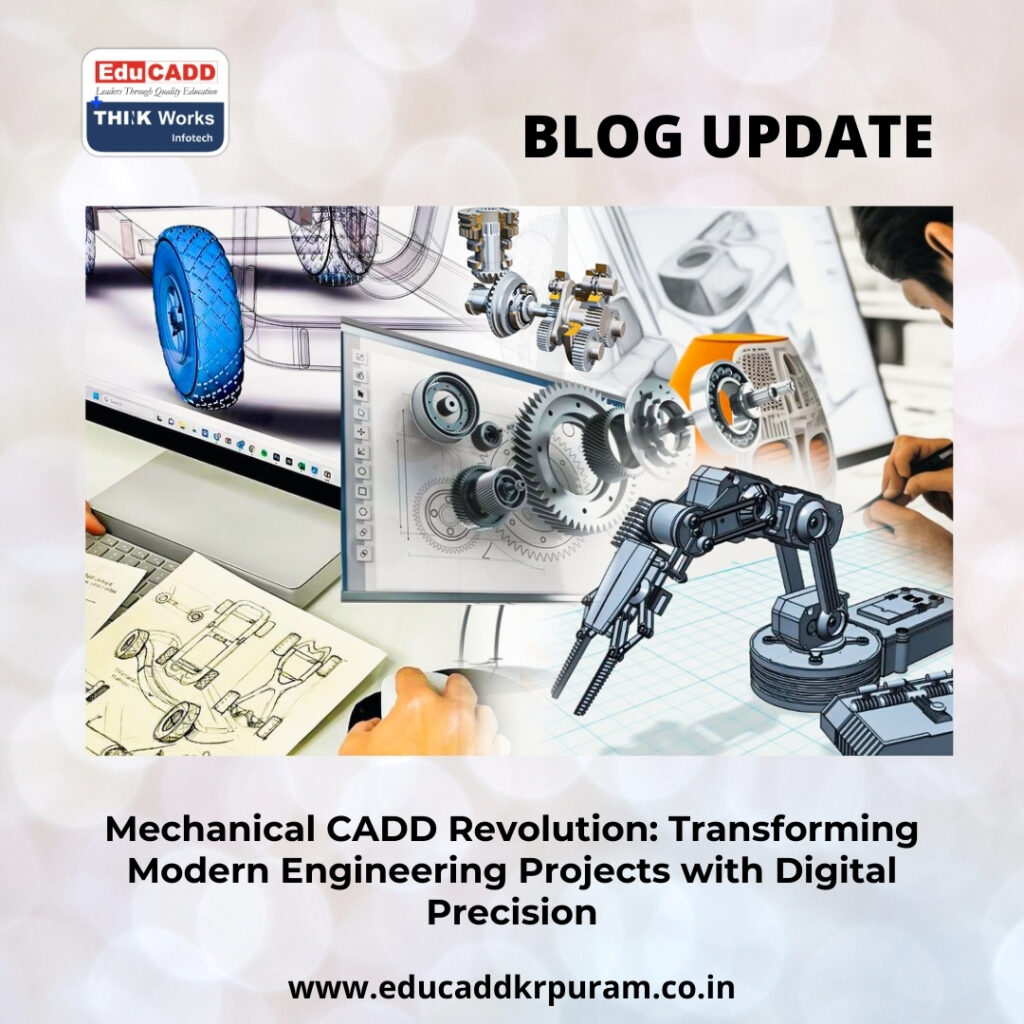
Mechanical CADD Digital Engineering
As industries embrace smart manufacturing and Industry 4.0 technologies, Mechanical CADD has become more than a design tool—it is the digital backbone of engineering innovation. From conceptual sketches to detailed simulations, Mechanical CADD supports every stage of modern engineering projects. In this blog, we explore the transformative role of Mechanical CADD, highlighting its impact on accuracy, productivity, collaboration, innovation, and the complete lifecycle of mechanical products.
Understanding Mechanical CADD in Depth
Mechanical CADD Digital Engineering is the application of specialized software to create digital representations of mechanical components and systems. Unlike traditional drafting methods, which are manual, time-consuming, and prone to human error, Mechanical CADD provides a structured digital environment for precision engineering. Engineers can produce both 2D technical drawings and 3D models, all derived from the same intelligent digital design file.
Through Mechanical CADD, engineers can define geometry, assign materials, specify mechanical properties, and simulate interactions between components. The digital model acts as a virtual prototype, allowing engineers to explore design possibilities without physical manufacturing. Furthermore, detailed documentation—such as bills of materials, assembly instructions, and technical specifications—can be generated automatically from the same model, streamlining the production workflow.
A key feature of Mechanical CADD is parametric modeling. Parametric relationships enable components to adapt automatically when design changes are introduced. This functionality ensures consistency and reduces manual corrections, enhancing both accuracy and efficiency. By leveraging these capabilities, engineers can complete complex mechanical designs faster and with greater confidence in their reliability.
Elevating Design Accuracy
Precision is the hallmark of quality engineering. Even minor deviations in dimensions or tolerances can lead to assembly failures, performance issues, or costly recalls. Mechanical CADD addresses these challenges by allowing engineers to define exact measurements, tolerances, and spatial relationships within a digital environment.
Digital models maintain dimensional integrity automatically. If a design parameter is modified, all related features update accordingly, ensuring consistent alignment across assemblies. This level of control is particularly critical in projects involving intricate mechanisms or large assemblies with multiple interdependent components.
Mechanical CADD also supports standardized drafting methods, enabling engineers to apply globally accepted engineering symbols, dimensioning conventions, and annotations. These standards facilitate clear communication with manufacturers, quality inspectors, and regulatory authorities, reducing the risk of errors and misinterpretations.
By enabling high-precision design, Mechanical CADD minimizes the likelihood of production errors, enhances product reliability, and establishes a solid foundation for complex engineering projects.
Streamlining Engineering Workflows
Time efficiency is a critical factor in modern engineering projects. Mechanical CADD accelerates the design process by automating repetitive tasks and providing extensive design libraries. Standard components such as fasteners, gears, and bearings can be inserted into a project instantly, reducing the need for repetitive manual design.
Parametric modeling further enhances workflow efficiency. Engineers can define interdependent design parameters, ensuring that modifications propagate automatically throughout the model. This approach allows for rapid exploration of multiple design alternatives and optimization without restarting the design process.
Automation in dimensioning, annotation, and documentation reduces manual drafting effort and frees engineers to focus on solving complex problems. Additionally, template-based workflows enable teams to reuse previous designs and adapt them to new projects, significantly reducing development time.
Through these capabilities, Mechanical CADD allows engineering teams to deliver high-quality designs more quickly while maintaining stringent accuracy standards.
Advanced 3D Modeling and Visualization
Mechanical CADD Digital Engineering has revolutionized visualization in engineering by enabling detailed 3D modeling. Unlike 2D technical drawings, which require engineers to mentally interpret complex geometries, 3D models provide interactive and realistic representations of mechanical systems.
Engineers can examine models from any angle, zoom into intricate details, and simulate the interaction of multiple components within an assembly. This ability to visualize designs in three dimensions allows early identification of potential design flaws such as interferences, misalignments, or inadequate clearances.
Exploded views further improve visualization by showing how individual components fit together and the assembly sequence. This clarity is invaluable for production teams, assembly technicians, and maintenance personnel. Additionally, 3D visualization facilitates communication with non-technical stakeholders, such as clients and investors, who may not easily interpret 2D drawings.
Through enhanced visualization capabilities, Mechanical CADD ensures that engineering projects are better understood, evaluated, and executed with confidence.
Integrating Simulation and Performance Analysis
Mechanical CADD extends beyond drafting and modeling by incorporating simulation tools that allow engineers to evaluate product performance digitally. Engineers can simulate mechanical stress, thermal effects, vibrations, and motion to ensure the design meets operational requirements.
Stress analysis helps determine whether components can withstand anticipated loads without failure. Motion simulation evaluates moving parts for smooth operation and interference avoidance, while thermal simulations predict material performance under varying temperature conditions.
These digital tests reduce reliance on physical prototypes, cutting costs and shortening development cycles. Engineers can iterate designs based on simulation feedback, ensuring optimized performance before production. This capability not only reduces errors but also encourages innovative solutions through rapid testing of multiple design scenarios.
Enhancing Collaboration Across Teams
Modern engineering projects involve diverse teams across multiple locations. Mechanical CADD supports collaboration by providing a shared digital environment where team members can access, review, and modify design files in real time.
Cloud-based platforms facilitate communication and coordination, allowing engineers, designers, and production teams to remain aligned. Version control ensures that every team member works with the latest model, preventing discrepancies and minimizing the risk of miscommunication.
Shared digital models also strengthen coordination between design and manufacturing. Production engineers can interpret design intent clearly and execute assembly processes accurately. This seamless collaboration helps projects maintain quality standards and adhere to deadlines.
Connecting Design and Manufacturing
Mechanical CADD Digital Engineering bridges the critical gap between design and manufacturing. Once the digital design is finalized, it serves as a blueprint for production processes. Computer-Aided Manufacturing (CAM) systems can utilize CADD models to generate precise machining instructions for CNC machines.
Detailed assembly drawings, part specifications, and documentation derived from CADD models guide production teams, ensuring that manufactured components match design specifications. This integration reduces errors, minimizes material waste, and optimizes production efficiency.
By linking digital design directly with manufacturing, Mechanical CADD accelerates the transition from concept to finished product while maintaining accuracy and quality control.
Minimizing Errors and Reducing Costs
Errors in design can be costly and disruptive. Mechanical CADD helps minimize these risks by detecting potential conflicts during the design stage. Automated validation tools identify issues such as overlapping components, incorrect tolerances, or missing dimensions.
Digital prototyping reduces the need for multiple physical iterations, saving time and material costs. Engineers can simulate different scenarios, analyze performance, and refine designs before any physical production occurs.
By mitigating risks early, Mechanical CADD enables organizations to maintain schedules, reduce costs, and ensure that projects meet performance and quality requirements.
Driving Innovation Through Digital Design
Mechanical CADD Digital Engineering fosters innovation by providing engineers with a flexible and experimental design environment. Parametric modeling and generative design allow for rapid testing of new concepts and optimized design solutions.
Generative design algorithms can suggest novel structures that minimize weight while maintaining strength, or enhance functionality within limited spatial constraints. Engineers can experiment with materials, geometries, and assembly methods digitally, exploring possibilities that would be difficult or impossible with manual drafting.
Through these capabilities, Mechanical CADD accelerates innovation and encourages creative problem-solving in modern engineering projects.
Integrating with Industry 4.0 and Smart Manufacturing
The rise of Industry 4.0 has transformed the industrial landscape through interconnected systems, automation, and data-driven decision-making. Mechanical CADD plays a crucial role in this ecosystem by providing digital models that integrate seamlessly with smart manufacturing technologies.
Digital twins—virtual representations of physical assets—can be created from CADD models. Engineers can monitor real-time performance, predict maintenance needs, and optimize operations using these digital twins. Additionally, CADD models can connect with Product Lifecycle Management (PLM) systems to track design, production, and maintenance information throughout the product’s lifecycle.
Mechanical CADD also facilitates additive manufacturing by enabling the creation of complex geometries that traditional manufacturing methods cannot easily produce. This integration ensures that modern manufacturing processes remain innovative, efficient, and scalable.
Ensuring Compliance with Engineering Standards
Regulatory compliance is a critical requirement in industries such as aerospace, automotive, and medical devices. Mechanical CADD helps engineers meet these standards by embedding drafting conventions, tolerance specifications, and documentation requirements within the software.
Engineers can produce standardized drawings that adhere to global guidelines, reducing the likelihood of non-compliance. Accurate digital records also support audits, certification processes, and quality inspections, ensuring that products meet legal and safety standards.
By facilitating adherence to standards, Mechanical CADD helps organizations mitigate regulatory risks while maintaining high-quality engineering practices.
Supporting the Complete Product Lifecycle
Mechanical CADD is not limited to the design phase; it contributes to the entire product lifecycle. Digital models serve as comprehensive references for future modifications, maintenance, or redesigns.
Maintenance teams benefit from detailed technical documentation, which allows for accurate and efficient servicing of equipment. Engineers can revisit original designs to implement updates or improvements while ensuring continuity and consistency.
Over time, organizations accumulate extensive digital design libraries that support knowledge management, process improvement, and the development of next-generation products. Mechanical CADD thus plays a pivotal role in sustaining long-term engineering excellence.
Expanding Career Opportunities in Engineering
The widespread adoption of Mechanical CADD has created significant career opportunities for professionals in engineering and design. Expertise in CADD tools is highly sought after across industries such as aerospace, automotive, heavy machinery, robotics, and energy.
Specialized skills in 3D modeling, simulation, parametric design, and digital documentation are increasingly becoming prerequisites for mechanical engineering roles. Educational institutions and training programs now emphasize CADD proficiency to prepare students for these industry demands.
As engineering organizations continue to embrace digital workflows, professionals skilled in Mechanical CADD will remain in high demand, offering strong career prospects and opportunities for advancement.
Conclusion
Mechanical CADD Digital Engineering has revolutionized modern engineering by transforming traditional drafting into a fully digital, integrated, and highly precise workflow. From conceptual sketches to detailed 3D models, simulation, production integration, and lifecycle management, Mechanical CADD supports every phase of modern mechanical design.
By enhancing accuracy, improving productivity, enabling collaboration, and fostering innovation, Mechanical CADD allows engineering teams to develop complex systems efficiently and reliably. Its integration with Industry 4.0, digital twin technologies, and advanced manufacturing processes ensures that organizations remain competitive in a rapidly evolving industrial landscape.
In essence, Mechanical CADD is more than a tool; it is the foundation of modern engineering innovation. Companies that embrace its capabilities can deliver high-quality mechanical products, reduce development costs, and accelerate project timelines while empowering engineers to explore creative, cutting-edge design solutions.

