
Digital Precision Unlocked: How 3D Scanning to CAD is Reshaping Modern Engineering
Industries across the world are rapidly moving toward digital transformation, and engineering technologies are evolving faster than ever before. Companies now demand greater precision, quicker product development cycles, and smarter manufacturing methods to stay competitive in the global market. In this changing industrial environment, the 3D Scanning CAD Engineering has emerged as one of the most advanced and efficient engineering solutions available today.
This workflow allows professionals to capture physical objects digitally and convert them into highly accurate CAD models for design, manufacturing, inspection, and product development purposes. Instead of relying on traditional measurement techniques, engineers now use sophisticated scanning systems to collect precise surface data within minutes. As a result, businesses reduce manual errors, improve productivity, and accelerate innovation.
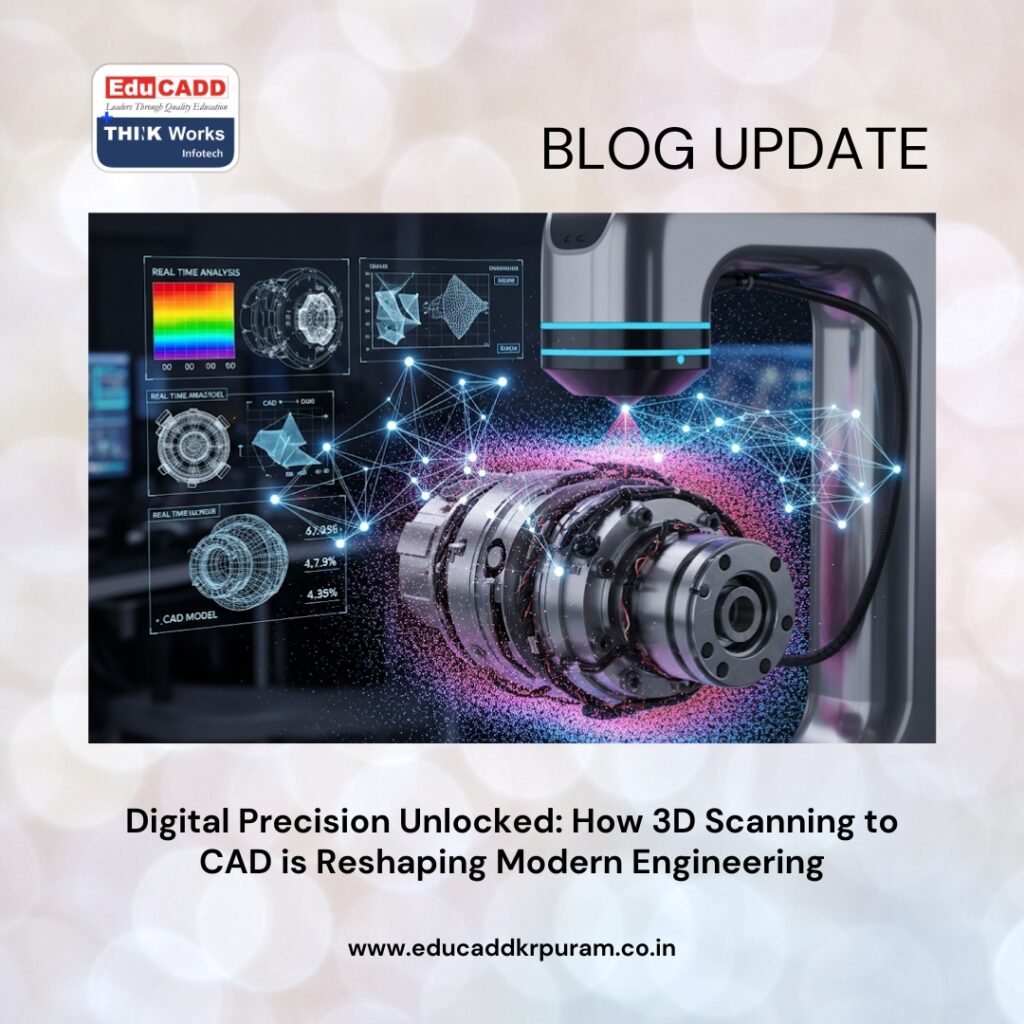
3D Scanning CAD Engineering
Moreover, industries such as automotive, aerospace, healthcare, architecture, and industrial manufacturing increasingly depend on digital modeling technologies to simplify complex engineering tasks. The integration of 3D Scanning CAD Engineering has completely transformed the way companies design, analyze, and recreate products. Because of its speed and reliability, this technology continues gaining importance across modern engineering sectors worldwide.
Understanding the Fundamentals of 3D Scanning
3D scanning is a digital process used to capture the exact shape and dimensions of physical objects. Specialized scanners collect millions of surface points from an object and create a detailed digital dataset known as a point cloud. This information represents the geometry of the object with extremely high accuracy.
Traditional measurement methods often require extensive manual effort and consume valuable time. However, 3D scanning technology simplifies the process by collecting detailed information automatically and efficiently. Engineers can now scan complex shapes, curved surfaces, and intricate components that are difficult to measure manually.
Different scanning technologies are available for different industrial applications. Laser scanners provide excellent precision for engineering projects, while structured light scanners work efficiently for medium-sized objects and product inspection tasks. Photogrammetry systems use photographs to generate digital models and are widely used in architecture and large-scale infrastructure projects.
Additionally, modern scanners are more portable and user-friendly than older systems. Handheld scanners allow technicians to move freely around objects, improving flexibility during data capture. Because of these advancements, industries continue adopting scanning technologies at a rapid pace.
The Growing Importance of CAD in Industrial Design
Computer-Aided Design, commonly known as CAD, plays a major role in modern engineering and manufacturing processes. CAD software enables professionals to create accurate digital models, technical drawings, assemblies, and simulations for a wide range of industrial applications.
Before CAD systems became popular, engineers relied heavily on manual drafting methods that required significant effort and time. Today, digital design tools allow instant modifications, better visualization, and improved engineering accuracy. Consequently, product development processes have become much faster and more efficient.
When CAD software combines with 3D scanning technology, engineers can create intelligent digital models directly from real-world objects. This integration simplifies reverse engineering, redesign, prototyping, and quality inspection tasks significantly.
Several industries rely on advanced CAD software platforms to manage engineering operations effectively. Automotive manufacturers use CAD for vehicle development, aerospace companies use it for aircraft design, and construction firms depend on it for building modeling and infrastructure planning.
As industries continue shifting toward automation and smart manufacturing, CAD systems remain essential for digital engineering success.
Why the 3D Scanning CAD Engineering Workflow Matters
The 3D scanning to CAD workflow bridges the gap between physical products and digital engineering environments. It enables companies to recreate existing objects digitally with remarkable precision and efficiency.
One of the biggest reasons industries use this workflow is reverse engineering. Many companies possess old machinery or components without original design documentation. Instead of redesigning parts manually, engineers scan the physical object and generate accurate CAD models for modernization or replacement.
Additionally, this workflow supports faster product development and innovation. Designers can analyze scanned models, identify weaknesses, and improve existing products with greater confidence. Because engineers work with accurate digital data, they reduce design errors and improve manufacturing quality.
Collaboration also becomes easier through digital workflows. Teams located in different regions can access the same CAD files instantly and contribute to projects without delays. Consequently, organizations improve communication and streamline engineering operations.
As global industries continue prioritizing digital transformation, the importance of reliable scanning-to-CAD workflows continues growing steadily.
Preparing Components for Accurate Scanning
Successful scanning begins with proper preparation. Before technicians start scanning, they carefully inspect the object to identify challenges that may affect scanning accuracy. Reflective surfaces, transparent materials, and dark finishes can interfere with scanner performance and produce incomplete data.
To improve scan quality, operators often apply temporary matte sprays to reflective surfaces. These coatings help diffuse light evenly and allow scanners to capture accurate surface details. In some cases, technicians place reference markers on large or complex objects to improve alignment during data collection.
Environmental conditions also influence the scanning process significantly. Stable lighting conditions and vibration-free surroundings help maintain consistent scanning accuracy. Furthermore, technicians position objects carefully to minimize hidden areas and scanning blind spots.
Object preparation usually includes:
- Cleaning surfaces thoroughly
- Positioning components correctly
- Applying scanning markers when necessary
- Removing unnecessary obstacles around the object
Although preparation may seem simple, it directly affects the quality of the final digital model and overall workflow efficiency.
Capturing Physical Data Through Advanced Scanning Systems
Once preparation is complete, the actual scanning process begins. During this stage, the scanner captures detailed geometric information from the object’s surface from multiple angles.
Modern scanning systems collect millions of measurement points within a short period. Operators move the scanner carefully around the object to ensure complete coverage and accurate data capture. Real-time software displays help technicians identify missing areas immediately, allowing them to perform additional scans if necessary.
Handheld scanners provide flexibility for scanning large or complex objects, while stationary scanners offer exceptional precision for industrial inspection applications. Depending on project requirements, professionals select the most suitable scanning technology.
The quality of the scanned data plays a critical role in the success of the CAD conversion process. Therefore, operators monitor alignment, positioning, and scanning speed carefully throughout the operation.
Furthermore, modern scanning systems now support faster processing speeds and improved portability. As a result, industries can complete large-scale scanning projects more efficiently than ever before.
Processing and Optimizing Scan Data
Raw scan data often contains unnecessary points, alignment issues, and digital noise that must be cleaned before CAD conversion begins. Therefore, engineers use specialized software to process and optimize the scanned information.
The first step involves aligning multiple scans into a single unified dataset. Technicians remove duplicate points, repair missing sections, and improve surface consistency to create a cleaner digital model.
Software tools then convert point cloud data into polygon meshes that visually represent the object’s surface more accurately. Mesh generation improves visualization and simplifies further modeling processes.
Quality verification is another important part of data processing. Engineers inspect the processed model carefully to ensure dimensional accuracy and eliminate inconsistencies that could affect manufacturing operations later.
Additionally, advanced software systems now include automation features that speed up processing activities significantly. However, skilled professionals still play an important role in maintaining model accuracy and engineering reliability.
Efficient data optimization ensures smooth CAD conversion and improves the quality of the final engineering model.
Converting Scanned Information into Intelligent CAD Models
The next stage involves transforming processed scan data into editable CAD geometry. Engineers use reverse engineering software to rebuild surfaces, curves, and solid features based on the scanned object.
This process requires both technical expertise and engineering knowledge because scanned data may contain irregular shapes and highly detailed surfaces. Engineers identify important geometric features such as cylinders, planes, edges, and holes before recreating them using CAD tools.
The goal is not only to create a visual representation but also to develop a fully editable engineering model suitable for manufacturing and analysis purposes. Therefore, professionals focus on generating clean and organized geometry throughout the process.
Modern reverse engineering software now includes advanced feature recognition capabilities that simplify certain modeling tasks. Nevertheless, manual adjustments remain necessary for highly complex components.
After model creation, engineers compare the CAD geometry with the original scanned data to verify dimensional accuracy. This validation process ensures the digital model accurately matches the physical object.
Reverse Engineering and Legacy Product Recreation
Reverse engineering remains one of the most valuable applications of the 3D scanning to CAD workflow. Many industries rely on this process to recreate old or damaged components without original design files.
Manufacturing companies frequently scan worn machine parts to produce replacements quickly and accurately. Automotive restoration firms also depend heavily on scanning technologies to recreate vintage vehicle components that are no longer available commercially.
Aerospace organizations use reverse engineering for aircraft maintenance and component modernization projects. Since aerospace parts require exceptional precision, scanning systems provide reliable digital accuracy for critical engineering tasks.
Additionally, product developers analyze competitor products using reverse engineering techniques to improve innovation and performance. Engineers can study structural details, manufacturing methods, and design efficiencies more effectively through digital models.
Because reverse engineering saves both time and operational costs, it continues becoming increasingly important across industrial sectors worldwide.
Improving Quality Inspection and Product Accuracy
Modern industries require extremely high manufacturing standards, and 3D scanning technology has become an essential tool for quality inspection. Companies use scanning systems to compare manufactured components against original CAD models and detect dimensional deviations instantly.
Traditional inspection methods often involve manual tools that consume significant time and may not capture complex geometries accurately. In contrast, 3D scanning provides fast and comprehensive inspection capabilities.
Inspection software generates color deviation maps that visually display differences between the scanned product and the original CAD design. Engineers can quickly identify defects, misalignments, or production inconsistencies before products reach customers.
Industries such as medical device manufacturing, aerospace engineering, and automotive production rely heavily on accurate inspection processes. Therefore, advanced scanning technologies help maintain strict quality standards and regulatory compliance.
Additionally, accurate inspection minimizes material waste, reduces product recalls, and improves customer satisfaction significantly.
Key Advantages of the 3D Scanning CAD Engineering Workflow
The popularity of the scanning-to-CAD process continues growing because of the numerous advantages it offers modern industries. One major benefit is speed. Scanners capture detailed geometry far more quickly than traditional manual measurement methods.
Another important advantage involves precision. Modern scanning systems collect highly accurate data that supports reliable CAD modeling and manufacturing operations.
The workflow also improves productivity by simplifying design modifications and enabling faster collaboration between engineering teams. Digital files can be shared instantly across departments and project locations.
Major workflow advantages include:
- Faster product development cycles
- Improved dimensional accuracy
- Reduced engineering errors
- Better digital documentation and storage
Furthermore, organizations can archive digital models for future redesign, maintenance, or inspection purposes. This capability supports efficient product lifecycle management and long-term operational planning.
As industries continue investing in automation and smart factories, the demand for accurate digital workflows continues increasing globally.
Challenges Associated with Scanning and CAD Conversion
Despite its many benefits, the 3D Scanning CAD Engineering workflow also presents several technical challenges. Reflective, transparent, and dark surfaces remain difficult to scan accurately because they affect light reflection and sensor performance.
Large scan datasets also require powerful computers and advanced processing software. High-resolution scans can generate massive files that demand significant computing resources for smooth operation.
Another challenge involves converting highly organic or irregular surfaces into clean CAD geometry. Although software automation continues improving, experienced engineers still play an essential role in refining complex models manually.
Cost may also become a concern for smaller organizations. Industrial-grade scanners and professional reverse engineering software often require substantial investment. However, businesses usually recover these costs through improved efficiency and reduced production errors.
Training and technical expertise remain equally important. Professionals must understand scanning principles, data processing techniques, and CAD modeling practices to achieve successful project outcomes.
Industries Benefiting from Scanning and CAD Integration
A wide range of industries now benefit from scanning and CAD technologies. Automotive companies use scanning systems for product design, customization, restoration, and quality inspection applications.
Aerospace manufacturers rely on scanning for aircraft inspection, maintenance, and reverse engineering tasks. Because aerospace components require exceptional precision, digital scanning provides reliable engineering accuracy.
The healthcare industry also benefits significantly from these technologies. Medical professionals use scanning systems to create customized prosthetics, dental structures, and patient-specific implants.
Architecture and construction companies scan buildings and infrastructure for renovation, restoration, and digital documentation projects. Industrial manufacturers also use scanning technologies for tooling, mold development, and machine optimization activities.
As digital transformation expands worldwide, additional industries continue adopting scanning-to-CAD workflows to improve productivity and innovation.
Future Trends Shaping the 3D Scanning Industry
The future of 3D scanning and CAD integration appears highly promising. Artificial intelligence and machine learning technologies are improving automatic feature recognition and scan processing capabilities rapidly.
Cloud-based collaboration systems now allow engineers to share large datasets globally and work together remotely more efficiently. Consequently, international engineering projects have become easier to manage.
Real-time scanning and automated CAD generation technologies are also advancing quickly. These innovations reduce manual intervention and accelerate product development processes significantly.
Additionally, virtual reality and augmented reality integration will create more immersive engineering experiences. Designers may soon interact with digital models directly within virtual environments for inspection and analysis purposes.
As Industry 4.0 continues evolving, digital twins, smart factories, and automated inspection systems will increasingly depend on accurate scanning technologies. Therefore, professionals skilled in scanning and CAD workflows will remain highly valuable in the future engineering landscape.
Conclusion
The 3D Scanning CAD Engineering workflow has revolutionized modern engineering by enabling industries to transform physical objects into intelligent digital models quickly and accurately. This advanced process supports reverse engineering, quality inspection, product redesign, manufacturing, and countless other industrial applications.
By combining accurate scanning systems with powerful CAD software, companies achieve faster development cycles, improved engineering precision, and better operational efficiency. Furthermore, digital workflows simplify collaboration, reduce production errors, and support smarter manufacturing practices.
Although certain technical challenges still exist, continuous advancements in scanning hardware, software automation, and artificial intelligence continue improving workflow capabilities every year. As industries move toward smarter and more connected production environments, the demand for digital engineering expertise will continue growing rapidly.
Professionals who understand the 3D scanning to CAD process gain valuable skills that are increasingly important across multiple industries. Therefore, mastering this technology not only improves engineering performance but also prepares businesses and individuals for the future of digital manufacturing and industrial innovation.

