
Building Failure-Free Products: The Powerful Role of Stress Analysis in Modern Engineering
In today’s competitive industrial landscape, product quality and reliability are more important than ever before. Customers expect every product to perform efficiently, last longer, and remain safe under different working conditions. Whether it is an automotive component, aerospace structure, industrial machine, medical device, or consumer product, every engineered system faces various forces during operation. If a product cannot handle those forces effectively, it may crack, deform, or fail completely. Such failures not only increase operational costs but also damage a company’s reputation and customer trust. Stress Analysis Engineering Products helps engineers understand how a product behaves when exposed to pressure, vibration, heat, tension, or repeated loading conditions.
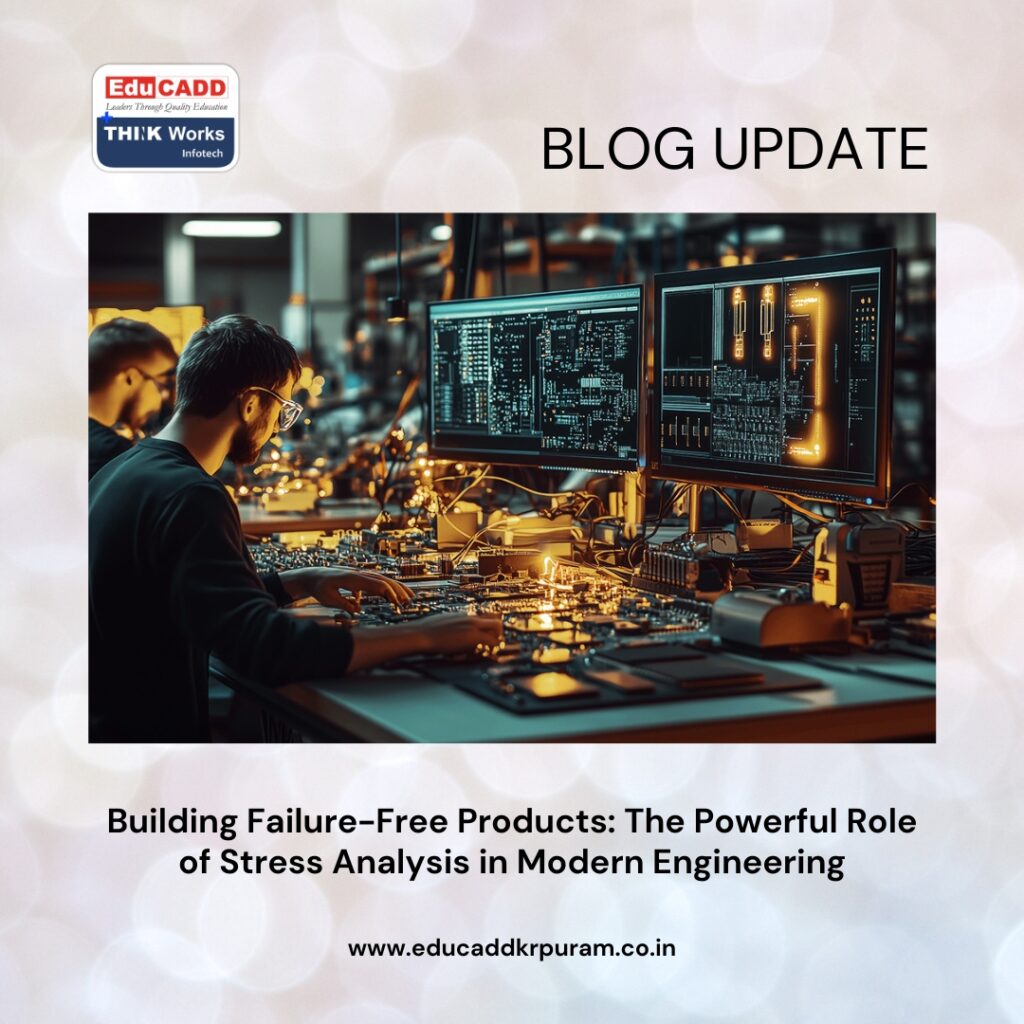
Stress Analysis Engineering Products
To avoid these challenges, industries rely heavily on stress analysis during product development. It allows manufacturers to identify structural weaknesses before production begins and improve the overall strength of a design. Modern engineering companies now use advanced simulation tools to perform accurate stress analysis and develop safer, stronger, and more durable products. As technology continues to evolve, stress analysis has become an essential process for ensuring product performance, safety, and long-term reliability.
Understanding Stress Analysis Engineering Products Design
Stress analysis is a detailed engineering method used to evaluate how materials and structures respond to external forces. Every product experiences some level of stress during operation, and engineers must ensure that these stresses remain within safe limits. If stress exceeds the material’s strength capacity, the product may fail unexpectedly.
During stress analysis, engineers examine stress distribution, deformation levels, strain patterns, and structural behavior under different loading conditions. This process provides valuable insights into how a component performs in real-world applications. Engineers can then modify the design to eliminate weak points and improve overall durability.
Modern engineering projects often involve complex geometries and demanding operational requirements. Therefore, stress analysis has become a critical part of product design and development. It helps industries build reliable products while reducing design risks and manufacturing errors.
Why Product Failures Create Serious Problems for Industries
Product failure can lead to severe consequences for both businesses and consumers. When a product breaks unexpectedly, companies may face warranty claims, financial losses, customer dissatisfaction, and legal complications. In industries such as aerospace and healthcare, product failures can even put human lives at risk.
Many product failures occur because structural weaknesses remain undetected during the design phase. Poor load calculations, improper material selection, and inadequate testing often contribute to these failures. Without proper stress analysis, manufacturers may release unsafe or unreliable products into the market.
Some common effects of product failures include:
- Increased maintenance and repair expenses
- Loss of customer confidence and brand reputation
By using stress analysis early in product development, companies can identify these risks before manufacturing begins. This proactive approach helps businesses avoid costly failures and maintain high-quality standards.
The Growing Need for Reliable Engineering Solutions
Modern industries are constantly pushing the boundaries of innovation. Manufacturers aim to create lightweight, high-performance, and energy-efficient products without compromising safety or durability. However, achieving these goals requires highly accurate engineering analysis and precise design optimization.
Stress analysis plays an important role in helping engineers develop reliable solutions for modern challenges. It allows them to evaluate multiple design concepts digitally and determine which structure offers the best performance. As a result, businesses can improve product quality while reducing development time.
Additionally, global competition has increased the demand for faster product launches. Companies can no longer afford lengthy trial-and-error processes. Stress analysis helps accelerate development cycles by enabling engineers to test product performance virtually before physical production begins.
Different Types of Stress That Affect Product Performance
Products experience different forms of stress depending on their operating environment and application. Each type of stress affects materials differently, making it essential for engineers to understand these conditions thoroughly.
Tensile stress occurs when forces attempt to pull a material apart. Compressive stress develops when forces squeeze or compress a structure. Shear stress appears when parallel forces act in opposite directions, causing layers to slide relative to one another. Torsional stress results from twisting actions that create rotational force inside a component.
Thermal stress is another major concern in engineering applications. Temperature changes cause materials to expand and contract, generating internal stress that may lead to distortion or cracking. Furthermore, fatigue stress develops due to repeated loading cycles over time. Even low stress levels can eventually weaken materials if the loading continues repeatedly.
Understanding these stress conditions helps engineers design products capable of performing safely under demanding operational environments.
How Finite Element Analysis Improves Product Design
Finite Element Analysis, widely known as FEA, has revolutionized the field of engineering stress analysis. Traditional testing methods relied heavily on physical prototypes and experimental evaluations, which consumed significant time and resources. FEA introduced a faster and more efficient digital alternative.
Using FEA software, engineers create virtual models of products and simulate real-world operating conditions. The software divides structures into smaller elements and calculates stress, strain, and deformation throughout the design. This detailed analysis helps identify critical failure zones with exceptional accuracy.
Finite Element Analysis offers several major benefits:
- Reduces prototype development and testing costs
- Enhances design accuracy and engineering efficiency
Because of these advantages, industries across the world use FEA extensively to improve product performance, optimize structures, and minimize manufacturing risks.
Material Selection and Structural Strength Optimization
Choosing the right material is essential for developing durable and reliable products. Even a well-designed component can fail if the material cannot withstand operational stresses. Therefore, material selection and stress analysis work closely together during product development.
Different materials possess unique mechanical properties such as strength, elasticity, hardness, ductility, and thermal resistance. Engineers must evaluate these characteristics carefully before selecting materials for specific applications. For example, aerospace industries require lightweight materials with high strength-to-weight ratios, while industrial machinery often demands wear-resistant alloys.
Stress analysis enables engineers to compare how different materials behave under varying loads and environmental conditions. This process helps manufacturers select materials that provide the best balance between safety, performance, and cost efficiency.
The Importance of Stress Analysis for Product Safety
Safety remains one of the most critical priorities in modern engineering. Products that fail during operation can cause injuries, operational shutdowns, and significant financial damage. Consequently, companies must ensure that every component meets strict safety standards before entering the market.
Stress analysis helps engineers verify whether products can withstand expected loads and extreme conditions safely. By identifying structural weaknesses during the design phase, companies can eliminate risks before production begins. This process significantly improves product reliability and operational safety.
Industries such as automotive manufacturing, aviation, construction, and medical equipment production rely heavily on stress analysis to meet regulatory requirements. Engineering simulations provide the technical data necessary to demonstrate structural integrity and compliance with safety standards.
Reducing Manufacturing Costs Through Early Analysis
One of the biggest advantages of stress analysis is its ability to reduce overall manufacturing costs. Detecting structural problems during the early design stage prevents expensive corrections later in production. Businesses therefore save time, materials, and engineering resources.
When failures are discovered after manufacturing begins, companies often face redesign expenses, production delays, and material waste. However, stress analysis enables engineers to identify and resolve these issues before tooling and fabrication start. This proactive strategy improves project efficiency significantly.
Optimized product designs also help reduce unnecessary material usage while maintaining required strength levels. As a result, manufacturers lower production expenses and improve sustainability by minimizing waste and energy consumption.
Fatigue Analysis for Long-Term Product Durability
Many engineering products fail not because of sudden overloads but due to repeated stress cycles over time. This type of damage is known as fatigue failure, and it is one of the most common causes of structural breakdown in industrial systems.
Components such as engine parts, rotating shafts, turbines, aircraft structures, and bridges experience continuous cyclic loading during operation. Small microscopic cracks may form gradually and expand over time until complete failure occurs. Fatigue analysis helps engineers predict these failures and improve product lifespan.
By studying stress cycles, loading frequencies, and material endurance limits, engineers can design products that resist fatigue damage effectively. This approach improves long-term reliability, reduces maintenance costs, and increases customer satisfaction.
Thermal Stress Analysis in High-Temperature Applications
Many industrial products operate under extreme temperature conditions, making thermal stress analysis highly important. Components exposed to heat often experience expansion and contraction, which creates internal stress within the material.
If thermal stress becomes excessive, products may warp, crack, or lose structural stability. Industries such as aerospace, power generation, automotive engineering, and electronics manufacturing frequently encounter these challenges.
Engineers use thermal stress analysis to study heat transfer, temperature distribution, and expansion behavior within a product. This information helps improve cooling systems, optimize material selection, and enhance structural design. Consequently, products maintain reliable performance even in harsh thermal environments.
Advanced Simulation Technologies in Modern Engineering
Engineering simulation technology has advanced significantly in recent years. Modern stress analysis software provides highly accurate predictions that help engineers make better design decisions and improve overall product quality.
Simulation tools allow engineers to visualize stress concentration zones, deformation patterns, and potential failure areas in three-dimensional models. These visual insights improve understanding and enable faster design optimization.
Additionally, simulation technology supports innovation by allowing engineers to evaluate multiple design variations quickly. Instead of producing numerous physical prototypes, companies can test several concepts digitally and finalize the best solution efficiently. This flexibility reduces development costs and accelerates product innovation.
Industries That Depend on Stress Analysis
Stress analysis plays a critical role across a wide range of industries. Any sector that develops structural or mechanical products relies on engineering simulations to ensure safety, durability, and performance.
The automotive industry uses stress analysis to improve crash safety, vehicle strength, and fuel efficiency. Aerospace companies apply it to develop lightweight aircraft structures capable of handling extreme flight conditions. Construction industries use stress analysis to ensure building stability and infrastructure reliability.
Medical device manufacturers also depend heavily on stress analysis. Orthopedic implants, surgical instruments, and healthcare equipment must withstand repeated loading conditions safely. Therefore, engineering simulation has become essential across modern industrial sectors.
Future Trends in Stress Analysis and Engineering Innovation
The future of stress analysis looks increasingly advanced as new technologies continue transforming engineering practices. Artificial intelligence, cloud computing, and machine learning are making simulations faster, smarter, and more accurate than ever before.
Digital twin technology is another major advancement shaping the future of engineering analysis. Engineers create virtual replicas of physical products and monitor their real-time performance using operational data. This approach helps predict failures before they occur and improves maintenance planning.
Automation is also making advanced simulation tools more accessible to industries worldwide. As software becomes more user-friendly and intelligent, businesses can perform detailed stress analysis with greater speed and confidence. These innovations will continue driving safer and more efficient product development in the coming years.
Conclusion
Stress Analysis Engineering Products has become one of the most essential engineering practices for preventing product failures and improving structural reliability. By evaluating how products respond to forces, temperature changes, and repeated loading conditions, engineers can identify weaknesses before manufacturing begins. This proactive strategy enhances product safety, reduces operational risks, and improves overall quality.
Modern technologies such as Finite Element Analysis and advanced simulation software have transformed the product development process. Industries worldwide now rely on stress analysis to create lightweight, durable, and high-performance products that meet customer expectations and safety regulations.
As engineering innovation continues to evolve, stress analysis will remain a cornerstone of reliable product development. Companies that invest in advanced analysis techniques and engineering simulation technologies will gain a strong competitive advantage while delivering safer, stronger, and more efficient products for the future.

