
Turning Real-World Objects into Digital Engineering Assets: The Complete Journey from 3D Scans to CAD Models
The engineering and manufacturing sectors have undergone a remarkable transformation over the last decade. Organizations now rely heavily on digital technologies to improve accuracy, reduce development time, and enhance product quality. Among these innovations, the process of creating 3D Scan to CAD data has emerged as one of the most valuable advancements. It allows engineers and designers to capture physical objects with exceptional precision and convert them into editable digital models that can be used for design, analysis, manufacturing, and quality control.
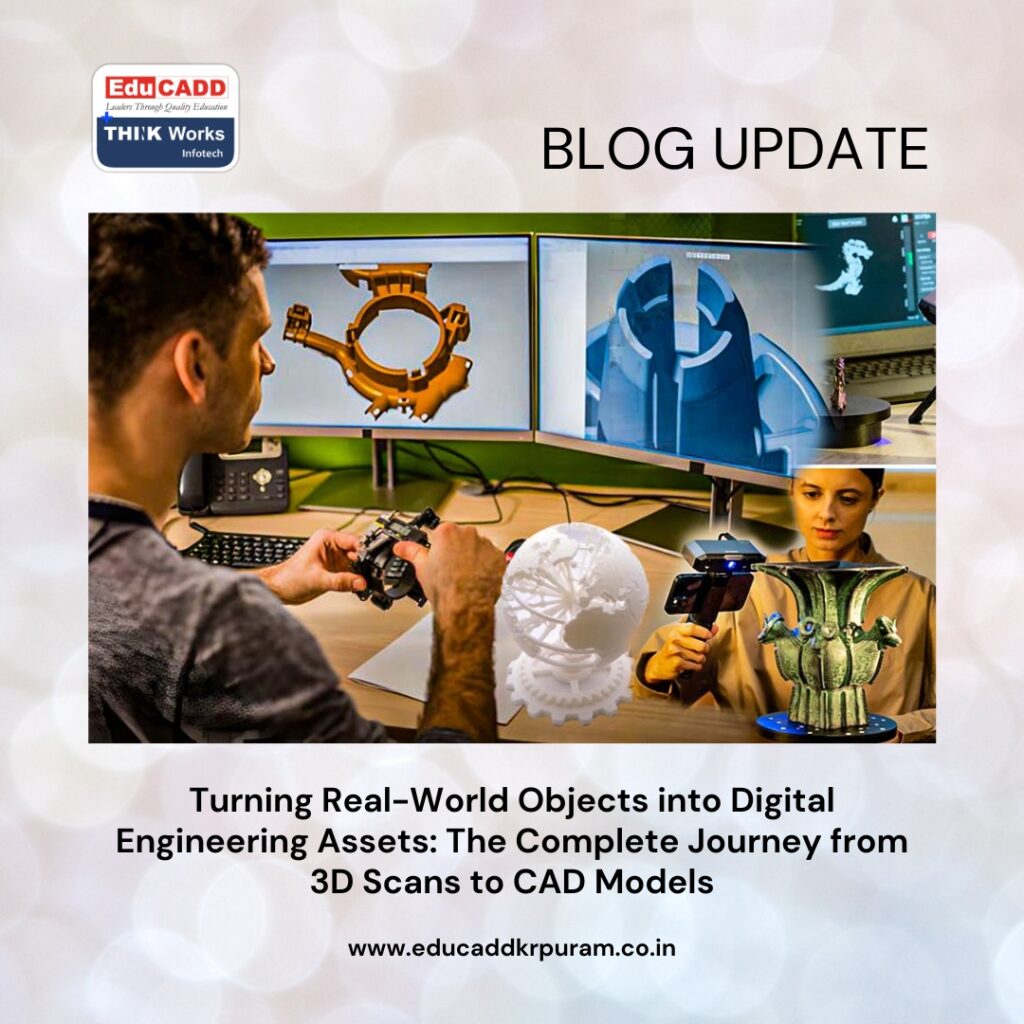
3D Scan to CAD
As industries move toward automation, smart manufacturing, and digital transformation, the demand for accurate digital representations of physical assets continues to grow. Traditional measurement techniques often require extensive manual effort and may fail to capture complex geometries efficiently. In contrast, 3D scanning technologies can collect millions of data points within a short period, creating a highly detailed representation of an object. However, scan data alone is not enough for engineering applications. The information must be transformed into a CAD model that supports editing, simulation, and manufacturing operations. This process bridges the gap between the physical and digital worlds, enabling businesses to innovate faster and operate more efficiently.
Understanding the Basics of 3D Scan to CAD Modeling
Before exploring the conversion process, it is important to understand the fundamental difference between 3D scan data and CAD models. A 3D scanner captures the shape and dimensions of an object by collecting spatial measurements across its surface. These measurements are stored as a point cloud, which consists of millions of individual points positioned in three-dimensional space.
While point clouds accurately represent physical geometry, they lack the intelligence required for engineering tasks. CAD models, on the other hand, are built using geometric features, dimensions, constraints, and relationships that make them editable and functional. Engineers use CAD software to modify designs, perform simulations, create manufacturing drawings, and optimize products. Therefore, converting scan data into a CAD model is not simply a matter of changing file formats. It involves reconstructing meaningful geometry from raw measurement data to create an intelligent digital representation that supports engineering workflows.
Why Modern Industries Depend on Scan-to-CAD Workflows
Organizations across various sectors have embraced scan-to-CAD technology because it delivers significant advantages in terms of efficiency, accuracy, and cost savings. Many industries work with complex products, aging equipment, and custom-built components that require precise documentation and digital records. In such cases, scanning and CAD reconstruction provide an effective solution.
Manufacturers frequently use scan-based modeling to reproduce obsolete parts for which original drawings no longer exist. Automotive companies apply the technology to redesign components and improve vehicle performance. Aerospace organizations depend on accurate digital models for maintenance and engineering upgrades. Architecture and construction firms utilize scanning to document existing structures and create renovation plans. As a result, scan-to-CAD workflows have become essential tools for organizations seeking to improve productivity while maintaining high-quality standards.
Capturing Accurate Geometry Through Advanced 3D Scanning
The success of any CAD reconstruction project begins with accurate data acquisition. The quality of the scan directly influences the quality of the final model. Therefore, selecting the appropriate scanning technology is a critical decision. Different applications require different scanning methods based on object size, complexity, and desired accuracy.
Laser scanners are commonly used for large industrial environments and infrastructure projects. Structured-light scanners provide exceptional detail for smaller mechanical components. Photogrammetry systems offer flexibility when capturing large objects or difficult environments. During the scanning process, operators must ensure complete coverage of the object’s surface. Proper positioning, environmental conditions, and scanning techniques help minimize errors and improve overall data quality. When accurate scan data is collected from the beginning, the entire modeling workflow becomes more efficient and reliable.
Preparing Point Cloud Data for Engineering Applications
Once scanning is complete, the raw point cloud typically requires significant preparation before CAD modeling can begin. Raw datasets often contain noise, overlapping information, unwanted background elements, and minor distortions. If these issues are not addressed, they can negatively affect the reconstruction process.
Engineers use specialized software to clean and organize the data. Noise reduction techniques remove irrelevant points, while alignment tools merge multiple scans into a single coordinate system. Data optimization processes improve software performance without sacrificing important details. Additionally, technicians verify that critical features have been captured accurately and completely. This preparation stage creates a strong foundation for the next steps in the workflow and helps ensure that the resulting CAD model accurately reflects the physical object.
Building Polygon Meshes from Point Cloud Information
After cleaning and organizing the point cloud, engineers convert the data into a polygon mesh. A mesh consists of interconnected triangles that create a continuous representation of the object’s surface. This step transforms scattered measurement points into a recognizable shape that can be analyzed and reconstructed.
The mesh generation process requires careful attention because imperfections can affect the quality of the final CAD model. Engineers inspect the mesh for gaps, holes, overlapping surfaces, and irregular geometry. Repair tools help eliminate these issues and create a smooth, accurate representation of the scanned object. Once refined, the mesh serves as a visual and geometric reference for extracting design features and reconstructing engineering geometry. This stage plays a vital role in bridging the gap between raw scan data and intelligent CAD models.
Reverse Engineering Legacy Components and Products
One of the most valuable uses of scan-to-CAD technology is reverse engineering. Many companies operate equipment that has been in service for decades. In numerous cases, original engineering drawings and digital design files are unavailable. When replacement parts are needed, organizations often face significant challenges.
By scanning an existing component, engineers can capture its geometry and reconstruct it within CAD software. This process allows businesses to manufacture replacement parts, improve designs, and maintain critical equipment without relying on outdated documentation. Reverse engineering also supports product improvement initiatives by enabling engineers to study existing designs and identify opportunities for optimization. Consequently, organizations can reduce downtime, extend equipment life, and preserve valuable engineering knowledge.
Creating Parametric CAD Models for Design Flexibility
A major objective of CAD reconstruction is the creation of parametric models. Unlike static meshes and point clouds, parametric CAD models contain editable features and dimensions that allow engineers to make modifications quickly and efficiently.
Some major advantages of parametric CAD models include:
- Simplified design modifications and updates.
- Faster generation of technical drawings and documentation.
Parametric models also support advanced engineering activities such as finite element analysis, motion simulation, and manufacturing planning. Designers can adjust dimensions, modify features, and test alternative configurations without rebuilding the entire model. This flexibility makes parametric CAD models significantly more valuable than simple geometric representations and supports long-term product development goals.
Software Technologies That Power Scan-to-CAD Conversion
The growing popularity of scan-to-CAD workflows has driven the development of sophisticated software solutions. These tools help engineers process scan data, reconstruct surfaces, extract features, and validate model accuracy. Modern software platforms combine automation with advanced engineering capabilities to streamline the reconstruction process.
Popular solutions include Geomagic Design X, SolidWorks, CATIA, Autodesk Inventor, Siemens NX, and Fusion 360. Many of these platforms feature automated feature recognition that identifies holes, planes, cylinders, and other common geometric elements. Artificial intelligence is also enhancing software performance by improving pattern recognition and reducing manual modeling effort. As software technology continues to evolve, engineers can complete projects more quickly while maintaining exceptional levels of accuracy.
Maintaining Precision Throughout the Modeling Process
Precision is one of the most important factors in CAD reconstruction. A model that deviates significantly from the original object may lead to manufacturing problems, assembly issues, or performance failures. Therefore, continuous validation is essential throughout the workflow.
Engineers use deviation analysis tools to compare reconstructed geometry against the original scan data. These tools highlight dimensional differences and help identify areas that require adjustment. Validation procedures ensure that critical features remain within acceptable tolerances. Regular quality checks also reduce the risk of costly errors later in the product lifecycle. By maintaining a strong focus on accuracy, organizations can create reliable digital models that support successful engineering outcomes.
Enhancing Manufacturing Processes Through Digital Models
Manufacturing organizations benefit greatly from accurate CAD models generated from scan data. Digital models support a wide range of production activities, including machining, tooling design, additive manufacturing, and assembly planning. They provide engineers with detailed information that helps optimize manufacturing processes and improve product quality.
Key manufacturing applications include:
- CNC machining and production planning.
- Mold, fixture, and tooling development.
Additionally, digital models help manufacturers identify design improvements and reduce production inefficiencies. By working with accurate digital representations of physical products, organizations can accelerate development cycles, improve consistency, and reduce manufacturing costs. This capability has become increasingly important in today’s competitive industrial environment.
Improving Inspection and Quality Assurance Operations
Quality assurance departments increasingly rely on scan-based 3D Scan to CAD models to verify product accuracy and consistency. Traditional inspection methods often measure only selected dimensions, leaving certain defects undetected. In contrast, 3D scanning provides a comprehensive view of an entire component.
Inspection teams compare scanned products against CAD models to identify dimensional variations and manufacturing defects. Detailed deviation maps reveal areas that fall outside acceptable tolerances. Furthermore, digital inspection reports provide valuable insights for process improvement and quality management initiatives. This approach improves inspection efficiency while ensuring that products meet strict performance and compliance requirements.
Supporting Industry 4.0 and Digital Twin Initiatives
The rise of Industry 4.0 has created new opportunities for scan-to-CAD technology. Digital twins, which serve as virtual representations of physical assets, rely heavily on accurate CAD models. These digital environments enable organizations to monitor performance, predict maintenance needs, and optimize operations.
Scan-derived CAD models provide the geometric foundation for digital twin development. Engineers use these models to simulate operating conditions, analyze system behavior, and evaluate performance under different scenarios. As businesses continue adopting smart manufacturing technologies, accurate digital representations will become even more important. Scan-to-CAD workflows help organizations establish the data infrastructure needed to support advanced digital transformation initiatives.
Challenges and Best Practices for Successful CAD Reconstruction
Despite its advantages, creating 3D Scan to CAD presents several challenges. Complex geometries, reflective surfaces, hidden features, and large datasets can complicate the reconstruction process. Engineers must carefully manage these factors to achieve successful outcomes.
Best practices include selecting the appropriate scanning technology, planning data acquisition thoroughly, maintaining clean datasets, and validating models regularly. Skilled professionals must also understand both scanning techniques and CAD modeling principles to ensure accurate reconstruction. Fortunately, advances in automation and artificial intelligence are reducing many traditional obstacles. As technology continues to improve, the process becomes more accessible and efficient for organizations of all sizes.
The Future of Scan-to-CAD Technology
The future of scan-to-CAD technology looks exceptionally promising. Emerging innovations are transforming the way engineers capture, process, and reconstruct physical objects. Artificial intelligence is improving automatic feature recognition, while cloud-based platforms are enabling seamless collaboration among distributed teams.
Advanced scanning hardware continues to deliver higher accuracy, faster capture speeds, and greater portability. At the same time, software developers are introducing smarter reconstruction tools that reduce manual effort and accelerate project completion. These advancements will further expand the role of scan-to-CAD workflows in engineering, manufacturing, healthcare, construction, and many other industries. Organizations that invest in these technologies today will be well positioned to capitalize on future opportunities.
Conclusion
Creating 3D Scan to CAD data has become a cornerstone of modern engineering and digital manufacturing. The process enables organizations to transform physical objects into intelligent digital assets that support design, analysis, production, and quality assurance activities. From reverse engineering and product development to digital twins and smart manufacturing, the applications of this technology continue to grow across industries worldwide.
As scanning systems become more advanced and reconstruction software becomes more intelligent, the conversion process will become even faster and more accurate. Businesses that embrace scan-to-CAD workflows gain valuable advantages in efficiency, precision, and innovation. More importantly, they establish a strong foundation for future digital engineering initiatives. In an increasingly competitive and technology-driven world, the ability to convert real-world geometry into editable CAD models is no longer a luxury—it is a critical capability for long-term success.

