
Precision Engineering Unleashed: Mastering Advanced Assembly Management in NX CAD
In the realm of modern engineering and product design, complexity is the new norm. Products today often consist of thousands of interconnected components, each with precise specifications and critical interdependencies. Managing such intricate assemblies demands not just skill, but advanced software capabilities. This is where Advanced NX Assembly Management plays a transformative role. It empowers engineers to organize, control, and optimize complex assemblies while maintaining design intent and maximizing efficiency.
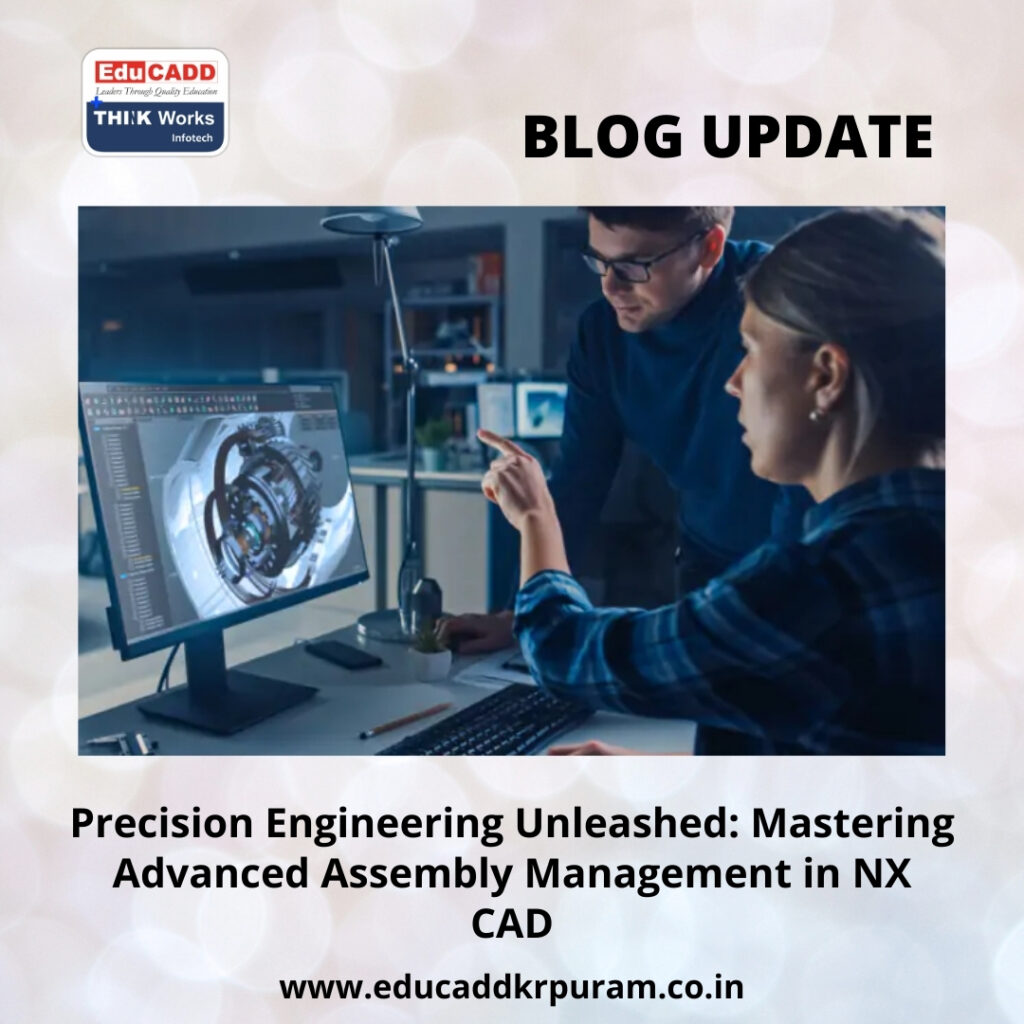
Advanced NX Assembly Management
NX CAD offers a sophisticated assembly environment that goes beyond simple part placement. Its tools allow designers to handle massive assemblies, enforce relationships between components, and integrate with downstream manufacturing and simulation processes. By leveraging these capabilities, engineers can reduce errors, accelerate design cycles, and ensure that products meet the highest standards of quality and functionality. This blog delves into the principles, techniques, and best practices for achieving mastery in assembly management within NX CAD.
1. Understanding the Critical Role of Assembly Management
Assembly management forms the foundation of high-quality product design. Every component in an assembly is interrelated, meaning that a change in one part can affect the entire system. Traditional CAD software treats assemblies as static collections of parts, often leading to inconsistencies, errors, and inefficiencies.
In contrast, Advanced NX Assembly Management provides a structured approach to controlling these interactions. Components are linked through intelligent relationships, and changes are propagated across the assembly without breaking design intent. This systematic approach reduces the likelihood of errors, supports collaboration among engineering teams, and allows for scalable, reliable assembly structures that can handle both simple and highly complex products.
2. Strategically Planning Scalable Assembly Structures
One of the most crucial steps in advanced assembly management is planning a scalable structure. NX CAD allows engineers to create logical hierarchies for assemblies, organizing parts into subassemblies, functional groups, and reference sets. This hierarchy ensures clarity, maintainability, and efficiency throughout the design process.
By implementing a structured approach, teams can work on different modules simultaneously, minimizing conflicts and facilitating collaboration. Planning assemblies thoughtfully also prepares them for future modifications or expansion, allowing products to evolve without introducing chaos into the design environment.
3. Leveraging Top-Down Design for Cohesive Assemblies
Top-down design is a methodology where the overall geometry and critical relationships are defined at the assembly level before creating individual parts. NX CAD provides tools such as master sketches, reference geometries, and associative relationships to enable this approach.
Advanced Assembly Management in NX CAD ensures that all components adhere to the top-level design intent. Changes made at the assembly level automatically update dependent parts, reducing the need for manual adjustments. This methodology is especially effective for complex products with multiple interdependent components, allowing engineers to maintain control while supporting iterative design improvements.
4. Bottom-Up Assembly Creation for Legacy Integration
While top-down design offers control and consistency, bottom-up assembly is essential for incorporating existing or legacy components. NX CAD supports seamless bottom-up workflows, allowing engineers to import pre-designed parts while maintaining their constraints, metadata, and properties.
Advanced Assembly Management in NX CAD organizes these components into functional subassemblies, making it easier to manage and update them over time. This hybrid approach ensures that both new designs and legacy components coexist without compromising overall assembly stability, providing flexibility in projects that combine new innovations with existing designs.
5. Mastering Component Positioning and Constraint Management
Accurate placement of components is fundamental to assembly performance. NX CAD provides a comprehensive set of constraints and alignment tools that simulate real-world mechanical behavior. These constraints allow parts to interact correctly, ensuring proper function and fit.
Advanced Assembly Management in NX CAD supports flexible positioning during early design stages, enabling rapid iteration and testing. Once components are finalized, rigid constraints can be applied to lock them into their precise positions. This approach balances the need for flexibility during concept development with the requirement for accuracy in final designs.
6. Efficient Management of Large Assemblies
Large assemblies, often containing thousands of parts, can strain both engineers and computing resources. NX CAD addresses these challenges through performance-enhancing features such as lightweight representations, partial loading, and reference sets.
Advanced Assembly Management in NX CAD allows designers to work on relevant sections without loading the entire assembly. This improves system responsiveness, enables faster design modifications, and reduces frustration when navigating complex structures. Teams can focus on critical areas while maintaining the integrity and interconnectivity of the full assembly.
7. Advanced Visualization and Navigation Tools
Visualization is key to understanding and managing complex assemblies. NX CAD offers advanced tools including exploded views, section cuts, and filtering options that help engineers inspect and analyze assemblies effectively.
Advanced Assembly Management in NX CAD enhances these capabilities by providing context-aware visualization. Engineers can isolate specific components, highlight interactions, and review critical areas without distraction. These tools make design review more efficient, reduce errors, and facilitate clearer communication among multidisciplinary teams.
8. Maintaining Associativity and Inter-Part Relationships
One of NX CAD’s most powerful features is its ability to maintain associativity between components. When a part changes, all dependent components update automatically, preserving design intent and ensuring consistency.
Advanced Assembly Management in NX CAD leverages these relationships to minimize manual updates and reduce the risk of design inconsistencies. Engineers can define dependencies intelligently, allowing the assembly to evolve flexibly without compromising accuracy. This functionality is critical for complex products where multiple design iterations occur simultaneously.
9. Controlling Revisions and Versioning in Assemblies
Assembly design rarely happens in a single iteration. Managing revisions and versions is vital to maintaining accuracy, consistency, and traceability. NX CAD integrates seamlessly with data management systems to track changes, control access, and prevent accidental overwrites.
Advanced Assembly Management in NX CAD ensures that designers can compare versions, roll back changes if necessary, and document the evolution of the assembly. This control enhances collaboration, reduces errors, and supports compliance with industry standards, particularly in highly regulated sectors.
10. Facilitating Collaborative Multidisciplinary Workflows
Modern product development involves engineers from mechanical, electrical, and manufacturing disciplines working together. NX CAD supports concurrent engineering by allowing multiple users to collaborate on separate parts or subassemblies simultaneously.
Advanced Assembly Management in NX CAD provides conflict detection, ownership tracking, and real-time updates, ensuring that changes are coordinated and mistakes are minimized. This collaborative environment accelerates design cycles, improves communication, and fosters innovation by allowing teams to iterate quickly and confidently.
11. Interference Detection and Assembly Validation
Validating assemblies before production is critical to avoid costly mistakes. NX CAD includes interference detection, clearance analysis, and tolerance checking to ensure components function together correctly.
Advanced Assembly Management in NX CAD allows engineers to identify clashes, misalignments, or tolerance violations early in the design process. Early validation reduces the likelihood of errors reaching manufacturing, improving product reliability and reducing time spent on rework. This proactive approach ensures that assemblies meet both functional and performance requirements.
12. Integration with Simulation and Manufacturing Processes
NX CAD goes beyond design, connecting assemblies directly with simulation and manufacturing tools. Engineers can simulate motion, analyze stresses, and plan assembly sequences before production begins.
Advanced Assembly Management in NX CAD ensures that assembly models remain consistent across these downstream applications. This integration reduces errors, streamlines the workflow, and enables engineers to optimize performance while coordinating effectively with manufacturing teams, bridging the gap between design and production.
13. Best Practices for Stable and Efficient Assemblies
Stable, high-performance assemblies require disciplined modeling practices. Engineers should avoid over-constraining components, use reference geometry effectively, and maintain clear organization and naming conventions.
Advanced Assembly Management in NX CAD thrives when designers follow these best practices. Clean, logical assembly structures improve system performance, simplify future updates, and make it easier for new team members to understand and contribute to the design. These habits ensure assemblies are both robust and adaptable over time.
14. Future Trends in NX CAD Assembly Management
The future of assembly management is shaped by growing product complexity and technological advancement. NX CAD is incorporating AI-driven suggestions, automation, and cloud-enabled collaboration to streamline workflows and improve decision-making.
Advanced Assembly Management in NX CAD is evolving to focus on predictive analysis, intelligent performance optimization, and seamless integration with digital twin technology. These innovations empower engineers to tackle even more complex assemblies with confidence, speed, and precision, ensuring their products remain at the cutting edge of design and manufacturing.
Conclusion
Advanced NX Assembly Management is essential for modern engineering teams seeking efficiency, accuracy, and innovation. By leveraging structured planning, top-down and bottom-up design methodologies, intelligent constraint management, and performance optimization, NX CAD enables designers to manage complex assemblies with unprecedented control.
Organizations that embrace these practices experience fewer errors, faster design cycles, and improved collaboration across multidisciplinary teams. The ability to navigate large, intricate assemblies with confidence positions engineers to deliver high-quality products that meet the evolving demands of today’s competitive markets. Mastery of NX CAD’s advanced assembly management is no longer just a technical advantage—it is a strategic imperative for achieving excellence in product design.

