
Engineering the Invisible Framework: A Complete Guide to Beam, Column, and Slab Drafting in Civil CADD
Behind every stable building lies a carefully engineered structural framework. Although people often admire architectural beauty, the true strength of a structure depends on its beams, columns, and slabs. These components work together to carry loads safely and ensure durability over decades. However, before construction begins, engineers must communicate their structural designs clearly. This responsibility falls on precise drafting. Beam Column Slab Drafting in Civil CADD transforms structural calculations into detailed graphical representations that guide contractors during execution. It bridges the gap between theory and practical construction. Modern drafting tools eliminate guesswork and improve coordination among stakeholders. Instead of relying on manual sketches, professionals now use Civil CADD software to create accurate, organized, and scalable structural drawings.
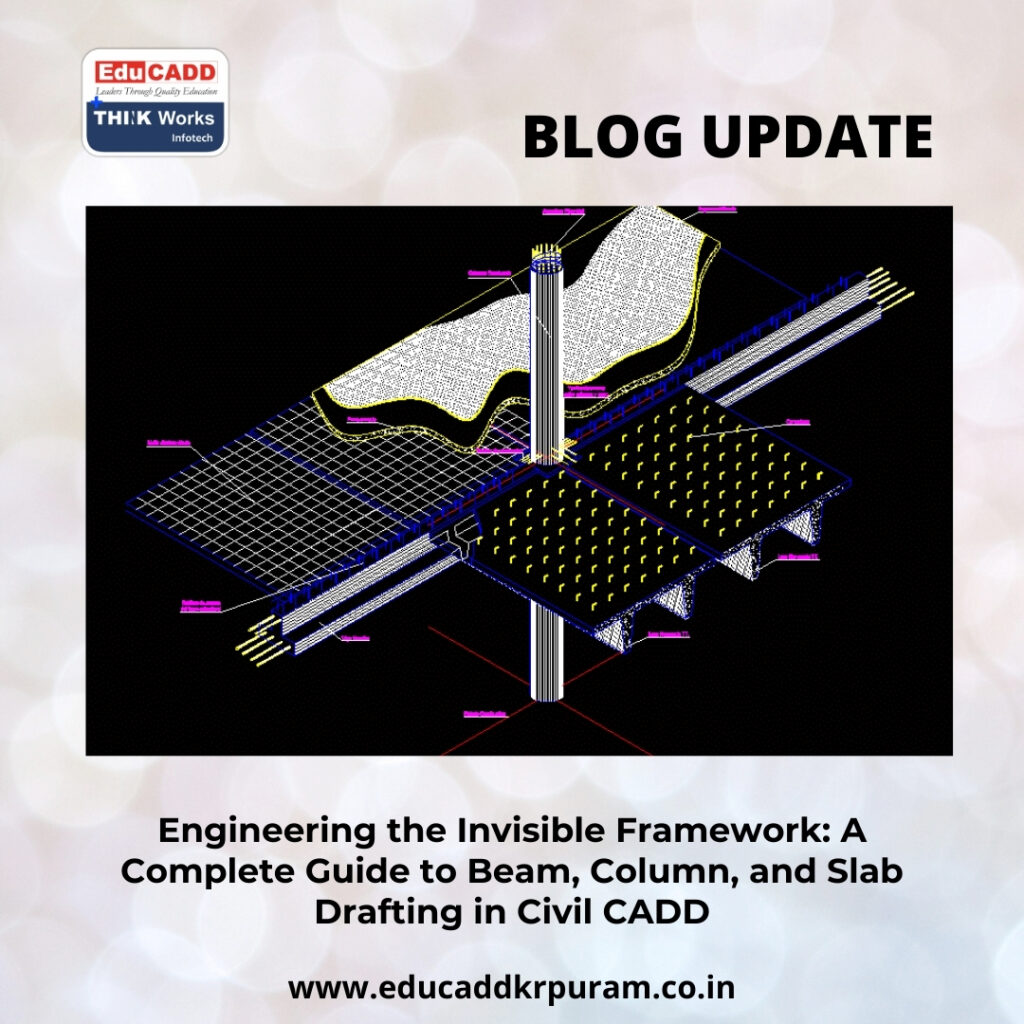
Beam Column Slab Drafting
This comprehensive blog explores the principles, workflow, detailing standards, and professional practices involved in Beam, Column, and Slab Drafting in Civil CADD. It provides deep technical insight while maintaining clarity and readability. By the end, you will understand how structural drafting strengthens project delivery and enhances career growth in civil engineering.
1. Structural Drafting as the Language of Construction
Structural drafting communicates engineering intent through drawings. Engineers perform load analysis, design reinforcement, and finalize member sizes. However, site teams cannot interpret complex calculations alone. They rely on visual documentation that translates structural data into clear instructions.
Beam Column Slab Drafting in Civil CADD ensures that every structural member appears accurately in plan views, sectional drawings, and detailed reinforcement layouts. These drawings specify dimensions, material grades, bar diameters, spacing, and anchorage details. Clear drafting reduces ambiguity and strengthens coordination between engineers and contractors.
Moreover, structural drawings serve as legal and technical references throughout the project lifecycle. Therefore, precision remains essential. Civil CADD software supports standardized layers, consistent text formatting, and accurate scaling. These features maintain drawing quality and enhance professionalism.
Without structured drafting practices, construction errors could increase significantly. Hence, structural drafting acts as the universal language of construction.
2. Beam Drafting: Mapping the Horizontal Load Path
Beams distribute loads from slabs to columns while resisting bending and shear forces. Their correct placement and reinforcement determine structural stability. Consequently, beam drafting demands careful technical execution.
In Beam, Column, and Slab Drafting in Civil CADD, beam layout preparation begins with referencing structural grids. Drafters define beam sizes, positions, and identification numbers. They align beams with walls and slab panels according to structural design.
After establishing the layout, professionals prepare longitudinal sections. These sections illustrate bottom reinforcement, top reinforcement, crank bars, and stirrup spacing. They clearly indicate development lengths and lap joints. Accurate dimensioning ensures that reinforcement placement matches design requirements.
Civil CADD simplifies this process through commands like offset, extend, and trim. Layer management separates structural outlines from reinforcement details, which improves readability.
Effective beam drafting ensures balanced load transfer and structural safety across floors.
3. Column Drafting: Defining Vertical Strength and Continuity
Columns form the primary vertical load-bearing system of a building. They transfer loads from beams to foundations while maintaining alignment through multiple levels. Therefore, accurate column drafting becomes essential for structural integrity.
Beam Column Slab Drafting in Civil CADD includes preparing column layout plans aligned with grid intersections. Drafters assign unique column marks that correspond to detailed schedules. Each schedule specifies column dimensions, reinforcement quantity, and tie spacing.
Cross-sectional drawings illustrate longitudinal bars and lateral ties. Drafters carefully indicate lap lengths and splice positions to ensure structural continuity. Civil CADD allows professionals to create reusable column blocks, which improves drafting efficiency and consistency across floors.
Clear labeling and precise dimensioning eliminate confusion during construction. Consequently, well-executed column drafting supports vertical stability and structural alignment throughout the building height.
4. Slab Drafting: Engineering Horizontal Stability
Slabs provide usable floor space while distributing loads to supporting beams. They must resist bending stresses and control deflection effectively. Therefore, slab drafting requires systematic planning and detailing.
In Beam, Column, and Slab Drafting in Civil CADD, drafters first prepare slab layout plans based on beam arrangements. They define slab thickness, panel boundaries, and reinforcement direction. Main reinforcement and distribution bars appear clearly with proper spacing annotations.
Special attention is required around openings, cantilevers, and service shafts. Drafters prepare sectional views at critical zones to explain reinforcement anchorage and bar curtailment. Civil CADD enables quick adjustments when design modifications occur, ensuring flexibility throughout the drafting process.
Accurate slab drafting enhances structural performance and improves long-term durability.
5. Step-by-Step Workflow for Efficient Drafting
A systematic workflow improves accuracy and productivity. Professionals begin by importing architectural drawings into Civil CADD. They establish structural grids and define reference levels.
Next, they draft beam, column, and slab layouts according to structural design calculations. After completing layouts, they focus on reinforcement detailing. They annotate bar diameters, spacing, and development lengths clearly.
Beam, Column, and Slab Drafting in Civil CADD also involves preparing sectional drawings and bar bending schedules. Throughout the process, layer organization ensures clarity and avoids overlapping elements.
Finally, professionals conduct detailed quality checks before issuing drawings. This structured workflow reduces errors and enhances technical reliability.
6. Importance of Adhering to Structural Codes
Every structural design must comply with relevant building codes. These codes specify reinforcement requirements, concrete cover, spacing limitations, and detailing standards.
Beam, Column, and Slab Drafting in Civil CADD must reflect these guidelines accurately. Drafters indicate cover thickness, anchorage lengths, and reinforcement spacing according to applicable standards.
Code compliance ensures safety and regulatory approval. It also strengthens coordination among project stakeholders. Therefore, knowledge of structural standards enhances drafting quality and professional credibility.
7. Key Civil CADD Tools for Structural Drafting
Civil CADD provides essential drafting tools that enhance efficiency. Commands such as line, polyline, rectangle, and circle create structural outlines quickly. Offset and trim refine shapes precisely. Hatch patterns represent sectional areas clearly.
In Beam Column Slab Drafting in Civil CADD, text and dimension commands clarify reinforcement details and spacing information. Block creation allows repeated use of similar components, which saves time.
Layer properties enable professionals to manage structural, reinforcement, and annotation elements separately. Mastering these tools significantly improves drafting speed and consistency.
8. Reinforcement Detailing and Bar Bending Schedules
Reinforcement detailing defines structural strength. Drafters illustrate bends, hooks, anchorage lengths, and splicing positions clearly. They ensure that reinforcement placement matches structural calculations precisely.
Beam, Column, and Slab Drafting in Civil CADD includes preparing comprehensive bar bending schedules. These schedules list bar marks, diameters, cutting lengths, quantities, and total weights.
Accurate schedules reduce material wastage and improve cost control. Contractors rely on these documents for steel procurement and fabrication.
Thorough reinforcement detailing enhances structural durability and project efficiency.
9. Common Drafting Challenges and Solutions
Structural drafting involves complex detailing. Errors may arise from incorrect scaling, unclear annotations, or missing reinforcement information.
In Beam, Column, and Slab Drafting in Civil CADD, professionals minimize errors by cross-checking drawings with design calculations. Peer reviews and revision tracking strengthen quality control.
Maintaining consistent layer naming and dimension standards further improves clarity.
Attention to detail and systematic verification ensure high-quality structural drawings.
10. Coordination with Architectural and MEP Drawings
Effective coordination prevents clashes during construction. Structural elements must align with architectural layouts and service installations.
Beam, Column, and Slab Drafting in Civil CADD involves overlaying architectural and MEP drawings to verify compatibility. Drafters ensure beams do not obstruct ducts or door openings.
Early detection of conflicts reduces costly design changes later. Coordination improves overall project efficiency and stakeholder collaboration.
11. Advantages of Digital Structural Drafting
Digital drafting improves precision and flexibility. Civil CADD enables instant modifications when design changes occur.
Beam, Column, and Slab Drafting in Civil CADD enhances productivity through reusable templates and automated dimensioning. Digital files simplify storage, sharing, and revision tracking.
Moreover, electronic documentation supports sustainable practices by reducing paper usage.
These benefits make digital drafting indispensable in modern construction.
12. Career Prospects in Structural Drafting
Structural drafting skills open diverse career opportunities. Construction companies, design firms, and infrastructure projects require skilled professionals.
Beam, Column, and Slab Drafting in Civil CADD prepares individuals for roles such as Structural Drafter, CAD Technician, and BIM Modeler.
With increasing infrastructure development, demand for qualified drafting professionals continues to grow.
Mastering these skills enhances employability and long-term career stability.
13. Integration with Emerging BIM Technologies
Building Information Modeling integrates 3D visualization with structural detailing. However, fundamental drafting knowledge remains essential.
Beam, Column, and Slab Drafting in Civil CADD provides the technical foundation for transitioning into BIM workflows. Professionals who combine drafting expertise with BIM capabilities gain competitive advantages in the industry.
As digital construction evolves, strong drafting fundamentals will remain highly valuable.
14. Best Practices for Achieving Drafting Excellence
Professional excellence requires discipline and consistency. Drafters should maintain standardized templates, organized layers, and uniform text styles.
Beam, Column, and Slab Drafting in Civil CADD demands continuous learning and practice. Staying updated with software features improves efficiency. Regular quality audits ensure technical accuracy.
Clear communication and structured documentation strengthen project outcomes. By following best practices, professionals deliver reliable and precise structural drawings.
Conclusion
Beams, columns, and slabs form the structural skeleton that supports every building. Their accurate representation ensures safe load transfer and long-term performance.
Beam Column Slab Drafting in Civil CADD converts engineering calculations into clear, actionable construction documents. Through proper detailing, adherence to codes, and effective coordination, drafting strengthens structural integrity and construction efficiency.
As the construction industry advances technologically, drafting skills remain foundational. Professionals who master Beam, Column, and Slab Drafting in Civil CADD not only enhance project quality but also build strong, future-ready careers in civil engineering.

