
Blueprints to Building Intelligence: The Shift from Traditional Drafting to BIM in Modern Construction
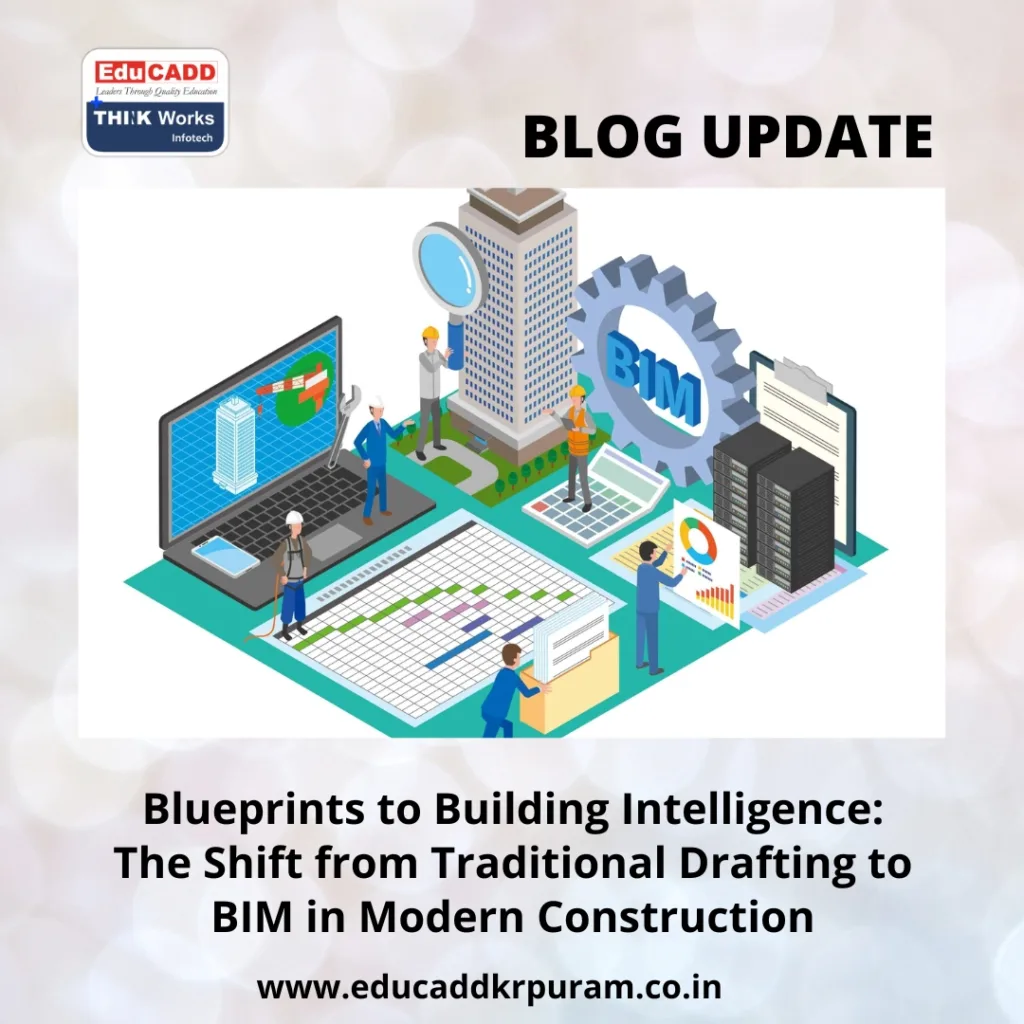
BIM vs Traditional Drafting
1. Construction Then and Now: The Shift in Perspective
The world of construction has undergone significant transformations over the past few decades. One of the most impactful changes is the move from BIM vs Traditional Drafting. While both approaches aim to plan and execute building projects, their capabilities and outcomes are vastly different.
Traditional drafting has long been the foundation of architectural design. Architects and engineers produced detailed, scaled drawings manually or through CAD software. These plans focused solely on physical dimensions, without offering insights into the building’s lifecycle, performance, or integration.
However, modern construction demands more than just blueprints. It requires real-time collaboration, data-rich environments, and predictive analytics. Enter BIM, a revolutionary digital approach that not only designs a building but also models its behavior, operation, and future performance.
When comparing BIM vs traditional drafting – what’s changing in construction?, the answer is everything—from visualization and data management to project coordination and sustainability.
Let’s now explore the specific shifts that are reshaping the construction industry through BIM.
2. Visualization and Conceptualization: From 2D Drawings to Interactive Models
One of the most noticeable differences lies in how design concepts are visualized. Traditional drafting produces 2D plans, elevations, and sections. These documents are essential but often abstract. Stakeholders without technical backgrounds may find it challenging to understand the space and relationships between elements.
BIM introduces 3D visualization as a core feature. Every object—be it a wall, window, or structural beam—is represented with precise geometry and metadata. Clients can take interactive walkthroughs, explore materials, and understand spatial dynamics before a single brick is laid.
Moreover, BIM’s 4D (time) and 5D (cost) capabilities bring a whole new level of conceptual clarity. With time-linked visualizations, stakeholders can see how a project will evolve week by week. Simultaneously, integrated cost data allows real-time budget tracking as changes occur.
This dynamic approach enhances decision-making at every level. By visualizing rather than imagining, errors are reduced, and expectations are better aligned. In contrast, 2D drafting lacks this immersive and intelligent visual environment.
With BIM, the design process becomes not just technical—but interactive, collaborative, and intuitive.
3. Workflow, Coordination, and Collaboration: From Silos to Synergy
Traditional drafting often leads to siloed working environments. Architects, structural engineers, and MEP professionals develop their own sets of drawings. Coordination happens manually, often after mistakes are already embedded in the plans. These gaps can lead to costly conflicts and delays during construction.
In contrast, BIM centralizes all project data into a single, coordinated model. When one discipline makes a change, others see it in real-time. This integrated workflow minimizes clashes and boosts efficiency across the board.
One of BIM’s standout features is automated clash detection. If an HVAC duct intersects a beam or a pipe runs through a column, the model flags the issue early. These insights enable teams to resolve problems digitally before reaching the job site.
Communication also improves drastically with BIM. Through cloud-based platforms like Autodesk Construction Cloud or Bentley ProjectWise, teams can comment, share, and review models anytime, anywhere. On-site supervisors, design leads, and clients collaborate from the same digital environment.
The result? Fewer RFIs, quicker decision-making, and smoother project execution. BIM turns fragmented teams into well-synchronized collaborators, reducing rework and increasing accountability.
4. Cost, Time, and Resource Efficiency: Smart Planning with BIM
In construction, the saying “time is money” rings especially true. Traditional drafting offers limited visibility into how design changes affect cost or timelines. Quantity take-offs are often performed manually, consuming valuable time and increasing the risk of error.
BIM streamlines cost management from the start. Every component in the model carries data, such as quantity, supplier info, and installation cost. When design modifications occur, cost estimates update automatically. This empowers project managers to detect budget overruns early and make smarter trade-offs.
Similarly, BIM’s 4D scheduling integrates project sequencing directly into the model. Planners can simulate construction phases, identify resource bottlenecks, and optimize workflow. This level of insight is rarely achievable with conventional methods.
BIM also contributes to material efficiency. By modeling the building precisely, teams avoid overordering or wasting resources. The environmental impact is reduced, and logistics become more predictable.
In every measurable way—cost tracking, scheduling, and material use—BIM delivers an intelligent and responsive system. Traditional drafting, though reliable, lacks this real-time adaptability.
5. Beyond Construction: Facility Management and Sustainability
One of the most transformative aspects of BIM is its utility beyond the construction phase. Traditional drafting concludes when the last drawing is issued. In contrast, BIM continues to serve long after the building is completed.
With BIM, the digital twin of the building becomes a living document. Facility managers use it to monitor maintenance schedules, manage energy consumption, and plan renovations. Every component—from lighting fixtures to HVAC units—has embedded data such as serial numbers, warranty info, and servicing history.
This long-term perspective supports predictive maintenance and extends the building’s lifespan. Additionally, it aligns perfectly with global goals for green construction and sustainability.
Using BIM tools, designers can simulate building performance under various conditions. Energy modeling, daylight analysis, and thermal simulations help create efficient buildings with reduced carbon footprints. Green certifications like LEED or BREEAM are easier to achieve when projects are data-rich and performance-optimized.
Traditional drafting simply doesn’t offer this level of operational depth. As buildings become smarter and more connected, BIM’s role in lifecycle management becomes indispensable.
Final Thoughts: The Digital Transformation of Construction
To truly understand BIM vs Traditional Drafting – What’s Changing in Construction?, one must look at the broader picture. This isn’t just about drawing differently—it’s about building differently.
BIM has revolutionized every aspect of construction. From visualizing ideas to managing costs, coordinating teams, and sustaining operations, BIM adds value at every stage. The model becomes more than a design; it’s a living system that evolves with the building.
Meanwhile, traditional drafting, although foundational, now falls short in a world driven by data, collaboration, and digital efficiency. Its inability to adapt in real time or extend value beyond the design phase places it firmly in the past.
Construction today demands smarter tools, faster workflows, and better outcomes. BIM delivers on all three fronts. It reduces errors, enhances decision-making, and aligns with the digital nature of modern cities and infrastructure.
As the construction industry continues its digital transformation, professionals who embrace BIM are not just keeping up—they’re staying ahead.

