
Engineering with Exactness: The Transformative Power of Civil CADD in Achieving Flawless Construction Drawings
Civil CADD Construction Drawings begins long before the first brick is laid or the first foundation is excavated. It starts with drawings—detailed technical documents that guide engineers, contractors, architects, and site supervisors throughout the project lifecycle. These drawings are not simple sketches. They contain precise dimensions, structural specifications, material notes, elevation details, and coordination layouts. Even a small inaccuracy in these documents can lead to major complications on-site. Delays, cost overruns, structural adjustments, and safety risks often trace back to drawing errors. Therefore, precision in construction documentation is not optional; it is essential.
In the modern construction landscape, digital tools have replaced manual drafting methods to meet growing complexity and scale. Among these tools, Civil CADD has emerged as a cornerstone for accuracy in civil engineering and infrastructure design. Civil CADD provides a highly structured and intelligent drafting environment that ensures every line, coordinate, and dimension reflects mathematical precision. It integrates automation, real-time updates, layered organization, and data-based modeling into a unified system. As a result, professionals can produce construction drawings that are clear, consistent, and reliable.
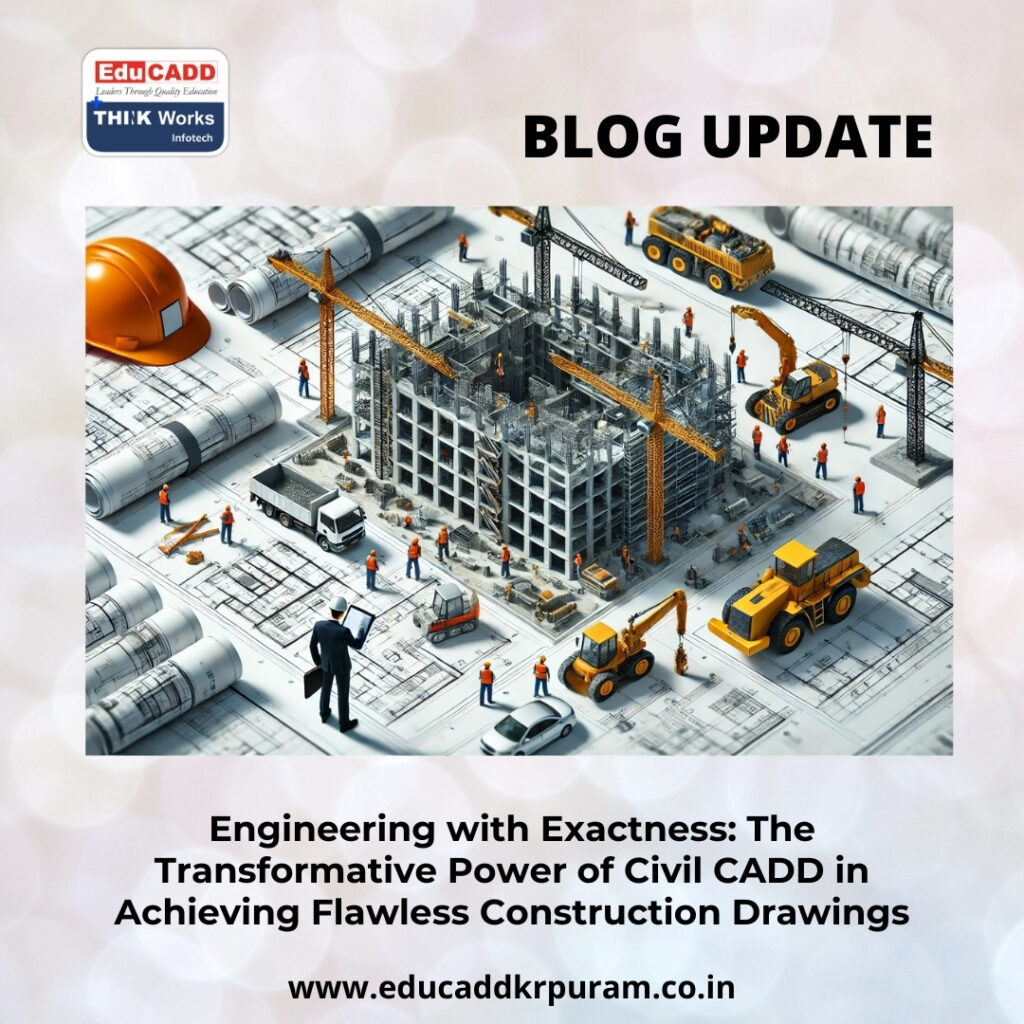
Civil CADD Construction Drawings
This comprehensive blog explores how Civil CADD enhances the accuracy of construction drawings, strengthens project coordination, reduces costly errors, and supports long-term engineering excellence. Each section highlights a different dimension of its impact, offering a complete understanding of its role in modern construction.
1. The Foundation of Every Project: Why Drawing Accuracy Matters
Civil CADD Construction Drawings function as the blueprint for execution. They translate design ideas into actionable instructions that guide labor, materials, and machinery. Contractors depend on these documents to determine dimensions, alignments, levels, and installation procedures. When a drawing contains an incorrect measurement or misaligned reference, the consequences extend far beyond paper.
In traditional drafting environments, professionals relied on manual calculations and physical tools such as scales and drafting boards. Although experienced drafters maintained high standards, manual processes introduced opportunities for human error. Scaling discrepancies, rounding mistakes, and missed updates during revisions created inconsistencies between plans, sections, and elevations. These inconsistencies often surfaced during construction, forcing teams to halt progress and make corrections.
Civil CADD eliminates many of these risks by embedding precision directly into the drafting workflow. Instead of estimating measurements visually, designers input exact numeric values. The software ensures that each element aligns with defined coordinates and project parameters. By replacing approximation with calculation, Civil CADD strengthens the reliability of construction drawings and establishes a solid technical foundation for project execution.
2. Digital Precision Through Coordinate-Based Design
One of the defining strengths of Civil CADD lies in its coordinate-driven drafting system. Every element within a drawing exists in relation to a fixed coordinate grid. This structure ensures consistent alignment and geometric integrity across the entire project.
When engineers create layouts for foundations, road alignments, or utility networks, they define reference points with exact coordinates. Each subsequent element connects logically within that system. As a result, there is no ambiguity about positioning or alignment. Measurements derive directly from mathematical relationships rather than visual interpretation.
This coordinate-based approach enhances accuracy significantly. If a structural component requires modification, the system recalculates relationships instantly. Adjacent elements adjust automatically, maintaining consistent geometry. The risk of distortion or scaling errors decreases dramatically.
Moreover, coordinate precision becomes particularly valuable in large-scale infrastructure projects such as highways, bridges, and urban developments. These projects demand strict alignment standards and minimal tolerance margins. Civil CADD ensures that each component integrates seamlessly within the broader design framework.
3. Intelligent Dimensioning for Consistent Measurements
Accurate dimensions form the backbone of reliable construction drawings. In manual drafting, dimensions often required separate entry, increasing the risk of mismatch between drawn elements and their measurements. When a design changed, updating every dimension manually became time-consuming and error-prone.
Civil CADD addresses this issue through intelligent dimensioning systems. Dimensions attach directly to drawing objects, creating associative relationships. When the size or position of an object changes, the dimension updates automatically. This dynamic behavior ensures that measurements always reflect the latest design version.
Additionally, advanced snapping tools guarantee exact alignment. Designers can snap to endpoints, intersections, midpoints, and centers with precision. These features eliminate guesswork and prevent slight misalignments that might otherwise go unnoticed.
The software also supports standardized dimension styles. Consistent formatting enhances clarity and ensures that contractors interpret measurements correctly. Through automation and consistency, Civil CADD minimizes dimensional discrepancies and reinforces drawing accuracy.
4. Structured Layer Management for Complex Projects
Modern Civil CADD Construction Drawings often contain multiple systems within a single layout. Structural elements, plumbing networks, electrical conduits, landscaping details, and drainage systems must coexist without confusion. Without organized separation, overlapping lines and annotations create clutter and increase the risk of errors.
Civil CADD introduces comprehensive layer management to maintain order. Designers assign each system to a dedicated layer. For example, structural components remain on one layer, while utility lines appear on another. Users can toggle layers on or off to focus on specific elements without distraction.
This structured organization reduces accidental edits. Critical layers can remain locked, protecting essential data from unintended changes. Layer-based color coding further enhances clarity, allowing professionals to distinguish components quickly.
By maintaining clear visual and logical separation between systems, Civil CADD ensures that complex drawings remain accurate, readable, and professionally organized.
5. Topographical Modeling and Real-World Integration
Construction does not occur in isolation. It interacts with natural terrain, existing infrastructure, and environmental conditions. Therefore, accurate site representation is vital. Civil CADD integrates survey data directly into the design environment, enabling precise topographical modeling.
Survey coordinates convert into digital terrain models that represent slopes, contours, and elevation levels accurately. Engineers can analyze gradients and design foundations that align with actual site conditions. This integration reduces discrepancies between drawings and physical terrain.
Grading tools allow calculation of earthwork volumes, including cut-and-fill quantities. Designers can evaluate different design scenarios and select the most efficient approach before excavation begins. Accurate drainage modeling ensures proper water flow and prevents long-term structural damage.
By incorporating real-world data into construction drawings, Civil CADD strengthens site-specific accuracy and reduces unforeseen complications during implementation.
6. Early Detection of Design Conflicts
Design conflicts often emerge when multiple systems intersect within limited space. For instance, a drainage pipe might interfere with a foundation beam, or an electrical conduit might overlap a structural column. Discovering such conflicts during construction leads to delays and additional expenses.
Civil CADD includes features that help identify these clashes during the design phase. When components overlap or violate spacing rules, the software alerts the user. Designers can then resolve conflicts before finalizing drawings.
Alignment verification tools further enhance accuracy. Horizontal and vertical relationships remain consistent across all views. Annotation validation ensures that text labels and symbols correspond correctly to their respective elements.
Through proactive conflict detection, Civil CADD minimizes the risk of on-site adjustments and enhances confidence in finalized drawings.
7. Standardization and Regulatory Compliance
Construction drawings must meet established standards and regulatory requirements. Inconsistent symbols, unclear line types, or missing documentation can delay approvals. Civil CADD supports standardized templates that align with professional guidelines.
Predefined title blocks, dimension styles, and annotation formats ensure uniform documentation across projects. Designers can create reusable templates to maintain consistency. This standardization reduces ambiguity and enhances professionalism.
Compliance checks also support structural integrity. Engineers can verify load paths, alignment tolerances, and measurement standards digitally. This integration strengthens the approval process and ensures that documentation meets technical expectations.
By promoting standardized drafting practices, Civil CADD enhances both accuracy and credibility.
8. Seamless Collaboration Across Disciplines
Construction projects involve multiple disciplines working simultaneously. Architects, structural engineers, civil designers, and service consultants must coordinate their efforts precisely. Misalignment between departments often results in inconsistent drawings.
Civil CADD facilitates collaboration through shared digital environments. Teams can access updated drawings in real time, reducing the risk of outdated references. Version tracking ensures accountability and clarity during revisions.
When changes occur, stakeholders receive immediate updates. This transparency strengthens communication and prevents duplication of work. Clear coordination ensures that every drawing reflects unified project objectives.
Collaborative precision enhances overall accuracy and contributes to smoother project execution.
9. Enhanced Visualization Through Three-Dimensional Modeling
Although two-dimensional drawings provide technical detail, they sometimes limit spatial understanding. Civil CADD enhances design clarity through 3D modeling capabilities. Engineers can transform 2D layouts into three-dimensional representations.
Three-dimensional views reveal relationships between structural components, utilities, and elevations. Designers can examine clearances and detect potential spatial conflicts. Clients also benefit from improved visualization, as they gain a clearer understanding of project outcomes.
By improving spatial awareness, 3D modeling strengthens design validation and reduces ambiguity. This additional layer of insight enhances overall drawing accuracy.
10. Efficiency That Minimizes Rework
Accuracy and efficiency work together in successful construction projects. When drawings remain precise, construction proceeds without interruption. Civil CADD streamlines repetitive tasks through automation.
Copying, mirroring, and array functions replicate components with exact alignment. Automated annotation tools reduce manual entry. Because changes update dynamically, designers avoid redundant revisions.
This efficiency shortens design cycles and reduces the likelihood of oversight. As a result, construction teams receive reliable documentation that requires minimal adjustment.
11. Integration with Broader Construction Technologies
Modern construction increasingly relies on integrated digital ecosystems. Civil CADD connects seamlessly with Building Information Modeling systems and project management platforms. This integration ensures consistency between design, scheduling, and budgeting.
Accurate drawing data informs quantity take-offs and cost estimation. Project managers can rely on precise information when planning procurement and timelines. Exporting design data into management systems enhances transparency and accountability.
By linking drafting accuracy with operational planning, Civil CADD strengthens project control and strategic decision-making.
12. Strengthened Quality Assurance Workflows
Quality assurance ensures that construction drawings meet technical expectations. Civil CADD supports digital review processes that simplify feedback and corrections.
Supervisors can mark up drawings directly within the software. Scaling checks verify proportional accuracy. Grid systems confirm alignment consistency. Structured review workflows reduce oversight and enhance reliability.
Through systematic validation, Civil CADD maintains high standards of documentation quality.
13. Versatility Across Diverse Project Types
Civil CADD Construction Drawings proves effective across residential, commercial, and infrastructure projects. In highway design, alignment tools maintain smooth curvature transitions. In bridge projects, detailed reinforcement layouts ensure structural integrity. Residential layouts benefit from precise room dimensions and service routing.
Utility planning also relies on accurate slope and depth calculations. Regardless of scale or complexity, Civil CADD adapts to project requirements while maintaining consistent precision.
Its versatility reinforces its importance in modern civil engineering practice.
14. Long-Term Value and Professional Excellence
Accurate drawings influence not only construction but also long-term maintenance and facility management. Reliable documentation supports renovations, inspections, and future expansions.
Organizations that adopt Civil CADD enhance their professional reputation. Reduced rework improves profitability. Improved coordination strengthens stakeholder trust. Over time, consistent precision becomes a competitive advantage.
Civil CADD does more than improve drawings; it elevates engineering standards and fosters a culture of accuracy.
Conclusion
In the dynamic world of construction, precision determines success. Civil CADD transforms drafting into a disciplined, data-driven process grounded in mathematical accuracy. Through intelligent dimensioning, coordinate-based design, structured layering, topographical integration, clash detection, and collaborative workflows, it ensures that Civil CADD Construction Drawings reflect exact design intent.
By reducing human error and enhancing coordination, Civil CADD supports efficient execution, regulatory compliance, and long-term project sustainability. As construction challenges continue to evolve, the demand for flawless documentation grows stronger. Civil CADD stands as a powerful solution, empowering engineers and designers to build with confidence, clarity, and uncompromising precision.

