
Engineering Release Confidence: DevOps Tools That Reduce Deployment Failures at Scale
Software delivery has evolved into a high-speed discipline where businesses push updates faster than ever before. Customers expect seamless digital experiences, instant feature rollouts, and uninterrupted availability. However, the faster teams release, the higher the risk of instability. A flawed deployment can lead to service outages, lost revenue, and damaged trust. Therefore, organizations must build systems that support rapid innovation without sacrificing reliability. This is where DevOps Deployment Failure Reduction become indispensable.
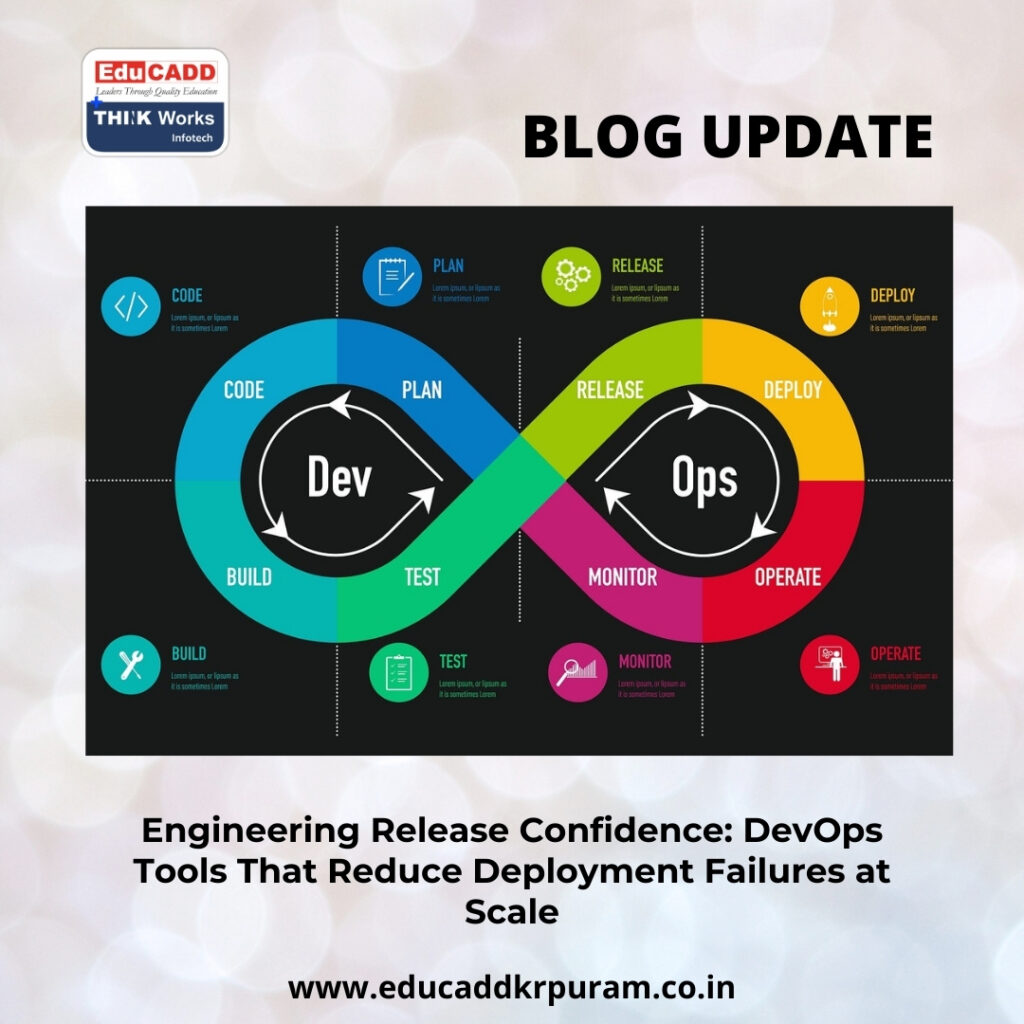
DevOps Deployment Failure Reduction
Modern DevOps practices revolve around automation, shared ownership, continuous testing, and proactive monitoring. Instead of treating deployment as a stressful final step, mature teams treat it as a routine and well-orchestrated process. They rely on integrated pipelines, environment automation, container ecosystems, and observability platforms to maintain stability. When companies adopt the right DevOps tools that reduce deployment failures, they replace uncertainty with confidence. This in-depth guide explores how these tools work together to create resilient release pipelines that thrive in dynamic environments.
1. Why Deployment Failures Still Happen in Modern Environments
Despite advanced development frameworks and cloud infrastructure, deployment failures remain common. The root causes often lie in environmental inconsistencies, communication gaps, rushed testing cycles, or manual configuration errors. Even when code works perfectly in development, subtle infrastructure differences can cause unexpected breakdowns in production.
For instance, mismatched dependency versions or missing environment variables frequently trigger runtime errors. Moreover, teams sometimes rely on manual server updates, which introduce human error. Without standardized workflows, small missteps can cascade into larger failures. Additionally, limited visibility during deployments prevents early detection of anomalies.
To address these risks, organizations must standardize every stage of their release process. DevOps tools that reduce deployment failures tackle these challenges through automation, traceability, and environmental consistency. By removing manual dependencies and enhancing collaboration, these tools ensure that deployments become predictable rather than reactive events.
2. Continuous Integration as the Foundation of Stable Releases
Continuous Integration (CI) establishes a reliable starting point for every deployment. In this model, developers frequently merge code into a shared repository. Automated systems then build and test the application immediately. This process detects integration conflicts and coding errors long before production release.
CI platforms automate tasks such as dependency resolution, compilation, and unit test execution. Whenever a failure occurs, the system alerts the responsible developer instantly. Because issues surface early, teams resolve them quickly without affecting downstream stages.
Frequent integration also promotes smaller code changes. Smaller changes are easier to review and debug. Consequently, CI acts as one of the most critical DevOps tools that reduce deployment failures. It prevents unstable code from progressing further into the pipeline and creates a consistent validation checkpoint for every update.
3. Continuous Delivery for Repeatable and Controlled Releases
After CI validates code quality, Continuous Delivery (CD) ensures that software remains ready for deployment at any moment. CD pipelines automate packaging, artifact storage, environment promotion, and deployment orchestration. Instead of manually preparing releases, teams rely on predefined workflows.
This automation reduces variability between staging and production environments. Every release follows the same tested sequence of steps. Therefore, CD eliminates guesswork and reduces human intervention during critical release windows.
Advanced CD systems also support blue-green deployments, rolling updates, and canary strategies. These controlled release patterns limit exposure to risk. If issues appear, teams can revert changes quickly. Because of these safeguards, Continuous Delivery platforms stand among the most reliable DevOps tools that reduce deployment failures in fast-moving organizations.
4. Version Control and Collaborative Code Governance
Reliable deployments begin with disciplined source control. Modern version control systems provide a structured framework for collaboration, traceability, and accountability. Every code change is documented, timestamped, and associated with a specific contributor.
Branching strategies enable developers to experiment safely without disrupting stable codebases. Feature branches isolate changes, while protected main branches maintain production stability. Pull request workflows encourage peer reviews, which often uncover logical flaws or security concerns before merging.
Comprehensive version tracking simplifies rollback operations. If a release introduces problems, teams can revert to a known stable state quickly. Because of this transparency and control, version control systems function as foundational DevOps tools that reduce deployment failures and promote disciplined collaboration.
5. Infrastructure as Code for Environmental Consistency
Infrastructure inconsistency often undermines deployment reliability. Traditional server provisioning involves manual steps that introduce variability. Infrastructure as Code (IaC) eliminates this unpredictability by defining servers, networks, and configurations through declarative templates.
When teams use IaC, they create identical environments across development, staging, and production. This alignment ensures that applications behave consistently regardless of deployment location. Automated provisioning scripts remove the risk of forgotten steps or undocumented configurations.
Furthermore, IaC integrates seamlessly with version control systems. Teams review infrastructure changes just like application code. If issues arise, they revert configuration files easily. By ensuring predictable infrastructure behavior, IaC remains one of the most impactful DevOps tools that reduce deployment failures across cloud-native environments.
6. Configuration Management for Ongoing Operational Stability
Provisioning infrastructure is only the beginning. Over time, servers may drift from their intended state due to updates or manual modifications. Configuration management tools maintain alignment between desired configurations and actual server states.
These platforms continuously validate installed packages, security patches, and system settings. If discrepancies appear, automated scripts correct them immediately. This proactive approach prevents hidden configuration issues from surfacing during deployment.
In addition, configuration management simplifies large-scale updates. Teams can apply consistent changes across hundreds of servers with a single command. Because it preserves uniformity and reduces drift, configuration management represents another category of DevOps tools that reduce deployment failures in complex infrastructures.
7. Containerization for Portable and Predictable Applications
Container technology revolutionized software packaging by bundling applications with their dependencies. Instead of relying on host environments, containers encapsulate runtime requirements in isolated units. This design eliminates compatibility conflicts between systems.
Developers build container images once and deploy them consistently across environments. Since each image includes exact dependency versions, production mirrors development precisely. This uniformity significantly lowers runtime surprises.
Container registries store versioned images, enabling precise control over deployed artifacts. Teams deploy specific tags rather than ambiguous builds. Because containerization guarantees portability and consistency, it stands among the most transformative DevOps tools that reduce deployment failures in distributed systems.
8. Container Orchestration for Scalable Reliability
As organizations scale container usage, orchestration platforms become essential. Kubernetes and similar systems automate container scheduling, scaling, and health management. If a container crashes, orchestration systems restart it automatically.
Rolling updates ensure gradual replacement of running containers. This approach prevents service interruptions during deployments. If monitoring systems detect anomalies, automated rollback restores the previous version instantly.
Load balancing and self-healing capabilities enhance service continuity. By maintaining healthy clusters even during peak traffic, orchestration systems qualify as advanced DevOps Deployment Failure Reduction in high-availability environments.
9. Automated Testing for End-to-End Assurance
Testing remains a cornerstone of deployment reliability. Automated test frameworks validate application behavior at multiple levels. Unit tests assess individual components, while integration tests evaluate service interactions. End-to-end tests replicate user workflows to verify real-world functionality.
Performance testing tools simulate heavy traffic conditions. Security testing tools scan for vulnerabilities. Integrating these tests into CI/CD pipelines creates a multilayered validation system.
Because automated testing identifies issues before release, it reduces production incidents dramatically. Comprehensive validation ensures that deployments meet quality standards consistently. Therefore, automated testing platforms rank among the most essential DevOps tools that reduce deployment failures in fast-paced environments.
10. Observability and Real-Time Monitoring
Even the most carefully tested systems require continuous observation. Monitoring platforms collect metrics related to performance, availability, and resource utilization. Logging systems capture application events and error messages for analysis.
Observability extends this visibility through distributed tracing. Teams can track requests across microservices and identify bottlenecks quickly. When anomalies occur, alert systems notify responsible engineers instantly.
Rapid detection shortens incident response times and minimizes downtime. Historical data also supports root cause analysis and continuous improvement. Consequently, observability platforms serve as proactive DevOps tools that reduce deployment failures by maintaining operational awareness.
11. Feature Flags for Controlled Feature Exposure
Feature flags provide flexibility during release cycles. Instead of bundling deployment with immediate feature activation, teams separate these steps. Developers deploy code with features disabled and enable them gradually.
If a new feature causes instability, teams deactivate it instantly without redeploying. This separation reduces risk during experimentation and innovation. Feature flags also support targeted rollouts to specific user segments.
By providing granular control over functionality exposure, feature management systems operate as strategic DevOps tools that reduce deployment failures and support safe experimentation.
12. Integrating Security Throughout the Pipeline
Security vulnerabilities can derail deployments unexpectedly. DevSecOps practices embed security checks within CI/CD pipelines. Static code analysis identifies coding flaws early. Dependency scanners detect outdated or vulnerable libraries.
Container security tools analyze images before deployment. Automated compliance checks verify adherence to regulatory standards. Integrating these measures prevents last-minute security crises during release windows.
Because security issues frequently trigger rollbacks, automated security platforms rank among the most vital DevOps Deployment Failure Reduction in regulated industries and cloud-native systems alike.
13. Incident Response and Automated Rollbacks
Even with preventive measures, unexpected incidents may occur. Efficient incident response systems ensure rapid coordination during outages. Alerting platforms notify relevant stakeholders immediately, while dashboards provide real-time insights.
Automated rollback mechanisms restore stable application versions quickly. Instead of rebuilding environments manually, teams revert to known good states through pipeline automation.
Post-incident reviews encourage learning and refinement. By analyzing root causes and updating safeguards, organizations strengthen resilience. Therefore, incident management solutions qualify as indispensable DevOps tools that reduce deployment failures and enhance recovery capabilities.
14. Building a Cohesive DevOps Ecosystem for Sustainable Reliability
The true power of DevOps emerges when tools operate within a unified ecosystem. CI pipelines trigger automated testing. CD workflows manage releases. Infrastructure automation ensures consistent environments. Container orchestration maintains scalability. Monitoring platforms observe performance. Security checks guard integrity. Incident systems coordinate response.
When these components integrate seamlessly, they create a self-reinforcing cycle of validation and feedback. Automation reduces manual intervention, while collaboration strengthens accountability. Continuous improvement transforms deployment from a risky milestone into a routine operation.
Organizations that invest in integrated DevOps tools that reduce deployment failures achieve both speed and stability. They release features confidently while maintaining operational excellence. Over time, this balance drives competitive advantage and long-term success.
Conclusion
Reliable software delivery requires more than technical expertise. It demands structured workflows, disciplined automation, and proactive monitoring. By implementing DevOps Deployment Failure Reduction across development, infrastructure, testing, and operations, organizations transform chaotic releases into controlled processes.
Continuous integration identifies issues early. Continuous delivery standardizes releases. Infrastructure automation ensures environmental consistency. Containers and orchestration enhance scalability. Automated testing protects quality. Observability ensures awareness. Security integration strengthens trust. Incident response safeguards continuity.
When these elements align, deployment confidence grows. Teams innovate without fear, knowing that safeguards protect every stage of the pipeline. Ultimately, DevOps tools that reduce deployment failures empower organizations to scale securely, respond rapidly, and deliver exceptional digital experiences in an increasingly competitive landscape.

