
Smart Grounding Mastery: Designing Robust Earthing & Lightning Protection Systems with CADD Precision
In an era where buildings are becoming smarter and industries are increasingly automated, electrical safety has never been more critical. Modern facilities rely on sensitive electronic equipment, uninterrupted power supply systems, and complex distribution networks. However, without a scientifically Earthing Lightning Protection Design system, even the most technologically advanced infrastructure can become dangerously vulnerable. Electrical faults, switching surges, and lightning strikes can cause severe equipment damage, financial loss, operational downtime, and life-threatening hazards.
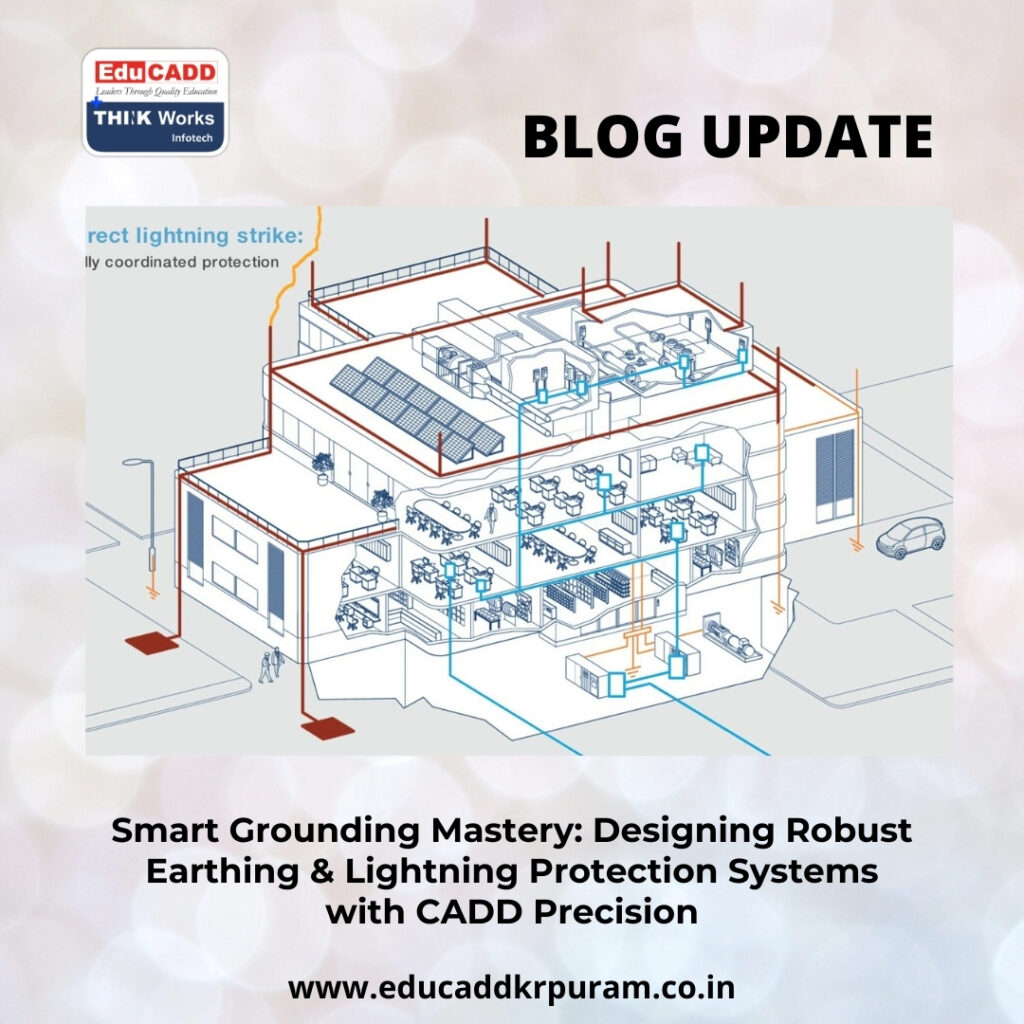
Earthing Lightning Protection Design
To address these risks, engineers now adopt digital tools that enhance accuracy and efficiency. Earthing Lightning Protection Design Using CADD has revolutionized traditional engineering practices by introducing precise modeling, real-time simulations, and automated documentation. Instead of relying solely on manual drafting and rough calculations, professionals can now evaluate soil behavior, simulate lightning strikes, analyze voltage gradients, and optimize conductor layouts within an integrated digital environment. This comprehensive blog explores the technical principles, design strategies, safety considerations, regulatory aspects, and future trends associated with grounding and lightning protection systems developed through advanced CADD methodologies.
1. The Foundation of Electrical Safety: Why Earthing Matters
Every electrical system requires a stable and reliable reference point. Earthing fulfills this requirement by providing a low-resistance path that safely directs fault current into the ground. When insulation fails or short circuits occur, excessive current flows through the grounding network rather than through equipment enclosures or structural components. Consequently, the risk of electric shock and fire hazards reduces significantly.
Moreover, grounding stabilizes voltage levels during transient conditions. It protects transformers, generators, switchgear, and distribution panels from sudden voltage spikes. Therefore, a well-designed earthing system not only safeguards human life but also ensures operational continuity.
Earthing & Lightning Protection Design Using CADD enhances this critical safety measure by allowing engineers to calculate grounding resistance accurately. Digital simulations determine optimal electrode depth, conductor size, and grid configuration. Additionally, three-dimensional visualization provides clarity regarding spatial arrangements within building foundations. As a result, engineers can design systems that are both efficient and compliant with international safety standards.
2. Understanding Lightning Phenomena and Structural Impact
Lightning is a powerful natural discharge that carries immense energy. A single strike can generate extremely high current and intense thermal effects within milliseconds. When such energy impacts a structure directly, it may cause structural cracking, fires, equipment damage, and electromagnetic disturbances.
To mitigate these risks, lightning protection systems incorporate air terminals, down conductors, bonding networks, and grounding electrodes. Air terminals intercept lightning strikes before they hit vulnerable building elements. Down conductors then channel the energy toward the earthing system, where it dissipates safely into the soil.
With Earthing & Lightning Protection Design Using CADD, engineers can conduct rolling sphere analysis and protection angle assessments digitally. These methods ensure complete coverage of the building. Furthermore, CADD tools enable precise placement of air terminals and routing of down conductors. Consequently, designers achieve optimal protection without excessive material usage or unnecessary complexity.
3. Soil Resistivity Testing and Its Influence on Grounding Design
The effectiveness of any grounding system depends largely on soil characteristics. Soil resistivity determines how easily fault current can disperse into the earth. High-resistivity soil restricts current flow, which increases ground resistance and reduces system efficiency.
Engineers conduct soil testing to understand local conditions. However, interpreting test data manually can lead to errors or oversimplifications. Therefore, integrating soil data into digital design platforms significantly improves accuracy.
Earthing Lightning Protection Design Using CADD allows engineers to input resistivity measurements and simulate different electrode configurations. The software analyzes multiple design options and calculates the resulting ground resistance values. As a result, engineers can select the most effective solution for specific soil conditions. This approach ensures long-term reliability and minimizes future maintenance challenges.
4. Grounding System Configurations and Application Areas
Different facilities require different grounding approaches. Residential buildings typically use simple pipe or plate earthing systems. Industrial plants, substations, and power generation facilities demand extensive grounding grids that can handle high fault currents. Data centers and hospitals require low-impedance grounding to protect sensitive electronic equipment.
Grid grounding distributes current across a wide area, thereby reducing step and touch potentials. Conversely, vertical rod systems may suffice for low-capacity installations. Therefore, selecting the appropriate configuration depends on system load, environmental conditions, and safety requirements.
Through Earthing & Lightning Protection Design Using CADD, engineers create detailed layouts of grounding networks. The software calculates conductor lengths, intersection points, and material quantities automatically. Additionally, it generates clear installation drawings that guide construction teams effectively. Consequently, design precision translates into smooth field implementation.
5. Controlling Step and Touch Potentials for Personnel Safety
When fault current enters the ground, it creates voltage gradients on the surface. If a person walks across this gradient or touches grounded equipment during a fault, electric shock may occur. Therefore, controlling step and touch potentials becomes essential in substations and heavy industrial environments.
Engineers often increase grid density or apply high-resistivity surface materials to mitigate risk. However, determining safe voltage limits requires accurate calculation and simulation.
Earthing Lightning Protection Design Using CADD enables engineers to model potential distribution across the entire site. Simulation results highlight areas where voltage exceeds safe thresholds. Designers can then modify grid spacing or add supplementary electrodes to enhance protection. Consequently, safety improvements are achieved before construction begins.
6. Compliance with Standards and Regulatory Requirements
Grounding and lightning protection systems must comply with established standards such as IEC, IEEE, and national electrical codes. These standards define acceptable resistance values, conductor sizing rules, and protection levels based on risk assessment.
Manual compliance documentation can be time-consuming and prone to errors. Incomplete records may delay project approvals or inspections.
Earthing & Lightning Protection Design Using CADD streamlines documentation by generating calculation reports, technical drawings, and material schedules automatically. Engineers can demonstrate compliance through structured and transparent documentation. As a result, regulatory approval becomes faster and more efficient.
7. Fault Current Analysis and Thermal Performance
Fault current magnitude influences conductor sizing and electrode configuration. If conductors are undersized, they may overheat during a fault condition, leading to system failure. Therefore, accurate short-circuit analysis is essential.
CADD-integrated software simulates fault scenarios and calculates temperature rise in conductors. Engineers can adjust parameters and evaluate different material options instantly. This flexibility enables optimization of both performance and cost.
By implementing Earthing & Lightning Protection Design Using CADD, engineers ensure that grounding systems can withstand extreme fault conditions without structural damage or performance degradation.
8. Integration with Building Information Modeling (BIM)
Modern construction projects rely heavily on multidisciplinary collaboration. Electrical systems must align with structural reinforcements, plumbing networks, and architectural elements. Therefore, integrating grounding design with BIM platforms enhances coordination.
CADD-based earthing models can be incorporated into BIM environments for clash detection and visualization. This integration prevents conflicts between grounding conductors and other building components. Additionally, stakeholders gain a clearer understanding of design intent.
Earthing & Lightning Protection Design Using CADD improves project coordination, reduces rework, and enhances overall construction efficiency.
9. Surge Protection and Equipotential Bonding
Lightning strikes and switching operations generate transient overvoltages that threaten sensitive electronic systems. Surge protection devices (SPDs) divert excess energy to the grounding network. However, their effectiveness depends on proper bonding and grounding coordination.
Equipotential bonding ensures that metallic components remain at the same electrical potential during transient events. This alignment prevents dangerous voltage differences.
Using Earthing & Lightning Protection Design Using CADD, engineers design comprehensive bonding networks and strategically place SPDs. Simulation tools verify surge pathways and evaluate performance under extreme conditions. Consequently, electronic systems remain protected against transient disturbances.
10. Material Selection and Corrosion Management
Grounding materials must withstand environmental exposure for decades. Copper offers excellent conductivity and corrosion resistance, while galvanized steel provides cost advantages. However, soil composition and moisture levels influence material performance.
Digital design tools calculate material requirements precisely. Engineers compare lifecycle costs and evaluate corrosion risks. As a result, they select materials that balance performance, durability, and budget.
Earthing & Lightning Protection Design Using CADD supports informed decision-making by providing accurate quantity takeoffs and performance simulations.
11. Installation Planning and Construction Efficiency
Clear installation drawings ensure proper execution at the site. Contractors require detailed layouts, depth specifications, and routing instructions.
CADD platforms produce scaled drawings with annotations and legends. Engineers can update designs quickly if site conditions change. This flexibility enhances adaptability during construction.
Earthing & Lightning Protection Design Using CADD bridges the gap between design and implementation. It ensures that the final installation reflects the original engineering intent accurately.
12. Testing, Inspection, and Long-Term Maintenance
After installation, engineers measure ground resistance to confirm system performance. Over time, environmental factors may affect grounding efficiency. Therefore, periodic inspection remains necessary.
Digital documentation created during design helps maintenance teams locate electrodes and bonding points efficiently. Historical records enable comparison of resistance values over time.
Earthing & Lightning Protection Design Using CADD supports long-term asset management by maintaining organized records and facilitating performance monitoring.
13. Cost Optimization and Project Sustainability
Balancing safety and budget constraints requires precise analysis. Overdesign increases expenses, while underdesign compromises reliability. Therefore, accurate modeling becomes essential.
CADD tools allow engineers to test multiple design scenarios and evaluate cost implications. Optimized designs minimize material waste and reduce installation time.
Earthing & Lightning Protection Design Using CADD enhances sustainability by promoting efficient resource utilization and long-term reliability.
14. Emerging Technologies and Future Innovations
Technological advancements continue to reshape electrical engineering. Real-time monitoring systems can measure grounding performance continuously. Cloud-based platforms enable collaboration across geographic boundaries.
Artificial intelligence may soon assist in optimizing grounding layouts automatically. Predictive analytics could identify potential failures before they occur.
Earthing & Lightning Protection Design Using CADD will remain central to these innovations. As digital transformation progresses, grounding systems will become smarter, more adaptive, and increasingly resilient.
Conclusion
Electrical safety forms the cornerstone of modern infrastructure. Grounding and lightning protection systems safeguard lives, equipment, and investments from unpredictable electrical events. However, designing these systems requires precision, compliance, and advanced analysis.
Earthing Lightning Protection Design using CADD transforms traditional engineering methods into a sophisticated digital discipline. It enhances accuracy, improves collaboration, ensures regulatory compliance, and strengthens system reliability. As infrastructure complexity continues to grow, digital grounding design will play a pivotal role in building resilient and sustainable electrical environments for the future.

