
Revolutionizing Electrical CADD: Powering Next-Generation MEP & Infrastructure Design
In this evolving scenario, mastering Electrical CADD MEP Design has become essential for engineers, designers, and professionals. Electrical CADD not only allows the creation of accurate layouts and schematics but also integrates systems into a unified, coordinated model. Through this tool, electrical engineers translate complex calculations and safety requirements into actionable designs that contractors can execute without error. This blog explores the multifaceted world of Electrical CADD, covering its applications, tools, workflow, career potential, and role in shaping modern infrastructure.
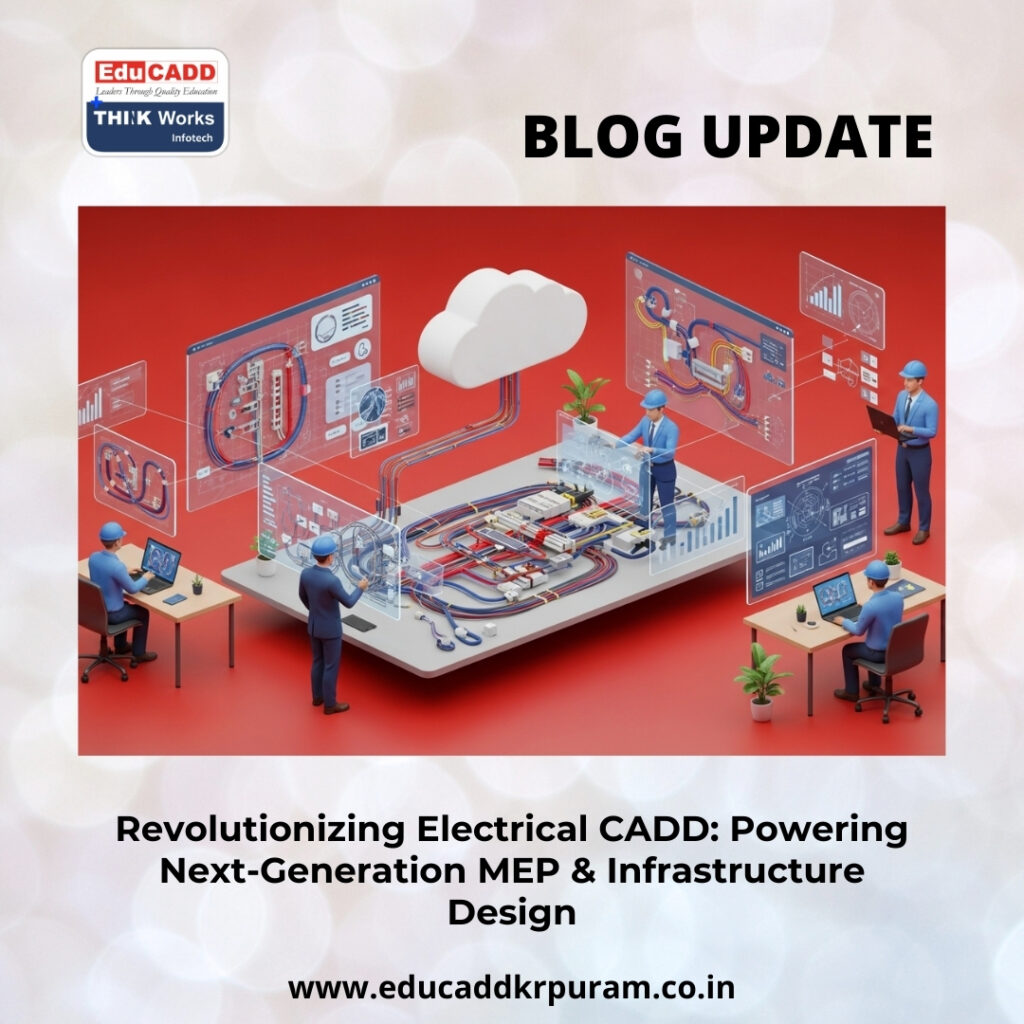
Electrical CADD MEP Design
The construction and infrastructure industry is undergoing a rapid transformation driven by technological advancement, urbanization, and increasing complexity of building systems. Electrical design, a core aspect of MEP (Mechanical, Electrical, and Plumbing) engineering, forms the backbone of all modern projects. Without precise electrical planning, even the most sophisticated building or infrastructure initiative can face delays, safety hazards, and inefficiencies.
Electrical CADD: Defining the Modern Standard for MEP Design
Electrical CADD MEP Design represents the evolution of traditional electrical drafting, combining engineering precision with advanced software capabilities. Engineers now have the ability to model circuits, panel schedules, power distribution networks, and low-voltage systems digitally. Unlike manual drafting, Electrical CADD ensures that every component, from wiring to switchgear, is accurately represented and integrated into the building’s architecture.
In MEP projects, electrical systems must seamlessly coordinate with mechanical ducts, plumbing, and structural elements. Electrical CADD facilitates this integration by providing layers, intelligent objects, and clash detection tools. The result is a design that optimizes space, ensures compliance with safety regulations, and minimizes the potential for costly on-site corrections.
Key Electrical Systems Modeled Through CADD
Electrical CADD covers a broad range of systems essential for modern buildings and infrastructure. The primary focus is on power distribution, which includes transformers, switchgear, panels, feeders, and cables. Proper planning ensures that electrical loads are managed efficiently, redundancy is maintained, and energy losses are minimized.
Lighting design is another critical area. Electrical CADD allows for precise layout planning, fixture placement, automated switching, and emergency lighting schemes. Designers can simulate lighting levels to meet safety codes and aesthetic standards while optimizing energy consumption.
Earthing and lightning protection systems are equally important for safety and code compliance. CADD tools allow engineers to accurately model grounding grids, earth pits, and lightning arrestors, ensuring that the facility remains safe under all operating conditions. Low-voltage systems, including fire alarms, CCTV, access control, and public announcement networks, are also seamlessly integrated into Electrical CADD models, reducing the risk of conflicts with other services.
Essential Software Tools for Electrical CADD
Proficiency in software defines the effectiveness of Electrical CADD professionals. AutoCAD is a foundational tool widely used for 2D drafting, enabling engineers to produce layouts, wiring diagrams, and schematics with precision. AutoCAD Electrical extends this capability by providing intelligent libraries, automated wire numbering, and panel schedules.
Revit MEP has revolutionized 3D modeling and coordination for electrical systems. It allows engineers to create BIM models where electrical components are intelligent, interconnected objects. Tools like ETAP, Dialux, and Relux assist in load flow analysis, lighting simulation, and system optimization, while integrating their results into final construction drawings. Mastery of these tools ensures that Electrical CADD professionals can handle complex projects with efficiency and accuracy.
Standards and Regulatory Compliance in Electrical CADD
Compliance with electrical codes and standards is critical for safety, approvals, and operational reliability. National and international guidelines, such as NEC (National Electrical Code) and IEC standards, govern the way electrical designs are drafted.
For infrastructure projects, additional regulations from government authorities, transport agencies, and utility providers must be incorporated. Electrical CADD professionals translate these rules into accurate drawings, symbols, and documentation. Adherence to standards not only ensures safety but also streamlines project approvals and minimizes legal or operational issues.
Role of Electrical CADD in MEP Coordination
Coordination among MEP disciplines is one of the most significant benefits of Electrical CADD. Electrical systems often share limited space with ducts, plumbing lines, and structural members. Any conflict can cause delays, additional costs, or safety hazards.
Through layered drawings or integrated BIM models, designers can visualize spatial relationships and adjust layouts proactively. Cable trays, conduit paths, panels, and switchgear are planned to avoid interference, ensuring installation efficiency and long-term maintainability. Collaboration between electrical, mechanical, and plumbing teams becomes far more effective, improving both constructability and operational reliability.
Electrical CADD Workflows: From Concept to Execution
Electrical CADD projects follow a structured workflow starting with requirement analysis, architectural review, and load estimation. Conceptual layouts define zones, feeder routes, equipment placement, and preliminary schematics.
During the detailed design stage, CADD drawings include precise panel schedules, circuiting, cable sizing, and system specifications. Coordination with other disciplines becomes intensive to prevent conflicts and ensure proper access for maintenance. The final phase involves preparing construction-ready documentation that contractors can use with confidence. Proper workflows enhance project quality, minimize site errors, and maintain schedule adherence.
Electrical CADD Applications in Large-Scale Infrastructure
Infrastructure projects, including metros, airports, highways, industrial plants, and smart city networks, present unique design challenges. These projects require high-capacity power systems, complex automation, and multi-stakeholder collaboration.
In railways, Electrical CADD MEP Design supports traction power, signaling, tunnel lighting, and substations. Airports rely on precise modeling for terminal power, airfield lighting, and backup systems. Industrial facilities demand high-voltage planning, control networks, and safety zone coordination. Electrical CADD provides scalable, modular documentation that simplifies these complex designs and ensures accuracy across the project lifecycle.
Integration with BIM and Digital Delivery
The advent of BIM has transformed Electrical CADD from traditional drafting to intelligent 3D modeling. Electrical systems become dynamic objects with embedded data for load, routing, and component specifications.
Digital delivery enables real-time collaboration across teams, clash detection, and version control. Large projects benefit from model-based coordination, reducing rework and improving efficiency. In smart infrastructure and digital twin applications, Electrical CADD continues to play a pivotal role in operations, maintenance, and asset management long after construction is complete.
Quality Control and Documentation Precision
Quality control is central to Electrical CADD. Accurate drawings prevent errors, improve safety, and protect project budgets. Electrical CADD professionals check circuit continuity, validate load calculations, and ensure symbols and legends comply with standards.
Clear annotations, detailed notes, and organized drawing sets facilitate contractor understanding and reduce installation risks. High-quality documentation streamlines approvals, ensures compliance, and enhances professional credibility. This focus on precision and clarity differentiates top-performing Electrical CADD teams from ordinary drafting resources.
Career Opportunities for Electrical CADD Professionals
Electrical CADD expertise opens diverse career paths. Professionals can become electrical design engineers, BIM coordinators, project engineers, or technical consultants.
MEP consulting firms employ Electrical CADD specialists across sectors such as commercial, healthcare, hospitality, and residential projects. Infrastructure developers require them for airports, railways, highways, industrial plants, and smart city initiatives. With experience, professionals advance to lead design roles, BIM management, and technical coordination positions, enjoying global mobility and career growth.
Importance of Structured Training and Continuous Upskilling
Structured training is vital for developing Electrical CADD expertise. Learning drafting principles, electrical systems, software proficiency, and workflow management prepares engineers for real-world challenges.
Continuous upskilling is equally critical. As software evolves and project complexity grows, professionals must adapt to new tools, industry standards, and digital delivery methods. Organizations that invest in Electrical CADD training benefit from higher efficiency, reduced errors, and faster project delivery, making it a strategic investment for long-term success.
Future Trends in Electrical CADD and MEP Design
Electrical CADD is evolving in line with technological advancements and digital construction trends. Automation, AI-assisted drafting, parametric modeling, and data-driven workflows are reshaping electrical design.
Sustainability is a growing focus. Energy-efficient systems, renewable integration, and smart controls are becoming standard expectations. In smart city projects, Electrical CADD supports intelligent lighting, monitoring systems, and resilient power networks. The role of Electrical CADD professionals continues to expand, shaping the future of infrastructure design and modern urban development.
Conclusion
Electrical CADD is no longer just a drafting tool—it is a strategic enabler of safe, efficient, and sustainable building and infrastructure design. By combining precision, coordination, compliance, and digital innovation, Electrical CADD MEP Design professionals ensure that complex electrical systems function seamlessly from concept to execution.
As projects become larger and more intricate, the demand for skilled Electrical CADD specialists will continue to grow. Mastery of tools, workflows, and standards not only empowers professionals with rewarding careers but also ensures high-quality project delivery. In the era of smart, sustainable, and resilient infrastructure, Electrical CADD remains at the heart of modern construction and urban development.

