
From Lines to Landmarks: A Beginner’s Complete Journey into Engineering Drawings
Engineering Drawings for Beginners form the invisible framework behind every successful product, structure, and infrastructure system in the modern world. Before a machine operates, a bridge carries traffic, or a building touches the skyline, detailed technical drawings define each measurement and material. These documents convert imagination into measurable reality. For beginners, however, engineering drawings can seem dense and technical, filled with symbols, numbers, and structured layouts that demand careful interpretation.
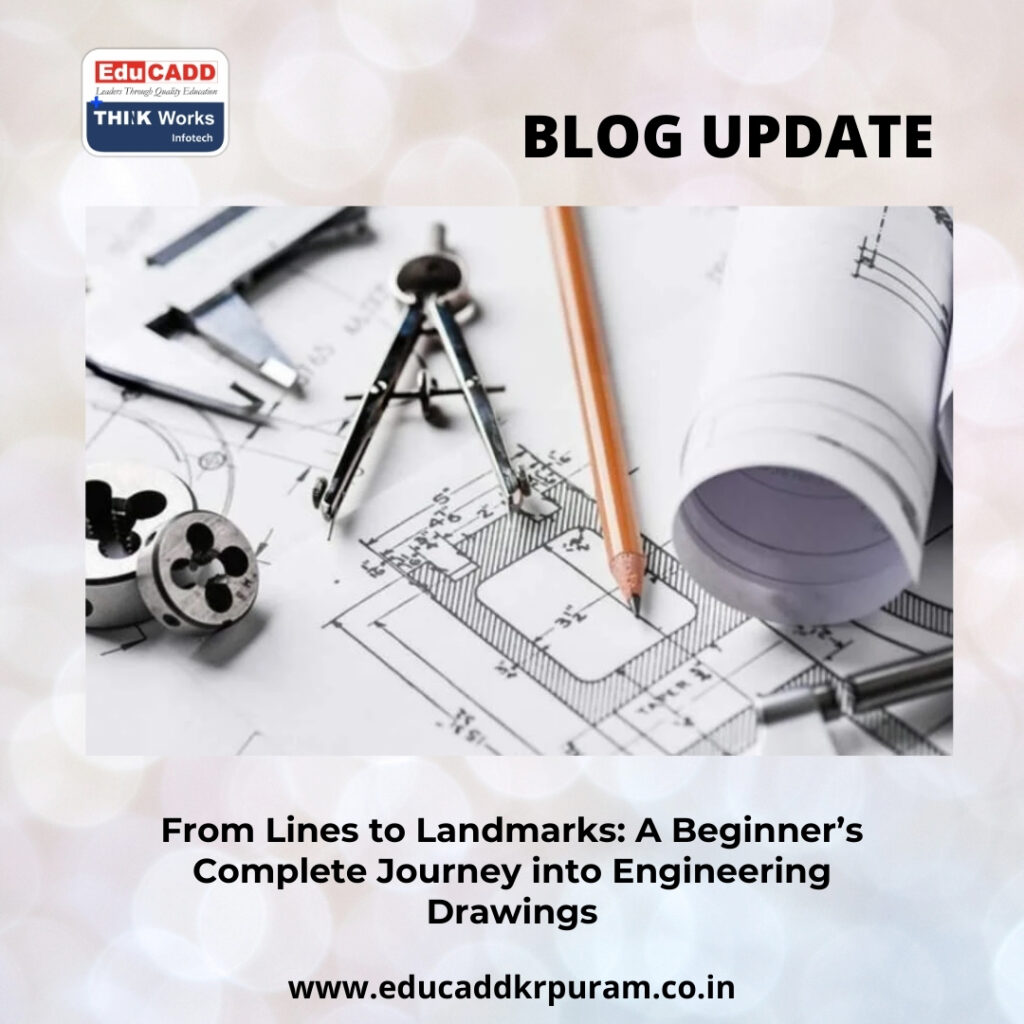
Engineering Drawings for Beginners
Yet, once you understand their logic, engineering drawings become clear, organized, and surprisingly systematic. They follow consistent principles that guide professionals across industries. This in-depth guide explores engineering drawings in a comprehensive and beginner-friendly manner. It explains their purpose, structure, types, components, standards, interpretation techniques, and future relevance. By the end of this extensive discussion, you will have a solid foundation in understanding how engineering drawings guide real-world creation with precision and clarity.
1. Understanding the True Meaning of Engineering Drawings
Engineering Drawings for Beginners are precise graphical documents that communicate technical information about objects, systems, or structures. Unlike freehand sketches or artistic illustrations, engineering drawings follow established standards and measurable accuracy. Every feature, dimension, and annotation carries defined meaning.
At their core, engineering drawings act as instruction manuals for production and construction. They describe geometry, dimensions, material specifications, and finishing requirements. Without engineering drawings, teams would rely on assumptions, leading to inconsistencies and errors.
Furthermore, engineering drawings create a universal technical language. An engineer in one country can interpret a drawing created elsewhere because standardized conventions guide its format. This clarity ensures smooth collaboration in global industries. For beginners, recognizing engineering drawings as structured communication tools helps remove the initial intimidation factor.
2. The Critical Role Engineering Drawings Play in Modern Industry
Engineering drawings influence nearly every technical field. In manufacturing, they guide the production of machine components and assemblies. In construction, they outline structural layouts, foundation details, and material placements. In electrical systems, they define wiring arrangements and circuit connections.
When professionals rely on well-prepared engineering drawings, they minimize misunderstandings and prevent costly mistakes. These drawings ensure that parts fit together correctly and systems function as intended. Consequently, organizations achieve higher efficiency and safety standards.
Additionally, engineering drawings support documentation and accountability. Regulatory authorities often require technical drawings before approving projects. Inspectors compare completed work against original drawings to verify compliance. Therefore, engineering drawings protect both public safety and project integrity.
For beginners, understanding this industrial significance highlights why learning to read and prepare engineering drawings is a valuable skill.
3. Exploring Different Types of Engineering Drawings
Engineering Drawings for Beginners vary depending on discipline and application. Each category serves a unique purpose while following shared principles of accuracy and clarity.
Mechanical engineering drawings focus on individual machine parts and assemblies. They include detailed dimensions, tolerances, and material notes. These drawings ensure components operate smoothly when assembled.
Architectural drawings illustrate building layouts, elevations, and cross-sections. They provide spatial organization and design intent. Civil engineering drawings present large-scale infrastructure projects such as highways, drainage systems, and bridges.
Electrical engineering drawings use symbols to represent circuits, wiring paths, and equipment layouts. Structural drawings emphasize load-bearing components and reinforcement details.
Although content differs, every form of engineering drawing applies similar conventions for line types, scales, and annotations. Beginners should explore these variations to understand how engineering drawings adapt to diverse professional environments.
4. Essential Elements Found in Engineering Drawings
Each engineering drawing contains standardized components that organize information clearly. Learning these elements allows beginners to interpret drawings systematically.
The title block provides identification details. It includes the drawing name, reference number, scale, author, and revision history. This section ensures traceability and version control.
Line types convey meaning. Visible edges appear as solid lines, hidden features as dashed lines, and centerlines indicate axes of symmetry. Dimension lines and extension lines define measurement boundaries.
Scale determines proportional representation. For example, a 1:100 scale indicates that one unit on paper equals one hundred units in reality.
Annotations and notes clarify materials, finishes, and manufacturing instructions. Together, these components transform engineering drawings into complete technical guides.
5. Projections and Views: Visualizing Three Dimensions on Paper
Engineering Drawings for Beginners represent three-dimensional objects on two-dimensional surfaces using projection methods. These techniques allow accurate visualization without distortion.
Orthographic projection remains the most common method. It presents separate front, top, and side views aligned precisely. Each view displays true dimensions.
Isometric projection offers a three-dimensional perspective within a single image. Although it enhances visualization, measurements are not always exact.
Sectional views reveal internal details by showing a cut-through perspective. Engineers use them when hidden components require clarity. Detail views enlarge small or intricate features to improve comprehension.
By studying projections carefully, beginners learn to mentally assemble multiple views into a single, coherent image. This skill forms the foundation of reading engineering drawings effectively.
6. The Art and Logic of Dimensioning
Dimensioning defines the exact size and placement of features within engineering drawings. Clear dimensioning prevents misinterpretation during production. Engineers apply logical placement rules to maintain clarity.
Dimensions include numerical values, arrowheads, and extension lines. Units must remain consistent throughout the drawing. Proper spacing avoids clutter and confusion.
Good engineering drawings avoid redundant dimensions. Instead, they provide enough information for complete understanding without repetition. Beginners should always verify dimensions across views to confirm accuracy.
Precision in dimensioning ensures that components fit together perfectly. Therefore, mastering this skill is essential for anyone working with engineering drawings.
7. Understanding Tolerances and Precision Control
Absolute perfection is impossible in manufacturing. Small variations occur due to machining processes and material properties. To manage these variations, engineering drawings specify tolerances.
A tolerance defines acceptable measurement limits. For example, a component might measure 50 mm plus or minus a small variation. This flexibility ensures proper assembly while maintaining performance standards.
Geometric Dimensioning and Tolerancing (GD&T) further refines control by regulating shape, orientation, and positional relationships. Engineering drawings often include specialized symbols for these requirements.
For beginners, understanding tolerances prevents unrealistic expectations. Instead of demanding exact duplication, engineering drawings balance precision with practicality.
8. Standard Symbols and Industry Conventions
Engineering drawings rely on consistent symbols to convey complex information efficiently. These standardized symbols eliminate language barriers and promote universal understanding.
Surface finish symbols indicate roughness levels. Welding symbols describe joint configuration and size. Electrical symbols represent switches, connectors, and transformers.
International standards organizations establish these conventions. By following them, engineers ensure uniform interpretation across industries. Beginners should gradually familiarize themselves with common symbols within their field.
As experience grows, recognizing these symbols becomes automatic. Engineering drawings then transform from complicated diagrams into readable technical narratives.
9. Drafting Tools: From Manual Techniques to Digital Platforms
Traditional engineering drawings were created using drafting boards, rulers, compasses, and technical pens. While manual drafting required patience and precision, it built strong foundational skills.
Today, Computer-Aided Design (CAD) software dominates technical drafting. Digital platforms allow designers to produce detailed engineering drawings quickly and accurately. They also enable easy revisions and collaborative sharing.
Three-dimensional modeling software can automatically generate two-dimensional engineering drawings. This integration improves efficiency and reduces calculation errors.
Despite technological advancements, understanding manual drafting principles remains valuable. Beginners benefit from learning both approaches to gain deeper technical insight.
10. Step-by-Step Method for Reading Engineering Drawings
To interpret engineering drawings effectively, follow a structured process. Begin by reviewing the title block to confirm identification and scale.
Next, examine the overall layout and identify the main views. Observe how projections align. Then, analyze dimensions carefully and check for tolerances.
Afterward, read notes and review symbols. Identify material specifications and finishing instructions. Finally, verify revision details to ensure you reference the latest version.
This systematic method reduces confusion and enhances comprehension. Over time, beginners develop confidence in navigating engineering drawings efficiently.
11. Common Challenges and How to Overcome Them
Beginners often misinterpret scale, leading to incorrect assumptions about size. Others overlook tolerances and treat dimensions as absolute.
Another frequent mistake involves focusing on a single view rather than analyzing all projections collectively. Engineering drawings require a holistic approach.
Confusion about symbols also presents challenges. Consulting standard references resolves uncertainty quickly. Regular practice builds familiarity and speed.
By recognizing these obstacles early, beginners can strengthen their technical understanding and improve accuracy.
12. Engineering Drawings Across the Project Lifecycle
Engineering drawings remain relevant throughout a project’s duration. During design stages, they refine ideas and define specifications. During production, they guide fabrication and assembly.
Quality control teams compare completed components against engineering drawings. Maintenance professionals later use them for troubleshooting and upgrades.
Because of this long-term importance, engineering drawings must remain clear and organized. Accurate documentation ensures reliability years after project completion.
This lifecycle perspective demonstrates why mastering engineering drawings benefits long-term professional growth.
13. Practical Guidance for Beginners Creating Drawings
Start with simple objects such as brackets or small mechanical parts. Practice creating orthographic views and adding precise dimensions.
Maintain neatness and logical spacing. Avoid clutter and unnecessary repetition. Always follow standard conventions for lines and symbols.
Review your work carefully before finalizing engineering drawings. Verify measurements, tolerances, and annotations. Even small errors can affect production significantly.
Consistent practice builds technical confidence. Over time, beginners transition from understanding engineering drawings to creating them effectively.
14. The Future of Engineering Drawings in an Evolving World
Technological innovation continues to transform engineering drawings. Advanced modeling software integrates data into comprehensive digital environments. Building Information Modeling connects architectural, structural, and mechanical systems within unified platforms.
Cloud collaboration enables global teamwork in real time. Artificial intelligence assists with design validation and optimization. Despite these advancements, the foundational principles of engineering drawings remain unchanged.
Clear communication, accurate measurement, and standardized representation will always define successful technical documentation. As industries evolve, engineering drawings will continue guiding innovation with structured precision.
Conclusion
Engineering Drawings for Beginners form the essential bridge between imagination and implementation. They convert ideas into measurable instructions that guide construction, manufacturing, and system development. Through projections, dimensions, tolerances, and standardized symbols, engineering drawings ensure clarity and consistency across industries.
Although beginners may initially find engineering drawings complex, structured learning transforms confusion into confidence. By understanding their components, mastering projection techniques, and applying proper dimensioning standards, anyone can develop strong technical interpretation skills.
In every engineering discipline, these drawings safeguard quality, efficiency, and safety. As technology advances, digital tools enhance their creation and collaboration. Nevertheless, the core purpose remains constant: precise technical communication.
Mastering engineering drawings empowers you to participate confidently in the creation of real-world innovations. With dedication and continuous practice, you can transform lines on paper into meaningful, functional achievements that shape the built environment.

