
From Blueprint to Production: Mastering GD&T Applications in Real Engineering Projects
In today’s competitive engineering landscape, precision is not optional. It defines product quality, customer satisfaction, and brand credibility. As industries evolve and products grow more complex, engineers must communicate design intent with absolute clarity. Traditional dimensioning methods often leave gaps in interpretation, which can lead to costly manufacturing errors. GD&T Applications in Engineering, solves this challenge by providing a structured and universally understood system of geometric control. However, understanding the theory alone is not enough. True expertise develops when professionals learn GD&T applications in real projects and apply those principles in practical scenarios.
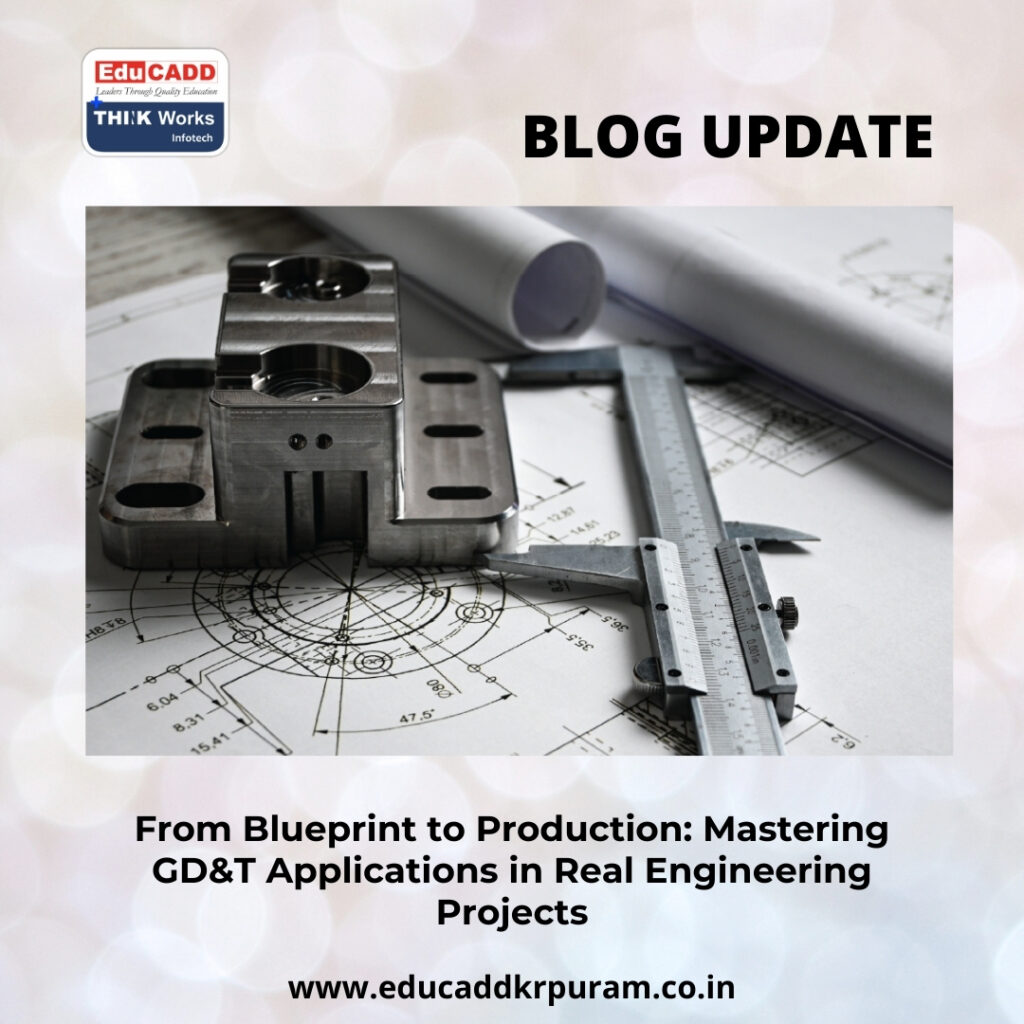
GD&T Applications in Engineering
GD&T Applications in Engineering drawings into precise communication tools. It explains how features relate to each other, how much variation is acceptable, and how components must perform during assembly. More importantly, it aligns design, manufacturing, and inspection teams under one consistent language. This detailed guide explores how engineers apply GD&T in actual projects, how it influences design decisions, and how mastering its real-world implementation strengthens both technical capability and career growth.
1. Why GD&T Matters in Real Engineering Environments
Engineering projects rarely fail due to lack of innovation. Instead, they fail because of miscommunication and uncontrolled variation. GD&T eliminates ambiguity by defining tolerance zones that describe allowable deviation in shape, orientation, and location. In practical settings, this clarity prevents rework and production delays.
When engineers learn GD&T applications in real projects, they begin to connect geometric controls with functional outcomes. A flatness tolerance on a sealing surface directly affects leakage prevention. A positional tolerance on a mounting hole determines assembly speed. These decisions impact manufacturing cost and performance reliability. Therefore, applying GD&T effectively ensures that products function as intended while remaining economically feasible to produce.
2. Incorporating GD&T During Product Planning
The best time to apply GD&T Applications in Engineering is not at the final drawing stage. Instead, it should guide product planning from the beginning. During concept development, engineers define how parts interact and how loads transfer across components. GD&T becomes a design strategy rather than a documentation requirement.
Engineers who learn GD&T applications in real projects evaluate critical features early. They identify mating surfaces, alignment requirements, and structural supports. By assigning proper geometric controls during planning, they reduce the likelihood of costly redesigns. Early GD&T integration also improves collaboration between design and manufacturing teams, ensuring smoother project execution.
3. Selecting Functional Datums for Real Assemblies
Datums serve as the reference framework for all geometric tolerances. In simple textbook examples, datum selection appears straightforward. However, real assemblies involve multiple interacting components, each with specific functional priorities. Choosing incorrect datums can disrupt alignment and cause assembly challenges.
When engineers learn GD&T applications in real projects, they evaluate which surfaces truly control function. For instance, a mounting face that contacts a machine frame often becomes the primary datum. A bearing bore may serve as a secondary datum because it governs rotational accuracy. By selecting datums based on functionality rather than convenience, engineers maintain assembly consistency and reduce tolerance stack-up issues.
4. Managing Form Tolerances in Production
Form tolerances control the shape of individual features without referencing other elements. Straightness, flatness, circularity, and cylindricity influence performance in subtle yet critical ways. In real manufacturing settings, improper form control can lead to vibration, leakage, or premature wear.
Engineers who learn GD&T applications in real projects assess process capability before assigning strict limits. For example, a long shaft may require straightness control to prevent bending under load. However, overly tight tolerances increase machining cost. Therefore, designers collaborate with manufacturing teams to balance function and feasibility. This approach ensures both quality and efficiency.
5. Ensuring Alignment Through Orientation Controls
Orientation tolerances such as perpendicularity, parallelism, and angularity maintain correct relationships between features. These controls are essential in systems where alignment affects movement or structural integrity.
When engineers learn GD&T applications in real projects, they consider real operating conditions. A perpendicular mounting plate ensures proper alignment of rotating components. Parallel guide rails maintain smooth linear motion. By understanding load distribution and operational dynamics, engineers assign orientation tolerances that preserve performance over time.
6. Position Tolerance and Interchangeable Manufacturing
Position tolerance defines the allowable variation in feature location relative to datums. It is widely used for holes, pins, and slots that require accurate alignment. In mass production environments, positional control ensures interchangeability across units.
Engineers who learn GD&T applications in real projects analyze clearance requirements and material conditions before specifying limits. They calculate tolerance zones that allow smooth assembly while preventing functional failure. This careful evaluation improves production speed and minimizes rework. As a result, companies achieve consistent quality in high-volume manufacturing.
7. Understanding Tolerance Accumulation in Assemblies
Every component in an assembly contributes to overall dimensional variation. When tolerances accumulate, misalignment can occur even if each part meets its individual specification. This phenomenon, known as tolerance stack-up, requires thorough analysis.
Professionals who learn GD&T applications in real projects perform stack-up calculations during design validation. They assess worst-case and statistical models to predict system behavior. By redistributing tolerances strategically, they maintain alignment and reduce risk. This proactive approach prevents costly adjustments during final assembly.
8. Using Material Condition Modifiers Effectively
Material condition modifiers, including Maximum Material Condition and Least Material Condition, enhance design flexibility. These modifiers allow additional geometric tolerance when features deviate from critical material boundaries.
When engineers learn GD&T applications in real projects, they leverage these modifiers to reduce manufacturing waste. For instance, if a hole exceeds its minimum size, positional tolerance increases under MMC. This bonus tolerance improves assembly compatibility without sacrificing performance. By applying modifiers strategically, designers achieve cost-effective solutions while maintaining reliability.
9. Collaboration Between Engineering and Machining Teams
Effective GD&T implementation requires cooperation across departments. Designers create specifications, but machinists execute them. If communication breaks down, production errors occur.
Engineers who learn GD&T applications in real projects engage directly with production specialists. They review drawings together and discuss tooling limitations. Through collaboration, teams refine tolerances to match machining capabilities. This integrated workflow improves product quality and shortens production cycles.
10. Inspection and Measurement Considerations
Quality control teams rely on GD&T Applications in Engineering specifications to verify compliance. Measurement methods must align with defined tolerance zones. If specifications are unrealistic or unclear, inspection becomes challenging.
Professionals who learn GD&T applications in real projects understand metrology principles. They ensure that tolerances correspond to measurable parameters. For example, defining orientation control without considering probe access can create inspection obstacles. Therefore, designers integrate measurement planning into the design process to maintain efficiency and accuracy.
11. Automotive Engineering Applications
The automotive industry operates at high production volumes where precision and interchangeability are essential. Engines, transmissions, and suspension components depend on accurate geometric relationships.
Engineers who learn GD&T applications in real projects within automotive contexts witness how optimized tolerances reduce assembly time. Position controls align bolt patterns precisely. Orientation tolerances maintain gear mesh accuracy. By applying GD&T effectively, manufacturers achieve both safety and scalability in mass production.
12. Aerospace and High-Precision Systems
Aerospace engineering demands extreme reliability under severe conditions. Components experience high loads, temperature variation, and vibration. Therefore, geometric precision becomes critical to safety.
When engineers learn GD&T applications in real projects within aerospace systems, they emphasize strict datum frameworks and detailed tolerance analysis. Each geometric control supports structural stability and aerodynamic performance. Through disciplined GD&T implementation, aerospace teams ensure compliance with rigorous standards and maintain operational reliability.
13. Digital Engineering and Model-Based Definition
Modern design environments increasingly rely on model-based definition. Instead of traditional drawings, engineers embed GD&T data directly into three-dimensional CAD models. This approach improves visualization and reduces interpretation errors.
Professionals who learn GD&T applications in real projects using digital tools perform virtual assembly simulations and tolerance analysis. They identify potential issues before physical prototypes exist. This digital integration shortens development cycles and enhances collaboration across global teams.
14. Advancing Careers Through Practical GD&T Mastery
Technical knowledge alone does not guarantee professional growth. Engineers must demonstrate practical competence in real projects. GD&T expertise signals precision, analytical thinking, and cross-functional awareness.
When individuals learn GD&T applications in real projects, they gain confidence in solving complex tolerance challenges. They contribute effectively to design reviews and production discussions. This capability increases their value within organizations and opens opportunities for leadership roles. Practical mastery distinguishes engineers who understand theory from those who deliver results.
Conclusion
Precision engineering relies on structured communication and controlled variation. GD&T provides the framework that connects design intent with manufacturing reality. However, its true impact emerges when professionals apply it thoughtfully in practical scenarios.
By learning GD&T Applications in Engineering in real projects, engineers strengthen their ability to balance functionality, cost, and manufacturability. They refine datum strategies, manage tolerance stack-up, and collaborate effectively with production and inspection teams. As industries continue to demand higher quality and faster innovation, practical GD&T expertise remains an essential skill. Engineers who invest in real-world application not only enhance product reliability but also position themselves for sustained success in an increasingly competitive engineering environment.

