
From Concept to Construction: The Complete Interior Design Course Journey Explained
Interior Design Course Journey is often misunderstood as a course that focuses only on decoration and styling. In reality, it is a comprehensive professional program that combines art, science, psychology, technology, and management. Students who enroll in this field step into a structured academic pathway designed to shape them into capable designers who can conceptualize, plan, execute, and supervise complete interior projects.
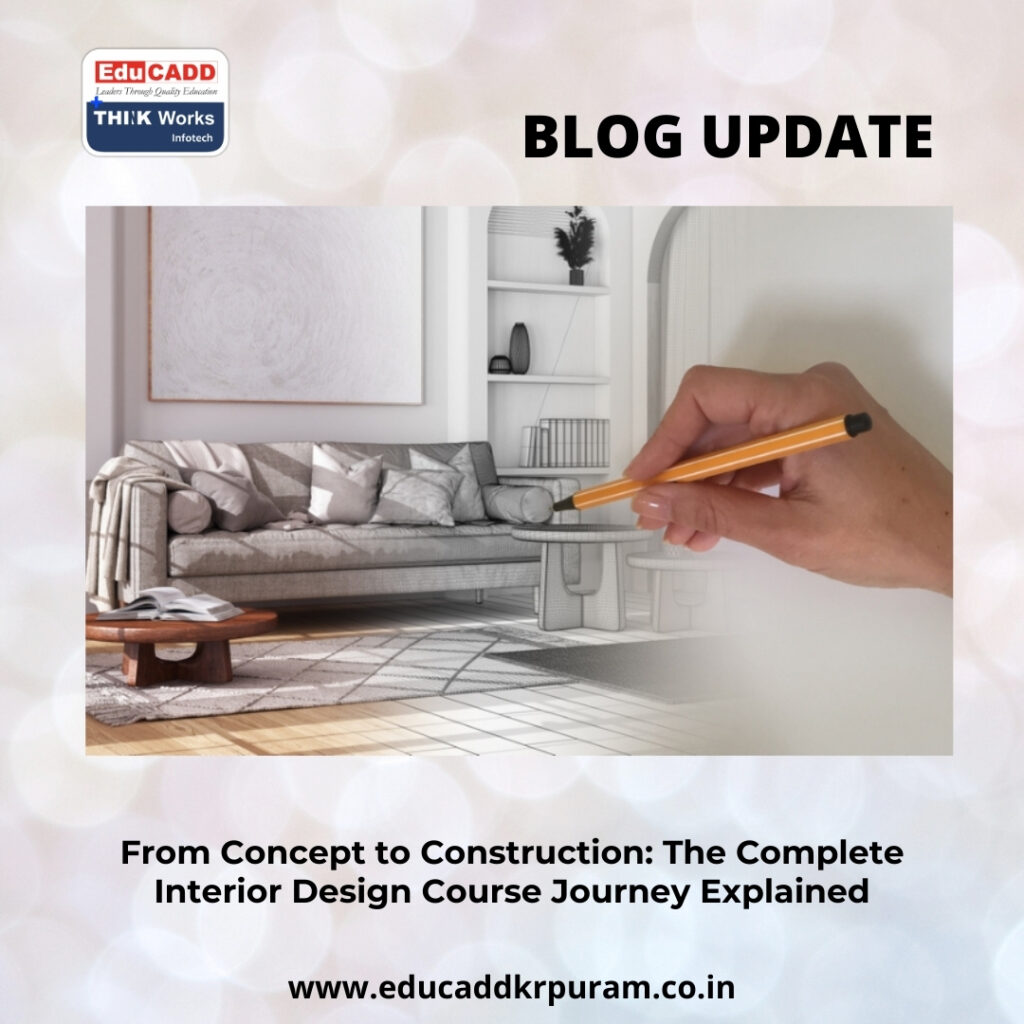
Interior Design Course Journey
Understanding the detailed structure of an interior design course helps aspiring students prepare mentally and academically. It also clarifies how creativity evolves into professional expertise. Every module builds upon the previous one, ensuring steady development of both artistic thinking and technical precision. This extensive guide explores the entire learning journey, highlighting how each subject contributes to building a successful interior design career.
1. Core Design Fundamentals: Establishing Creative Thinking
Every Interior Design Course Journey begins with foundational design principles. This initial stage trains students to observe spaces critically and think creatively. Rather than jumping directly into complex layouts, learners focus on understanding basic elements such as line, form, color, texture, shape, and pattern.
Students explore how balance creates visual stability and how contrast enhances interest. They also examine proportion and scale, which determine how objects relate to one another within a room. Through structured assignments, learners begin applying these concepts in small compositions before progressing to larger design challenges.
This foundation strengthens problem-solving skills. Instead of relying on intuition alone, students develop a logical approach to visual organization. As their understanding deepens, they gain confidence in making design decisions that are both aesthetically pleasing and functionally sound.
2. Drawing Skills and Visual Communication Techniques
Interior designers must communicate ideas clearly, and drawing plays a crucial role in that process. During this stage, students develop both freehand sketching abilities and technical drafting skills. Quick conceptual sketches help designers capture ideas instantly, while precise drawings provide clarity for execution.
Learners practice perspective drawing to represent depth accurately. They also create floor plans, elevations, and sectional drawings to demonstrate spatial relationships. These exercises build precision and attention to detail.
Presentation techniques receive equal emphasis. Students learn shading, rendering, and layout organization to enhance visual appeal. As a result, their ideas become easier for clients and instructors to understand. Effective visual communication ultimately bridges imagination and practical implementation.
3. Historical Influences and Architectural Context
Interior Design Course Journey reflects cultural, social, and technological evolution. A thorough academic program introduces students to the historical development of architecture and interior styles. By studying various periods, learners understand how past societies shaped their living environments.
From classical civilizations to contemporary minimalism, each era presents distinct characteristics. Students analyze materials, decorative elements, spatial planning methods, and structural innovations from different timeframes. This historical exploration sharpens their analytical thinking.
Moreover, learning design history prevents repetitive thinking. Instead of copying current trends, students gain inspiration from timeless principles. They learn to reinterpret traditional concepts in modern ways, ensuring originality and depth in their work.
4. Space Planning and Functional Layout Development
Space planning forms the backbone of professional interior practice. This subject teaches students how to arrange spaces effectively while considering user needs and movement patterns. Function always precedes aesthetics in this phase of learning.
Students measure areas accurately and experiment with various layout options. They study zoning techniques to separate private, public, and service areas within residential and commercial environments. Circulation paths are analyzed carefully to ensure smooth movement.
Practical projects gradually increase in complexity. Learners begin with small apartments and later design offices, retail stores, and hospitality spaces. Through repeated practice, they develop a systematic approach to organizing space efficiently and creatively.
5. Materials, Finishes, and Building Systems
A professional designer must understand materials thoroughly before specifying them in projects. Therefore, courses dedicate significant time to studying material properties, durability, texture, maintenance, and cost considerations.
Students examine natural and synthetic materials used in walls, flooring, ceilings, furniture, and decorative elements. They learn how finishes influence visual perception and longevity. Additionally, they explore building systems such as plumbing basics, electrical layouts, and ceiling frameworks.
This technical exposure ensures that designs remain realistic and safe. When students understand how materials perform under different conditions, they make informed choices that balance beauty with practicality.
6. Furniture Design and Human-Centered Ergonomics
Furniture contributes significantly to comfort and usability within interiors. Consequently, students receive structured training in furniture design and ergonomic principles. Ergonomics focuses on aligning design dimensions with human body measurements.
Learners study anthropometric data to determine appropriate heights, widths, and depths for seating and storage units. They experiment with designing custom furniture pieces that serve specific purposes. Structural stability and joinery techniques are also explored.
By combining creative vision with ergonomic accuracy, students create furniture that enhances user experience. This module strengthens their ability to design spaces that are both visually appealing and physically comfortable.
7. Lighting Strategies and Ambience Creation
Lighting transforms interiors dramatically. Hence, a dedicated module teaches students about natural and artificial illumination techniques. They examine how sunlight affects mood and energy efficiency. At the same time, they explore artificial lighting categories such as ambient, task, and accent lighting.
Students calculate spacing, placement, and intensity to achieve balanced illumination. They study color temperature and its psychological impact on occupants. Through practical exercises, learners design lighting plans that enhance architectural features.
Mastering lighting strategies allows designers to create depth, highlight focal points, and influence atmosphere effectively. This knowledge elevates overall design quality significantly.
8. Color Theory and Emotional Impact
Color holds the power to influence human emotions and perceptions. Therefore, interior design education includes detailed exploration of color theory. Students learn about the color wheel, harmony schemes, and psychological associations of different shades.
Practical sessions involve creating mood boards and experimenting with various palettes. Learners observe how subtle changes in hue can alter the feel of a room. Warm tones often energize spaces, while cool tones create calmness.
Understanding color relationships enables designers to craft cohesive environments. By applying theory strategically, students learn to communicate themes and emotions effectively through interior spaces.
9. Digital Drafting and 3D Modeling Technologies
Technology has become essential in modern design practice. Academic programs integrate digital drafting and modeling software to enhance efficiency and precision. Students begin with computer-aided drafting tools to create accurate construction drawings.
They then progress to three-dimensional modeling software that produces realistic visualizations. Rendering programs add texture, lighting effects, and shadows, making presentations more engaging. Digital walkthroughs further improve client understanding.
By mastering these tools, students increase their professional readiness. Employers and clients value designers who can present ideas clearly using advanced technology.
10. Sustainable Design and Environmental Responsibility
Sustainability now plays a central role in interior design education. Students learn strategies to reduce environmental impact while maintaining design quality. Energy-efficient planning, natural ventilation, and daylight optimization are emphasized.
They explore eco-friendly materials and recycling practices. Waste reduction techniques during construction also form part of the discussion. Designers are encouraged to consider long-term environmental consequences of their decisions.
This responsible approach prepares students to create healthier spaces while contributing positively to global sustainability goals.
11. Budget Planning and Project Management Skills
Interior Design Course Journey require careful coordination and financial planning. Therefore, students learn budgeting, cost estimation, and vendor management. They understand how to prepare bills of quantities and negotiate with suppliers.
Time management also becomes a focus. Meeting deadlines while maintaining quality requires discipline and planning. Through simulated projects, learners practice coordinating with contractors and consultants.
These managerial skills ensure that future designers can handle real-world challenges confidently. Professional success depends not only on creativity but also on organizational ability.
12. Portfolio Creation and Professional Development
Throughout the course, students compile their projects into a professional portfolio. Faculty members guide them in selecting and organizing work strategically. Presentation layout, graphic clarity, and storytelling techniques receive careful attention.
Students also learn about personal branding and communication etiquette. Interview preparation sessions build confidence. By presenting their skills effectively, learners enhance employment opportunities significantly.
A strong portfolio often determines career growth. Therefore, this stage plays a decisive role in shaping professional identity.
13. Internship and Industry Exposure
Practical training bridges the gap between academic theory and professional practice. Internships allow students to experience real project environments. They participate in site visits, client discussions, and material selection processes.
Exposure to live challenges strengthens adaptability. Students learn how to manage unexpected issues and coordinate with multiple stakeholders. Observing experienced designers provides valuable insights.
Industry connections formed during internships often lead to job placements. This phase accelerates professional growth and reinforces classroom learning.
14. Final Capstone Project and Specialized Focus
The final stage of the program involves a comprehensive design project that integrates all acquired knowledge. Students select a specialization such as residential, commercial, retail, or hospitality design.
They conduct research, develop concepts, prepare detailed drawings, and create realistic visualizations. Budget estimation and documentation are included as part of the final submission. Faculty mentors provide guidance throughout the process.
This capstone project represents the culmination of years of learning. It demonstrates technical competence, creative maturity, and professional readiness. Successfully completing this stage marks the transition from student to industry-ready designer.
Conclusion
An Interior Design Course Journey offers a structured pathway that transforms artistic interest into career-ready capability. Each module builds logically upon the previous one, ensuring balanced development of creativity, technical knowledge, and managerial skills.
From mastering design fundamentals to executing a comprehensive final project, students undergo a complete professional transformation. They learn to think critically, design responsibly, and communicate effectively.
By understanding the full academic journey, aspiring designers can approach their education with clarity and purpose. This carefully crafted learning experience ultimately prepares them to create functional, inspiring, and sustainable interior spaces in an ever-evolving design industry.

