
Mechanical CADD 2026: The Digital Engine Powering Next-Generation Mechanical Innovation
Mechanical engineering stands at the crossroads of intelligence, automation, and accelerated innovation. Organizations no longer rely on isolated drafting tools or disconnected design methods. Instead, they depend on integrated digital systems that connect concept, validation, and production seamlessly. Mechanical CADD 2026 Innovation has become the backbone of this transformation. It empowers engineers to design complex assemblies, simulate real-world performance, and collaborate across global teams without compromising accuracy. As industries embrace smart factories, AI-driven optimization, and sustainable product development, Mechanical CADD plays a defining role in shaping outcomes. In 2026, companies that leverage Mechanical CADD effectively achieve faster time-to-market, reduced operational risks, and superior product quality. This comprehensive blog explores what Mechanical CADD truly represents, how it evolved, its applications across industries, and why its importance continues to grow in the modern engineering ecosystem.
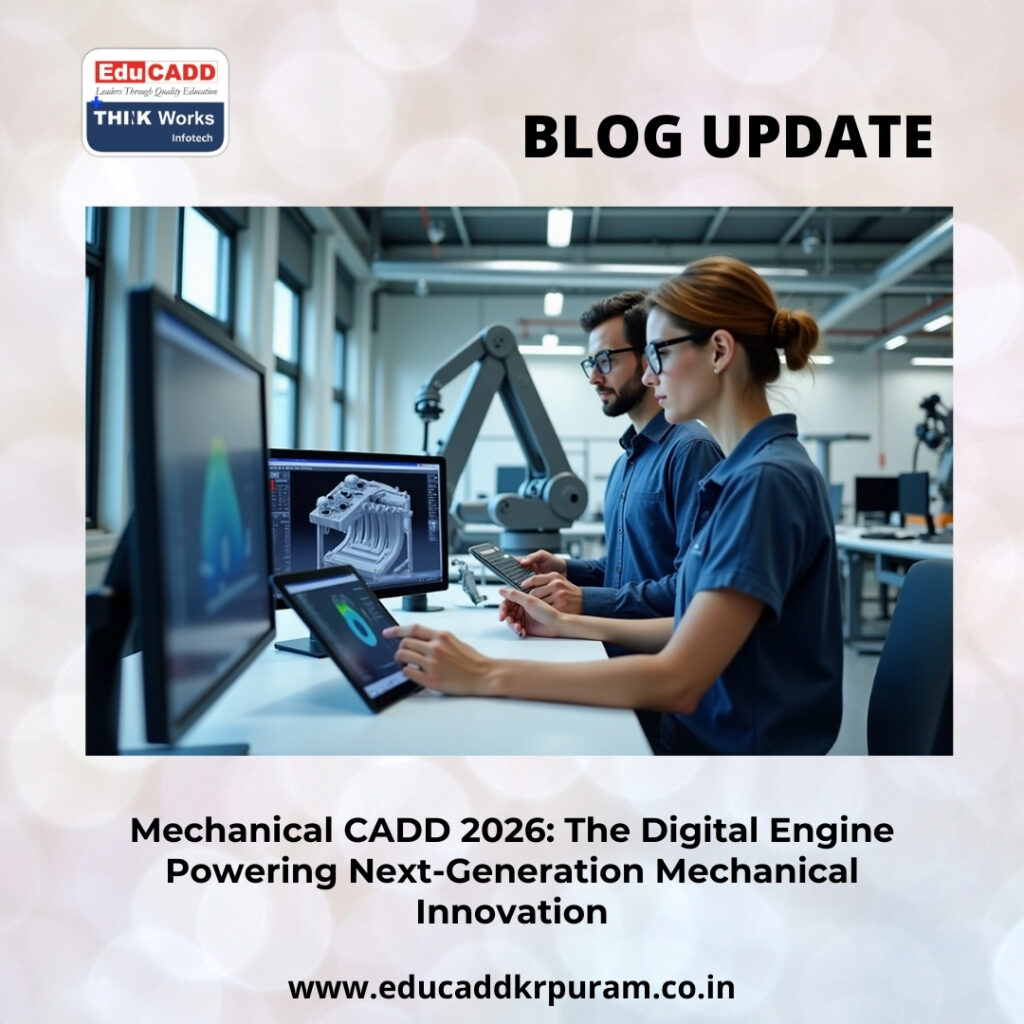
Mechanical CADD 2026 Innovation
1. What Mechanical CADD Really Means in Today’s Engineering Landscape
Mechanical CADD refers to Computer-Aided Design and Drafting systems specifically developed for mechanical engineering applications. These advanced platforms allow professionals to create precise 2D drawings and intelligent 3D models of machines, components, and mechanical assemblies. However, Mechanical CADD goes far beyond digital drafting. It integrates parametric control, material properties, tolerance definitions, and functional relationships into a unified environment.
Engineers use Mechanical CADD 2026 Innovation to translate conceptual ideas into fully defined digital prototypes. Every dimension, curve, and joint carries measurable accuracy. Moreover, modifications occur instantly without redrawing entire systems. When a parameter changes, related components update automatically. This dynamic behavior enhances consistency and reduces costly errors. In 2026, Mechanical CADD functions as a complete design ecosystem rather than a simple drawing tool. It connects ideation with engineering precision, making it indispensable for modern mechanical professionals.
2. The Evolution from Manual Drafting to Intelligent Modeling
The journey of Mechanical CADD reflects the broader evolution of engineering technology. Initially, drafting boards dominated mechanical design processes. Engineers manually sketched components, calculated tolerances, and documented details on paper. While effective at the time, manual drafting limited speed and scalability.
The introduction of computer-based drafting tools marked a turning point. Early Mechanical CADD systems replicated manual drawings digitally. Over time, parametric modeling revolutionized workflows. Engineers began defining relationships between features so that modifications cascaded intelligently across assemblies. Subsequently, 3D solid modeling enabled immersive visualization of complex machinery.
By 2026, Mechanical CADD integrates cloud computing, artificial intelligence, and simulation engines. This progression transformed static drafting into dynamic engineering intelligence. The evolution demonstrates how Mechanical CADD adapted to growing industrial demands and continues to expand its capabilities.
3. Core Capabilities That Define Modern Mechanical CADD
Modern Mechanical CADD platforms provide a comprehensive suite of features that drive design precision. Parametric modeling remains central to functionality. Engineers define constraints and dependencies, ensuring design consistency even after multiple revisions.
Three-dimensional solid modeling enhances visualization and spatial understanding. Designers inspect assemblies from any perspective, analyze internal sections, and validate clearances. Drafting tools automatically generate detailed manufacturing drawings from 3D models, which streamlines documentation workflows.
Furthermore, Mechanical CADD includes component libraries containing standardized mechanical parts. This feature accelerates design creation and maintains compliance with industry standards. Simulation modules evaluate stress distribution, motion dynamics, and thermal performance. Together, these capabilities position Mechanical CADD as a complete engineering solution in 2026.
4. Accelerating Product Development in Competitive Markets
Speed determines survival in today’s industrial landscape. Companies must introduce innovative products quickly while maintaining strict quality standards. Mechanical CADD significantly reduces development timelines by automating repetitive tasks and enabling rapid design iterations.
When engineers adjust a single dimension, associated drawings and assemblies update instantly. This automation eliminates redundant work and minimizes human error. Additionally, Mechanical CADD 2026 Innovation integrates seamlessly with rapid prototyping technologies such as additive manufacturing. Designers export digital models directly for 3D printing, accelerating concept validation.
In 2026, customers expect frequent innovation cycles. Mechanical CADD empowers organizations to adapt swiftly to market demands while preserving engineering excellence.
5. Enhancing Design Validation Through Integrated Simulation
Design validation ensures that products perform reliably under real-world conditions. Mechanical CADD integrates powerful simulation tools that analyze structural, thermal, and motion behaviors. Engineers can test digital prototypes extensively before committing to physical production.
Finite element analysis evaluates stress distribution and structural resilience. Motion simulation identifies mechanical interference and efficiency gaps. Thermal studies predict heat dissipation patterns within machinery. These analytical capabilities reduce reliance on costly physical prototypes.
As a result, Mechanical CADD lowers development risks and improves overall product reliability. In 2026, simulation-driven engineering forms the foundation of high-performance mechanical systems.
6. Enabling Smart Manufacturing and Digital Twins
Smart manufacturing depends on seamless connectivity between design and production. Mechanical CADD generates highly accurate digital models that integrate directly with CNC machines and automated production lines. This direct data flow reduces translation errors and enhances manufacturing precision.
Moreover, digital twin technology relies heavily on Mechanical CADD models. Engineers create virtual replicas of physical systems to monitor performance and predict maintenance requirements. These digital twins simulate real-time operational conditions without disrupting production.
In 2026, industries emphasize predictive analytics and process optimization. Mechanical CADD provides the digital blueprint that makes intelligent manufacturing possible.
7. Strengthening Cross-Functional Collaboration
Engineering projects involve designers, analysts, manufacturers, and clients. Mechanical CADD platforms now support cloud-based collaboration, enabling teams to work simultaneously on shared models. Real-time updates prevent data conflicts and maintain version integrity.
Stakeholders review designs remotely and provide feedback efficiently. This transparency accelerates decision-making and reduces communication gaps. Additionally, centralized data management ensures secure storage and easy retrieval of project files.
As global teams become more common in 2026, Mechanical CADD supports distributed workflows effectively. Collaboration enhances productivity and leads to more refined engineering solutions.
8. Supporting Sustainable and Resource-Efficient Engineering
Sustainability remains a primary objective for modern industries. Mechanical CADD contributes significantly to environmentally responsible design. Engineers optimize material usage, reduce waste, and improve energy efficiency through digital modeling.
Lightweight component design lowers fuel consumption in transportation sectors. Lifecycle analysis tools evaluate environmental impact from production to disposal. Virtual testing reduces the need for excessive physical prototypes, conserving resources.
In 2026, sustainable innovation drives corporate strategy. Mechanical CADD empowers engineers to achieve ecological responsibility without compromising performance.
9. Artificial Intelligence Integration in Mechanical CADD
Artificial intelligence continues reshaping engineering workflows. Modern Mechanical CADD systems incorporate AI-powered recommendations and automation features. These tools analyze historical data and suggest optimized design parameters.
AI identifies potential conflicts within assemblies and proposes corrective solutions instantly. Topology optimization algorithms enhance structural strength while minimizing material usage. Automated geometry generation accelerates early-stage concept development.
By combining human expertise with machine intelligence, Mechanical CADD enhances both creativity and efficiency. In 2026, AI integration transforms design processes into intelligent decision-making systems.
10. Expanding Career Pathways and Industry Demand
Mechanical CADD skills open doors to diverse professional opportunities. Industries such as automotive, aerospace, energy, and industrial manufacturing rely heavily on digital design expertise. Employers prioritize candidates proficient in modeling, simulation, and technical documentation.
In 2026, digital proficiency directly influences career growth and salary potential. Professionals with advanced Mechanical CADD skills often secure leadership roles in design engineering teams. Additionally, freelance opportunities continue expanding due to global outsourcing trends.
Mastering Mechanical CADD equips engineers with a competitive advantage in a technology-driven job market.
11. Transforming Engineering Education
Educational institutions recognize the importance of digital engineering competencies. Mechanical CADD training forms a core component of modern mechanical engineering curricula. Students gain hands-on experience through project-based learning.
They learn drafting standards, assembly modeling, and simulation techniques aligned with industry expectations. Exposure to real-world case studies strengthens practical understanding.
By 2026, graduates enter the workforce prepared for digital engineering environments. Mechanical CADD bridges academic theory with industrial application effectively.
12. Overcoming Learning Curves and Technical Challenges
While Mechanical CADD offers immense benefits, mastering it requires dedication and continuous learning. Beginners must understand engineering fundamentals before exploring advanced modeling techniques. Complex assemblies demand precision and systematic planning.
Software updates introduce new features regularly, requiring professionals to adapt quickly. However, structured training programs and hands-on practice accelerate proficiency.
In 2026, adaptability becomes a defining trait of successful engineers. Mechanical CADD challenges encourage skill enhancement and professional development.
13. Encouraging Innovation Through Digital Experimentation
Innovation thrives in environments that encourage experimentation. Mechanical CADD enables rapid exploration of multiple design variations without excessive cost. Engineers test alternative geometries and performance parameters efficiently.
Digital prototyping reduces financial risks associated with physical testing. Integration with additive manufacturing technologies supports quick validation cycles.
This flexibility fosters creativity and encourages bold engineering ideas. In 2026, organizations rely on Mechanical CADD to transform imaginative concepts into viable products rapidly.
14. Why Mechanical CADD Defines Engineering Success in 2026
Mechanical CADD matters profoundly in 2026 because it integrates intelligence, precision, and connectivity within a single digital framework. It accelerates development cycles, enhances validation accuracy, and strengthens collaboration.
Industries depend on digital integration to remain competitive in a rapidly evolving market. Mechanical CADD supports smart factories, AI-driven optimization, and sustainable product strategies. Its role extends beyond design into the broader ecosystem of innovation and manufacturing.
Organizations that invest in Mechanical CADD build resilience against technological disruption. Engineers who master its capabilities shape the future of mechanical innovation confidently.
Conclusion
Mechanical CADD 2026 Innovation has transformed mechanical engineering from manual drafting practices into an advanced digital discipline. It empowers professionals to design, analyze, and refine products with exceptional precision. In 2026, industries operate within interconnected ecosystems that demand speed, sustainability, and intelligence. Mechanical CADD addresses these demands by bridging creativity with computational power.
From accelerating product development to enabling smart manufacturing and AI-driven optimization, Mechanical CADD remains central to engineering progress. Its influence extends across education, industry, and career development. As technology continues evolving, Mechanical CADD will remain the digital engine powering next-generation mechanical innovation.

