
Digital Proof Before Production: Mastering Mechanical Reliability with CAE Software for Mechanical Design Validation
Mechanical engineering has entered an era where precision, speed, and reliability determine the success of every product. Manufacturers can no longer depend solely on physical prototypes and late-stage testing to verify performance. Competitive markets demand faster development cycles, lighter materials, improved safety, and cost-efficient production. Under these pressures, digital engineering technologies have become indispensable. Mechanical Design Validation Software enables engineers to evaluate performance in virtual environments that replicate real-world operating conditions with impressive accuracy. These advanced tools help designers study structural strength, motion behavior, temperature variations, vibration patterns, and fluid interactions before manufacturing begins.
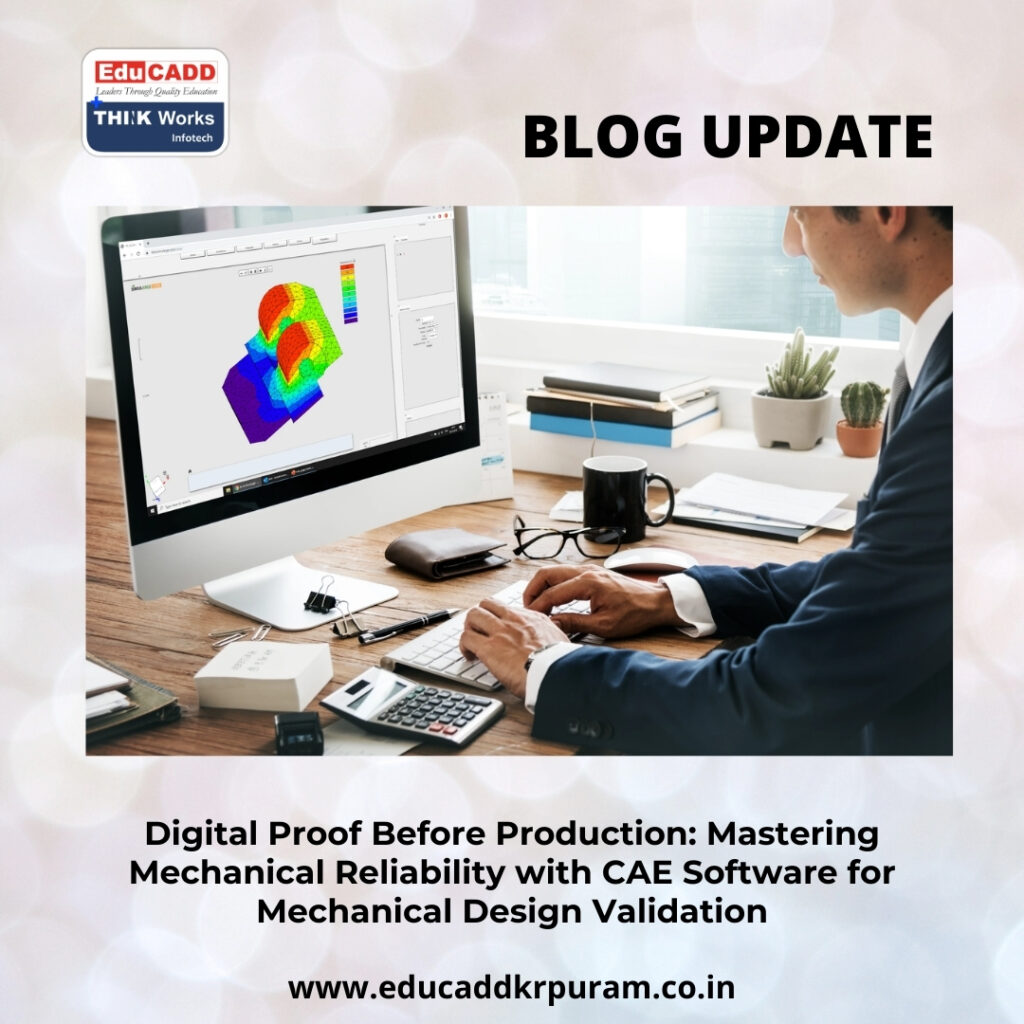
Mechanical Design Validation Software
As a result, development teams can predict failures, optimize performance, and refine designs early in the process. This simulation-driven approach reduces uncertainty, conserves resources, and enhances engineering confidence. By embracing digital validation, industries are building smarter mechanical systems while minimizing risks associated with traditional testing methods.
1. Evolution of Mechanical Design in the Digital Engineering Era
Mechanical design methodologies have progressed significantly over the past few decades. Earlier, product development relied heavily on manual calculations, simplified assumptions, and repeated physical experimentation. These processes were time-consuming and often limited the ability to explore innovative ideas. However, digital transformation has reshaped engineering workflows by introducing intelligent modeling and simulation technologies. Mechanical Design Validation Software now allows engineers to create accurate virtual prototypes that behave like real mechanical systems under operational conditions.
This shift has enabled teams to identify design weaknesses much earlier than before. Engineers can test multiple design concepts rapidly without consuming materials or manufacturing resources. Moreover, digital tools allow seamless modifications, encouraging experimentation and performance optimization. As mechanical systems grow more complex, simulation platforms provide the precision needed to analyze intricate geometries and interconnected assemblies. The evolution toward virtual validation therefore represents a fundamental change in how mechanical products are designed, tested, and perfected.
2. Importance of Early-Stage Mechanical Design Validation
Validating a mechanical design at early development stages prevents costly complications later in production. When design flaws remain undetected, they can cause structural failures, operational inefficiencies, and safety hazards. Late-stage corrections also increase expenses due to tooling changes and production delays. Mechanical Design Validation Software addresses these challenges by enabling engineers to simulate operational conditions before manufacturing begins.
Through digital validation, engineers evaluate how components respond to stress, temperature shifts, repeated loading, and environmental influences. This predictive analysis highlights performance limitations that might otherwise go unnoticed. Early detection of issues allows teams to implement corrective improvements without disrupting manufacturing schedules. Additionally, validated designs improve customer satisfaction because products perform reliably throughout their lifecycle. Manufacturers benefit from reduced warranty claims and enhanced brand credibility. Consequently, early-stage validation serves as a strategic safeguard that ensures product reliability and long-term operational success.
3. Core Technologies Powering Engineering Simulation Platforms
Advanced simulation environments rely on multiple computational technologies to model different physical behaviors. CAE Software for Mechanical Design Validation integrates diverse analytical approaches to ensure complete and accurate performance evaluation.
Primary technologies involved include:
-
Finite Element Modeling for evaluating stress distribution and structural deformation
-
Fluid Flow Simulation for analyzing airflow behavior, turbulence patterns, and heat transfer
-
Dynamic Motion Analysis for understanding interactions among moving mechanical parts
-
Thermal Distribution Modeling for examining temperature variations within components
-
Fatigue Life Prediction for estimating durability under repetitive loading cycles
Each technique addresses a unique engineering challenge while contributing to overall design validation. By combining these methods, simulation platforms provide a comprehensive view of mechanical performance. Engineers can therefore make informed decisions based on realistic digital testing rather than assumptions.
4. Structural Performance Assessment Through Finite Element Modeling
Mechanical components must withstand operational forces without experiencing excessive deformation or fracture. Finite Element Modeling divides complex geometries into small interconnected sections that can be analyzed individually. CAE Software for Mechanical Design Validation uses this technique to calculate how structures react to various loading conditions with high precision.
This approach enables engineers to:
-
Detect stress concentration areas that may cause material failure
-
Predict deformation patterns under heavy mechanical loads
-
Optimize geometry to reduce weight while preserving strength
-
Evaluate structural joints, bolts, and welded connections
-
Simulate impact scenarios and pressure-induced stresses
Such detailed structural analysis ensures mechanical integrity across demanding environments. Engineers can refine designs by reinforcing vulnerable areas and selecting suitable materials. As a result, products achieve improved durability, safety, and performance reliability.
5. Enhancing Fluid and Thermal Efficiency with Simulation Tools
Fluid flow and heat transfer significantly influence the efficiency and stability of mechanical systems. From engine cooling mechanisms to aerodynamic vehicle designs, fluid behavior affects operational performance. Advanced simulation tools allow engineers to study these complex interactions digitally. Mechanical Design Validation Software provides powerful fluid and thermal modeling capabilities that reveal patterns difficult to observe in physical experiments.
Fluid and thermal simulations help engineers to:
-
Improve aerodynamic efficiency in transportation systems
-
Design advanced cooling channels for engines and electronics
-
Optimize performance of turbines, pumps, and compressors
-
Reduce energy losses in fluid transport pipelines
-
Evaluate interactions between fluids and structural components
These analyses help engineers enhance energy efficiency while preventing overheating and pressure-related issues. By refining airflow paths and heat dissipation systems, designers can achieve improved mechanical performance and longer component lifespan.
6. Motion and Mechanism Optimization Using Dynamic Simulation
Mechanical assemblies frequently involve interconnected parts that move simultaneously. Understanding their motion behavior is essential for ensuring smooth performance and reducing mechanical wear. Dynamic simulation analyzes movement patterns, forces, velocities, and accelerations within assemblies. CAE Software for Mechanical Design Validation provides accurate digital environments where engineers can visualize and refine motion behavior.
Key advantages of motion simulation include:
-
Accurate visualization of mechanism movement paths
-
Evaluation of gear contact and transmission efficiency
-
Performance assessment of suspension and steering systems
-
Identification of vibration sources and noise reduction strategies
-
Prevention of component collisions during machine operation
Through these capabilities, engineers can enhance the functional efficiency of machinery, robotics, and automotive systems. Dynamic validation also helps extend component lifespan by minimizing friction and mechanical stress.
7. Thermal Stability and Fatigue Resistance Evaluation
Mechanical systems operating under extreme conditions often face temperature fluctuations and repetitive stress cycles. Excess heat can weaken materials, while continuous loading may initiate microscopic cracks that expand gradually. CAE Software for Mechanical Design Validation incorporates thermal and fatigue analysis to predict long-term component reliability.
Thermal modeling helps engineers identify hotspots and design efficient cooling systems that maintain safe operating temperatures. Fatigue simulations estimate how many stress cycles a component can withstand before failure occurs. Combining these analyses ensures products remain durable even under demanding workloads. Predictive durability testing reduces unexpected breakdowns and improves maintenance planning. Consequently, mechanical systems achieve extended operational life and enhanced performance stability.
8. Virtual Prototyping for Faster Product Development Cycles
Physical prototyping consumes substantial time, materials, and financial resources. Virtual prototyping offers a faster and more cost-effective alternative by allowing engineers to evaluate digital models in simulated environments. CAE Software for Mechanical Design Validation supports rapid design iterations without requiring physical fabrication.
Engineers can modify design parameters instantly and observe simulation results in real time. This flexibility encourages experimentation with alternative materials and innovative geometries. Additionally, virtual testing enables performance evaluation under extreme conditions that may be difficult to reproduce physically. Digital validation reduces production delays and supports environmentally sustainable practices by minimizing material waste. Faster development cycles ultimately improve market responsiveness and product competitiveness.
9. Integration of Simulation Tools with Design and Data Platforms
Efficient product development requires smooth coordination between design, analysis, and data management systems. CAD software creates geometric models, while data platforms track revisions and documentation. CAE Software for Mechanical Design Validation integrates seamlessly with these technologies to create unified engineering workflows.
Engineers can update design geometry and run simulations simultaneously, eliminating redundant modeling efforts. Real-time validation feedback accelerates design optimization and prevents communication gaps between departments. Centralized data management improves traceability and regulatory compliance. Integrated digital ecosystems therefore streamline development processes while ensuring consistent product quality.
10. Industrial Applications Driving Simulation Adoption
Digital validation technologies support numerous industries where mechanical reliability and safety remain critical priorities. CAE Software for Mechanical Design Validation offers specialized analysis solutions tailored to diverse engineering sectors.
Industries benefiting from simulation-driven validation include:
-
Automotive engineering for crashworthiness and powertrain efficiency
-
Aerospace technology for structural safety and thermal protection
-
Heavy machinery manufacturing for operational durability
-
Energy generation for turbine performance and pipeline reliability
-
Consumer electronics for heat management and structural resilience
These varied applications demonstrate the adaptability of simulation platforms across different engineering challenges. Industry-specific modeling ensures products comply with performance standards while meeting strict safety regulations.
11. Financial Benefits of Simulation-Led Engineering
Managing engineering costs effectively is essential for maintaining profitability and competitiveness. Simulation-driven validation significantly reduces expenses associated with physical testing and late-stage redesigns. Mechanical Design Validation Software enables early detection of performance issues, preventing costly production modifications.
Digital testing minimizes material waste and reduces dependency on multiple prototype iterations. Optimized designs also consume fewer resources during manufacturing and operation. Shortened development cycles allow companies to introduce products to market faster, increasing revenue opportunities. Over time, investments in digital validation technologies yield substantial economic advantages through streamlined engineering operations.
12. Encouraging Engineering Creativity Through Digital Experimentation
Innovation thrives when engineers can test creative ideas without excessive risk. Digital simulation platforms provide safe environments for exploring unconventional design approaches. CAE Software for Mechanical Design Validation supports rapid experimentation with alternative materials, lightweight structures, and advanced geometries.
Optimization algorithms further enhance creativity by recommending performance improvements automatically. Engineers can compare multiple design options quickly and select the most efficient solution. These tools encourage development of sustainable, high-performance products that meet evolving industry demands. Continuous advancements in computing power expand simulation accuracy, enabling engineers to explore increasingly complex mechanical systems.
13. Overcoming Implementation Challenges in Simulation Adoption
Adopting advanced simulation technologies may present initial challenges for organizations unfamiliar with digital engineering systems. Software costs, hardware requirements, and specialized training needs can create implementation barriers. Additionally, interpreting simulation outputs accurately requires skilled professionals.
Errors in boundary conditions or material data may lead to inaccurate predictions. However, structured training programs help engineers develop analytical expertise. Cloud-based CAE Software for Mechanical Design Validation reduces infrastructure costs by enabling remote high-performance computing. Collaboration with experienced simulation specialists further ensures successful technology integration. With strategic planning and proper support, organizations can overcome these challenges and unlock the full potential of digital validation tools.
14. Future Innovations Transforming Mechanical Design Validation
Emerging technologies continue enhancing the effectiveness of digital engineering platforms. Artificial intelligence assists simulation processes by predicting performance outcomes and automating optimization tasks. Machine learning algorithms analyze historical engineering data to improve modeling accuracy.
Cloud computing supports large-scale simulations without requiring expensive local hardware. Digital twin technology enables real-time replication of physical systems, allowing continuous monitoring and predictive maintenance. Additive manufacturing also benefits from simulation-based material optimization and structural verification. CAE Software for Mechanical Design Validation will continue evolving through intelligent automation, advanced analytics, and smart material modeling, shaping the next generation of precision engineering.
Conclusion
Modern mechanical engineering demands accurate validation, rapid development, and consistent performance reliability. Mechanical Design Validation Software empowers engineers to meet these expectations through advanced digital simulation technologies. By replacing traditional trial-and-error testing with predictive modeling, organizations reduce development risks and optimize product performance. Integrated workflows enhance collaboration between design and manufacturing teams, while virtual prototyping accelerates innovation cycles.
Although implementation requires technical expertise and investment, long-term benefits include reduced costs, improved product quality, and faster market readiness. As industries embrace smarter manufacturing strategies, digital validation will remain a cornerstone of engineering excellence, enabling the creation of safe, efficient, and high-performance mechanical systems.

