
Beyond Spreadsheets: Intelligent Construction Project Monitoring with Primavera Dashboards
Construction projects rarely move in a straight line. They evolve through design revisions, shifting site conditions, fluctuating material costs, and continuous coordination between multiple stakeholders. In this environment, effective monitoring becomes the backbone of project success. Without structured oversight, even well-planned projects can drift off schedule or exceed budget. That is why intelligent monitoring systems have become essential in Primavera Construction Project Dashboards.
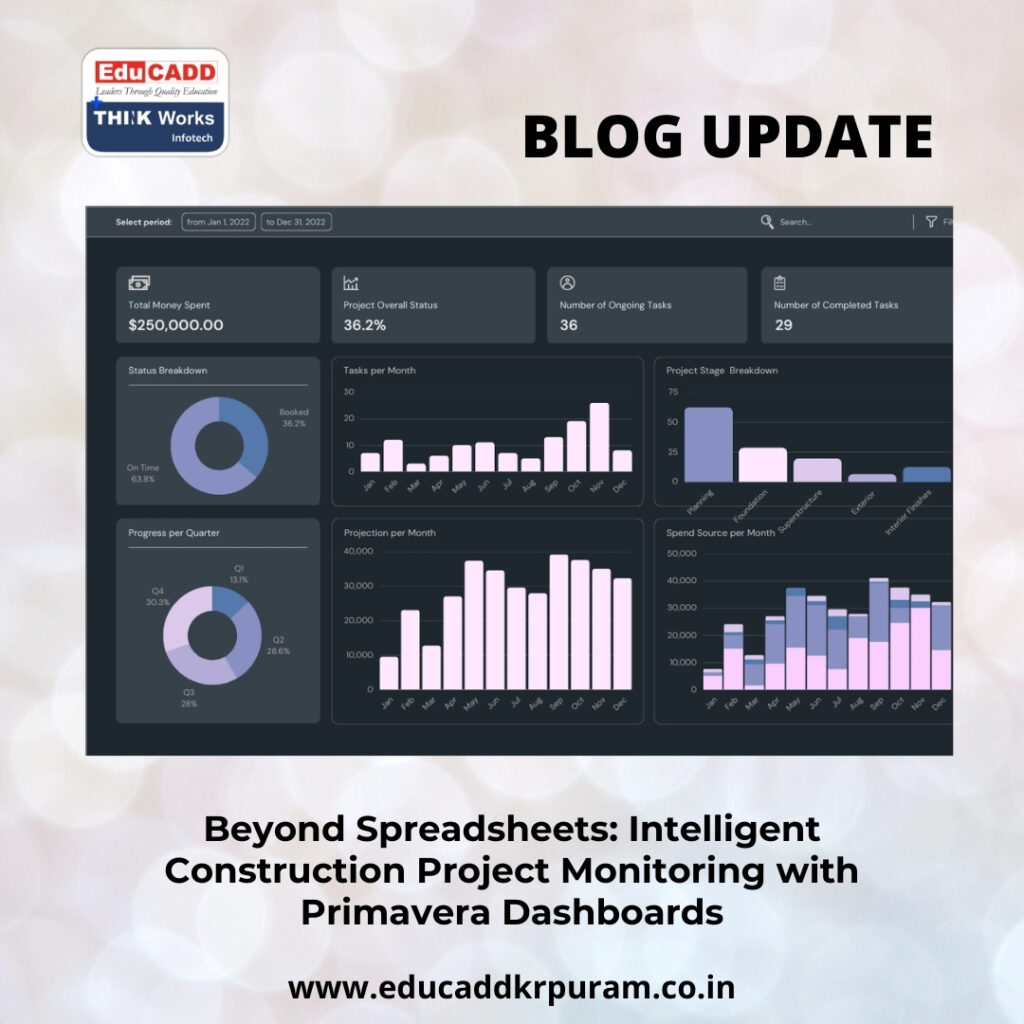
Primavera Construction Project Dashboards
Construction Project Monitoring with Primavera Dashboards provides a powerful framework for maintaining control over complex projects. Instead of relying on fragmented reports or disconnected spreadsheets, project teams gain access to a centralized, data-driven platform. These dashboards transform technical schedules, cost data, and resource allocations into clear visual insights. As a result, managers respond to challenges faster, communicate more effectively, and make confident decisions based on real-time performance metrics.
1. The Evolution of Monitoring in Construction
Primavera Construction Project Dashboards has progressed significantly over the past few decades. Earlier methods relied on paper-based documentation and manual tracking systems. Project managers often compiled weekly reports by collecting data from various departments. This approach consumed time and increased the possibility of errors.
As projects grew larger and more complex, traditional systems proved insufficient. Digital project management platforms emerged to streamline scheduling and budgeting. However, raw digital data alone did not guarantee clarity. Managers still needed a way to interpret performance quickly and accurately.
Primavera Construction Project Dashboards represents the next stage in this evolution. Dashboards convert large datasets into structured visual summaries. They eliminate information overload and focus attention on key indicators. This transition from static reports to interactive dashboards marks a significant improvement in project governance.
2. Why Visibility Determines Project Success
Visibility is essential for controlling any construction project. When managers lack clear insight into progress and performance, small issues can grow into serious problems. Delayed activities, unbalanced resources, and rising costs often remain unnoticed until corrective measures become expensive.
Primavera dashboards provide immediate access to essential metrics. Construction Project Monitoring with Primavera Dashboards ensures that project leaders view up-to-date information at any time. Instead of waiting for periodic updates, they monitor performance continuously.
This enhanced visibility strengthens accountability. Every team member understands their responsibilities and progress targets. Consequently, communication improves and misunderstandings decrease. Clear data presentation supports faster decisions and reduces project uncertainty.
3. Transforming Complex Schedules into Clear Insights
Large construction projects involve thousands of interconnected activities. Understanding relationships between tasks requires more than reviewing activity lists. Managers must identify critical paths, float values, and milestone dependencies efficiently.
Primavera dashboards simplify this complexity. They display schedule performance indicators, progress charts, and milestone tracking panels in an intuitive format. Construction Project Monitoring with Primavera Dashboards allows managers to detect deviations from baseline schedules immediately.
For example, if a critical activity experiences delay, visual alerts highlight the impact. Managers can then reallocate resources or adjust sequencing strategies. By focusing on visual trends rather than raw numbers, teams maintain stronger schedule discipline and prevent cascading delays.
4. Enhancing Financial Oversight Through Real-Time Data
Financial management remains one of the most challenging aspects of construction. Material price fluctuations, change orders, and unforeseen site conditions affect budgets continuously. Without precise monitoring, financial control weakens quickly.
Primavera dashboards integrate cost metrics directly with schedule data. Construction Project Monitoring with Primavera Dashboards provides a comprehensive view of budget performance through earned value analysis and cost performance indicators.
Managers compare planned expenditure with actual costs in real time. When discrepancies appear, they investigate immediately. This proactive approach reduces the risk of major overruns and improves forecasting accuracy. Transparent cost monitoring also builds trust with investors and clients.
5. Resource Management and Workforce Optimization
Efficient resource allocation drives productivity and profitability. Construction projects require careful coordination of labor, equipment, and materials. Overloading teams results in burnout and reduced quality, while underutilization wastes financial resources.
Primavera dashboards present resource histograms and allocation charts that reveal workload distribution. Construction Project Monitoring with Primavera Dashboards enables managers to balance assignments across project phases effectively.
If a particular team faces excessive workload, managers adjust schedules or redistribute tasks. Balanced resource planning minimizes delays and maintains consistent output. Moreover, optimized allocation enhances team morale and operational efficiency.
6. Proactive Risk Monitoring and Mitigation
Risk management is integral to construction project control. Weather disruptions, regulatory changes, and supply chain interruptions introduce uncertainty. Identifying risks early reduces their potential impact.
Primavera dashboards incorporate risk indicators into performance monitoring systems. Construction Project Monitoring with Primavera Dashboards highlights high-risk activities and flags deviations from established baselines.
By analyzing trends and warning signals, managers implement preventive measures promptly. Instead of reacting to crises, they anticipate challenges. This proactive risk management strengthens project stability and protects both timelines and budgets.
7. Strengthening Collaboration Across Departments
Construction projects involve coordination between designers, engineers, contractors, suppliers, and clients. Effective communication ensures alignment among all stakeholders. Fragmented data often creates confusion and misinterpretation.
Primavera dashboards provide a unified platform where authorized users access consistent information. Construction Project Monitoring with Primavera Dashboards reduces dependency on lengthy email exchanges and disconnected spreadsheets.
During review meetings, visual summaries replace complex textual explanations. Clear charts and performance indicators streamline discussions and focus attention on solutions. Improved collaboration enhances efficiency and reduces conflict.
8. Supporting Executive-Level Portfolio Management
Large organizations frequently manage multiple projects simultaneously. Monitoring individual projects separately limits strategic oversight. Executives require consolidated insights into overall portfolio performance.
Primavera dashboards allow portfolio-level reporting by aggregating data from multiple projects. Construction Project Monitoring with Primavera Dashboards enables leadership teams to evaluate performance trends across locations and departments.
This holistic perspective supports strategic resource allocation and capital planning. Executives identify high-performing projects and intervene where necessary. Portfolio dashboards strengthen organizational governance and long-term planning.
9. Customization for Diverse Project Requirements
Every construction project differs in scope, complexity, and stakeholder expectations. Therefore, monitoring systems must adapt to specific objectives.
Primavera Construction Project Dashboards offer flexible customization options. Construction Project Monitoring with Primavera Dashboards allows organizations to define key performance indicators aligned with project goals.
For example, infrastructure projects may prioritize schedule adherence and resource productivity, while commercial developments focus on cost efficiency and client reporting. Tailored dashboards enhance relevance and user engagement. Customization ensures that monitoring remains meaningful and actionable.
10. Integration with Digital Construction Technologies
Digital transformation continues to reshape construction management. Technologies such as Building Information Modeling (BIM), enterprise resource planning systems, and cloud collaboration platforms enhance data accuracy and accessibility.
Primavera dashboards integrate seamlessly with these technologies. Construction Project Monitoring with Primavera Dashboards ensures synchronized information flow across systems.
This integration eliminates duplication and reduces manual data entry. Consequently, teams maintain consistency and reliability in performance reporting. Unified digital ecosystems improve efficiency and strengthen decision-making processes.
11. Data-Driven Decision Making and Predictive Insights
Modern construction management emphasizes data-driven leadership. Managers must base decisions on measurable evidence rather than intuition. Primavera dashboards provide analytical tools that support informed choices.
Construction Project Monitoring with Primavera Dashboards enables trend analysis and performance forecasting. By reviewing historical data, managers predict potential delays or cost overruns before they occur.
Predictive insights transform monitoring from a reactive process into a strategic advantage. Organizations that leverage analytics improve accuracy in planning and enhance competitive positioning.
12. Implementation Strategies for Effective Dashboard Use
Successful implementation requires careful planning. Organizations should define clear objectives before designing dashboards. Identifying relevant performance indicators ensures alignment with strategic goals.
Training plays a critical role in maximizing dashboard value. Construction Project Monitoring with Primavera Dashboards delivers results only when users interpret metrics accurately. Teams must understand how schedule indices, cost indicators, and resource charts function.
Regular data updates maintain reliability. Establishing governance protocols ensures consistent reporting standards. Continuous review and refinement keep dashboards aligned with evolving project requirements.
13. Driving Continuous Improvement Through Performance Analysis
Monitoring does not end with project completion. Historical data provides valuable insights for future planning. Primavera dashboards store performance records that organizations analyze for improvement.
Construction Project Monitoring with Primavera Dashboards supports benchmarking and performance comparison. Managers evaluate which strategies produced positive outcomes and which require adjustment.
This continuous learning approach enhances scheduling accuracy, cost estimation precision, and risk mitigation strategies. Over time, organizations develop stronger operational frameworks and deliver projects more efficiently.
14. The Future of Intelligent Monitoring in Construction
The future of construction monitoring lies in intelligent automation and advanced analytics. Artificial intelligence and machine learning technologies are expanding dashboard capabilities. Predictive modeling and automated alerts will further enhance proactive management.
Construction Project Monitoring with Primavera Dashboards will continue evolving to meet industry demands. Real-time data integration, mobile accessibility, and advanced visualization tools will shape next-generation monitoring systems.
Organizations that adopt intelligent dashboards today position themselves for long-term success. As project complexity increases, structured digital oversight becomes indispensable. Primavera dashboards offer a scalable, adaptable, and strategic solution for maintaining control in a rapidly changing industry.
Conclusion
Effective construction management depends on clarity, coordination, and control. Traditional monitoring approaches cannot address the demands of modern projects. Intelligent dashboards provide the structure necessary for precise oversight.
Primavera Construction Project Dashboards transforms scattered information into actionable intelligence. It enhances schedule management, strengthens financial control, optimizes resources, and improves stakeholder communication.
By embracing data-driven monitoring, organizations achieve greater transparency and operational efficiency. They respond to risks proactively and maintain alignment with strategic objectives. In a competitive construction landscape, structured dashboard monitoring becomes a powerful differentiator that drives sustainable success.

