
Mastering Project Timelines: How Primavera Software Transforms Scheduling
Every ambitious project, whether in construction, engineering, oil and gas, infrastructure, or manufacturing, relies on precise scheduling. Without a well-structured plan, even the most promising projects can face delays, resource shortages, and cost overruns. In modern project management, relying on manual charts or basic spreadsheet tools is no longer sufficient. Complex projects demand tools that offer clarity, control, and foresight. Primavera Project Scheduling Software has emerged as a cornerstone for organizations that aim to execute large, multi-faceted projects efficiently. Developed by Oracle, Primavera goes far beyond conventional scheduling. It combines robust planning, resource management, risk analysis, and reporting into a unified platform. It empowers project managers to visualize dependencies, track progress, allocate resources, and anticipate challenges long before they become problems.
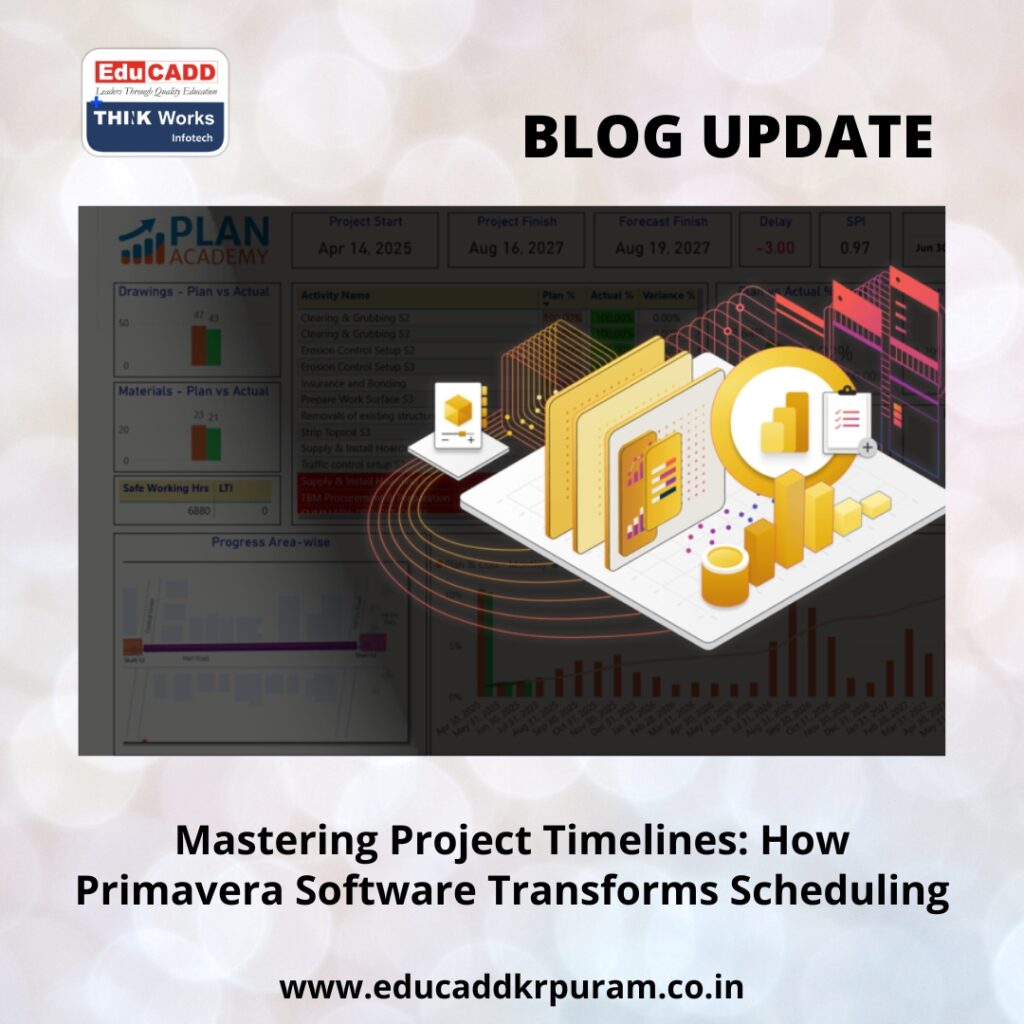
Primavera Project Scheduling Software
This blog delves into the advantages of Primavera software in scheduling, exploring its key features and why it has become an indispensable tool for project managers worldwide.
1. Handling Complexity with Ease
Large-scale projects often involve thousands of tasks, multiple teams, and overlapping timelines. Traditional tools cannot manage such complexity without errors or slow performance. Primavera software scheduling, however, is engineered to manage enterprise-level projects seamlessly.
Project managers can break projects into hierarchical components and maintain visibility over every task. Even when schedules span years or involve multiple contractors, Primavera remains stable and responsive. This capability allows teams to focus on execution rather than struggling with the limitations of simpler tools.
By managing complexity effectively, Primavera software scheduling becomes a strategic asset, enabling organizations to take on ambitious projects with confidence.
2. Structured Work Breakdown for Clarity
Every project begins with a clear roadmap, and this is where the Work Breakdown Structure (WBS) plays a pivotal role. Primavera software scheduling allows users to create detailed WBS hierarchies that link directly to deliverables and milestones.
This structure ensures transparency. Each team member understands their responsibilities, deadlines, and how their work contributes to the larger project. Tasks can be nested logically, making tracking and reporting simpler and more precise.
Moreover, Primavera allows dynamic adjustments to the WBS. When project scopes change, managers can reorganize tasks without starting over. This adaptability is essential for projects that evolve over time.
3. Advanced Task Dependencies for Realistic Scheduling
Real-world projects rarely follow a linear timeline. Primavera software scheduling supports multiple dependency types, including Finish-to-Start, Start-to-Start, Finish-to-Finish, and Start-to-Finish.
This flexibility allows planners to create schedules that mirror actual workflows. By modeling real-life constraints and relationships, teams can anticipate bottlenecks and potential delays. Primavera’s dependency management ensures that schedules are not theoretical, but executable plans.
With this clarity, project managers can prioritize critical tasks, streamline sequencing, and maintain momentum across all project stages.
4. Critical Path Analysis for Precision Planning
Identifying the tasks that drive project completion is vital. Primavera software scheduling offers advanced Critical Path Method (CPM) analysis, providing managers with a clear understanding of which activities are essential to meet deadlines.
The software recalculates critical paths in real time as updates are entered, ensuring decisions are based on current conditions. Managers can identify risks and take corrective actions before they impact project delivery.
By highlighting float and slack, Primavera helps teams optimize timelines and focus efforts on high-impact activities, resulting in more predictable and reliable schedules.
5. Resource Planning and Efficient Allocation
Inefficient resource management is one of the primary causes of delays and budget overruns. Primavera software scheduling addresses this by allowing detailed assignment of labor, materials, and equipment to every task.
The system identifies over-allocation and conflicts instantly, enabling proactive resolution. Multiple calendars and resource profiles ensure that availability, shifts, and holidays are accounted for accurately.
Through these features, Primavera transforms resource management from a reactive challenge into a proactive planning process, improving both efficiency and productivity.
6. Integrated Cost Management and Time Tracking
Cost and schedule are inseparably linked in project management. Primavera software scheduling integrates both dimensions, providing visibility into budgets, expenditures, and timelines simultaneously.
Earned value management, including metrics like Planned Value (PV), Actual Cost (AC), and Earned Value (EV), can be tracked directly within the schedule. This allows project managers to compare financial and time performance at every stage.
By linking costs to activities, Primavera ensures that every decision considers both time and budget implications, enabling smarter, financially sound planning.
7. Proactive Risk Assessment
Every project carries inherent risks. Primavera software scheduling supports risk identification and mitigation by analyzing dependencies, slack, and resource constraints.
Teams can simulate “what-if” scenarios to forecast potential delays and resource conflicts. This proactive approach allows managers to implement contingency plans and reduce reactive problem-solving.
The result is a schedule that not only plans the work but anticipates challenges, making projects more resilient and less vulnerable to unforeseen disruptions.
8. Baseline Management for Performance Control
Baselines are crucial for measuring progress. Primavera software scheduling allows users to set multiple baselines and compare them against actual progress.
This feature helps managers identify deviations, understand causes, and take corrective action. By tracking schedule adherence in real time, organizations maintain accountability and ensure that projects remain aligned with initial objectives.
Baseline management transforms Primavera from a planning tool into a performance control platform, giving managers measurable insights into project health.
9. Real-Time Tracking and Dynamic Forecasting
Accurate forecasting relies on timely data. Primavera software scheduling supports real-time updates at both task and resource levels.
As actual start and finish dates are entered, the system recalculates projected completion dates automatically. Managers can monitor progress continuously and anticipate bottlenecks before they become critical.
This dynamic capability ensures that schedules remain relevant throughout the project lifecycle, enabling informed decision-making and reducing the likelihood of costly surprises.
10. Collaborative Multi-User Environment
Large projects involve multiple stakeholders, often spread across locations. Primavera software scheduling supports collaborative, multi-user environments with role-based access.
Each team member can view and update tasks relevant to their responsibilities. Planners, engineers, and executives work from the same reliable data source, reducing miscommunication and errors.
This collaborative approach ensures alignment across teams, improving coordination, efficiency, and overall project performance.
11. Custom Reports and Dashboards
Primavera software scheduling provides robust reporting tools, transforming complex project data into actionable insights. Users can generate customized dashboards, charts, and reports tailored to stakeholders’ needs.
Decision-makers can quickly grasp project status, identify problem areas, and prioritize interventions. Clear visualization strengthens leadership confidence and accelerates approvals.
By turning raw data into meaningful intelligence, Primavera empowers teams to make proactive, data-driven decisions.
12. Integration with Enterprise Systems
Modern projects require integration across platforms. Primavera software scheduling works seamlessly with ERP, BIM, and financial systems.
This connectivity ensures that scheduling, cost, procurement, and execution data remain consistent across all departments. Teams avoid duplication of effort and reduce errors caused by disconnected systems.
Integration with enterprise platforms makes Primavera software scheduling a central hub for end-to-end project management.
13. Global Recognition and Professional Advantage
Primavera software scheduling is recognized worldwide as a standard for professional project management. Organizations value certified Primavera users for their ability to manage complex schedules efficiently.
Professionals skilled in Primavera enjoy enhanced career opportunities, as the software demonstrates their capability to handle large, high-value projects.
By mastering Primavera, individuals and teams position themselves as indispensable contributors to project success, creating long-term professional value.
14. Scalability Across Project Lifecycles
Projects evolve, expand, and often face unforeseen changes. Primavera software scheduling scales effortlessly to accommodate these dynamics.
From early planning to project closeout, the platform maintains accuracy, performance, and visibility. Whether handling a single project or an entire portfolio, Primavera adapts without losing effectiveness.
This scalability ensures that organizations can rely on Primavera software scheduling as a long-term solution for project control and lifecycle management.
Conclusion
Primavera Project Scheduling Software is more than a planning tool—it is a strategic asset that transforms how organizations manage time, resources, and risks. Its robust capabilities in scheduling, resource allocation, cost integration, risk management, and reporting empower project managers to deliver projects on time and within budget.
By adopting Primavera, organizations gain control, clarity, and predictability. Professionals gain valuable skills and a competitive edge in the global marketplace.
Ultimately, Primavera software scheduling ensures that complex projects are executed efficiently, deadlines are met, and objectives are achieved, solidifying its position as the backbone of modern project management.

