
The Art and Accuracy of RCC Detailing in Civil CADD: Building Strong Structures Through Smart Drafting
Every strong structure begins with a solid design, but it reaches completion only when that design is translated into precise construction drawings. RCC Detailing in Civil depend heavily on accurate reinforcement placement. Even the most advanced structural calculations will fail to deliver intended performance if reinforcement is not detailed correctly. That responsibility falls on RCC detailing, a specialized process that converts engineering design into clear, practical, and executable drawings.
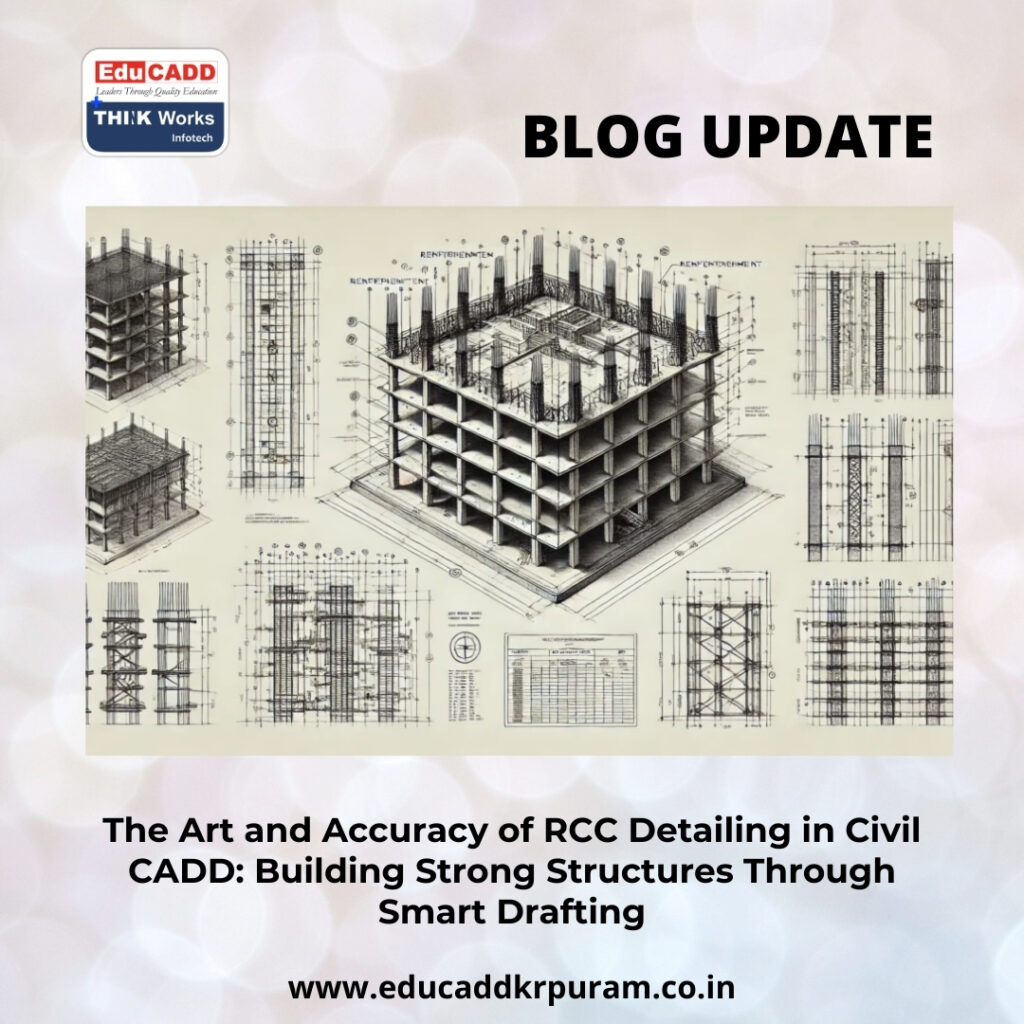
RCC Detailing in Civil
With the advancement of technology, Civil CADD has become an indispensable tool in this field. It enables engineers and detailers to prepare reinforcement drawings with speed, precision, and clarity. RCC Detailing in Civil not only improves drafting efficiency but also enhances coordination, reduces errors, and ensures that construction teams receive reliable information. This detailed blog explores the complete landscape of RCC detailing, including its principles, workflow, tools, standards, challenges, professional skills, and future prospects.
1. Understanding the Foundation of RCC Detailing
RCC Detailing in Civil is the process of preparing comprehensive reinforcement drawings for concrete structures. Structural engineers calculate loads, bending moments, shear forces, and reinforcement requirements. However, construction workers require more than calculations. They need clear visual instructions that show exactly where each reinforcement bar must be placed.
Detailing bridges this gap. It specifies bar diameters, spacing, lengths, lap positions, hooks, bends, and anchorage details. Each structural element, such as beams, slabs, columns, and foundations, demands specific reinforcement arrangements. Therefore, detailers must understand both structural behavior and practical construction requirements.
Civil CADD simplifies this translation process. Instead of hand-drawn sketches, engineers use digital drafting tools to create precise reinforcement layouts. This approach minimizes interpretation errors and enhances drawing clarity. As a result, RCC detailing ensures that the structure built on site matches the engineer’s design intent.
2. Why RCC Detailing Plays a Critical Role in Construction
In modern construction, projects involve tight schedules, large budgets, and strict safety standards. Under such conditions, clarity in structural drawings becomes essential. Poor detailing can lead to reinforcement congestion, incorrect lap placement, insufficient concrete cover, or even structural weaknesses.
Accurate RCC detailing prevents these issues. It ensures that reinforcement placement follows structural design standards. When reinforcement is placed correctly, load transfer becomes efficient and structural durability improves.
Civil CADD strengthens this reliability by allowing quick modifications and easy error correction. If structural revisions occur, detailers can update reinforcement layouts without redrawing entire sheets. Consequently, project timelines remain stable.
Moreover, detailed reinforcement drawings improve communication between engineers, contractors, and site supervisors. Clear instructions reduce misunderstandings and rework. Thus, RCC detailing in Civil CADD directly contributes to project efficiency and structural safety.
3. Core Structural Elements in RCC Detailing
Each structural component requires unique reinforcement detailing techniques. Beams typically contain bottom reinforcement to resist tension, top bars for negative moments, and stirrups for shear resistance. Detailers must indicate anchorage lengths and bar curtailment positions accurately.
Slabs involve main reinforcement in one direction and distribution reinforcement in the other. In two-way slabs, reinforcement runs in both directions, and spacing must be maintained precisely.
Columns require vertical bars that resist compressive forces, along with ties or spirals that provide lateral confinement. Lap splices in columns must be staggered to maintain strength continuity.
Foundations and footings support the entire structure. They include bottom reinforcement layers and column dowels that connect structural elements. Correct detailing ensures uniform load distribution to the soil.
Civil CADD enables precise drafting of these components. Using digital tools, detailers can prepare plan views, sectional details, and reinforcement layouts that guide on-site execution efficiently.
4. Step-by-Step Workflow in Civil CADD for RCC Detailing
The detailing process begins with a careful review of structural design drawings. Detailers analyze general arrangement drawings, beam schedules, slab details, and reinforcement specifications.
Next, they configure the Civil CADD environment. Units, scales, and layers are defined properly. Structured layer management keeps reinforcement, dimensions, and annotations organized.
The structural outline is drafted first. Afterward, reinforcement bars are inserted according to design calculations. Spacing and bar diameters are carefully maintained.
Section views are then created to illustrate internal reinforcement placement. These sections provide clarity for site workers.
Bar marks are assigned to each reinforcement type. These marks correspond to entries in the bar bending schedule, which lists quantities and cutting lengths.
Before issuing drawings, thorough checks are performed. Dimensions, lap positions, and cover distances are verified to ensure compliance and accuracy.
5. Essential Civil CADD Commands for Reinforcement Drafting
Civil CADD offers powerful tools that enhance RCC detailing productivity. Basic commands such as line, polyline, offset, and trim help create structural outlines.
Copy and array functions simplify repetitive reinforcement placement. For example, slab bars with uniform spacing can be generated quickly using array commands.
Blocks are used to store standard bar shapes, stirrups, hooks, and symbols. Reusing blocks saves time and ensures consistency.
Dimension and text tools improve drawing readability. Layer control maintains organized drafting, allowing different elements to be edited easily.
Mastering these commands increases efficiency and supports professional-quality RCC detailing.
6. The Importance of Bar Bending Schedules
The bar bending schedule, often referred to as BBS, is a detailed list of reinforcement bars used in a project. It includes bar marks, diameters, shapes, lengths, quantities, and total weight.
Contractors rely on the BBS for procurement and steel cutting. Accurate scheduling reduces material wastage and prevents shortages.
Civil CADD facilitates BBS preparation by linking bar marks with schedule tables. However, detailers must calculate cutting lengths correctly, considering bends and hooks.
Since reinforcement steel represents a major cost component, accurate BBS preparation improves cost control and resource management.
7. Code Compliance and Standard Practices
RCC Detailing in Civil must follow structural codes and industry guidelines. These codes specify minimum reinforcement percentages, development lengths, lap requirements, and concrete cover values.
Detailers must interpret design instructions correctly and apply code provisions in drawings. Clear labeling and standardized notation enhance compliance.
Regular updates to structural standards require continuous learning. Professionals who stay informed maintain higher levels of accuracy and reliability.
8. Coordination Between Engineering and Site Teams
Successful RCC detailing depends on effective communication. Structural engineers provide reinforcement calculations and design intent. Detailers convert these into practical drawings.
Site engineers rely on these drawings for execution. Therefore, clarity and accuracy remain crucial.
Digital sharing through Civil CADD improves coordination. Drawings can be reviewed, revised, and approved quickly.
Strong teamwork ensures that reinforcement placement matches structural design without confusion.
9. Common Errors and Preventive Measures
Even with advanced tools, detailing errors can occur. Reinforcement congestion often results from poor planning. Proper spacing must be maintained to allow concrete compaction.
Incorrect lap placement can weaken structural continuity. Laps should be staggered and positioned carefully.
Ambiguous annotations may confuse site workers. Therefore, clear notes and consistent dimensioning are essential.
Systematic checking procedures reduce such errors and enhance drawing reliability.
10. Benefits of Digital RCC Detailing
Digital drafting improves speed, precision, and document management. Modifications can be implemented quickly without affecting overall drawing structure.
Storage and retrieval of digital files become simple. Archived projects remain accessible for future reference.
Reduced rework and optimized steel estimation contribute to cost savings.
As construction complexity increases, digital RCC detailing becomes increasingly valuable.
11. Skills Required for Professional Detailers
RCC detailers must possess technical knowledge of structural principles. Understanding load paths and reinforcement behavior enhances drawing accuracy.
Proficiency in Civil CADD commands improves productivity. Attention to detail ensures error-free documentation.
Strong communication skills support coordination with engineers and contractors.
Continuous practice and professional training strengthen expertise in RCC detailing.
12. Career Opportunities in RCC Detailing
The demand for skilled reinforcement detailers continues to grow. Construction firms and structural consultancies actively recruit professionals with Civil CADD expertise.
Entry-level roles may include CAD technician or junior detailer positions. With experience, professionals can advance to senior detailing or coordination roles.
Specialization in RCC detailing opens doors to infrastructure, residential, and commercial construction projects.
13. Emerging Technologies in Structural Drafting
While Civil CADD remains widely used, 3D modeling and BIM integration are gaining popularity. These tools enhance visualization and clash detection.
However, strong foundational knowledge of reinforcement detailing remains essential.
Professionals who combine RCC detailing skills with digital adaptability will thrive in the evolving construction landscape.
Conclusion
RCC Detailing in Civil forms the backbone of reinforced concrete construction. It ensures that structural designs are implemented accurately on site. Civil CADD enhances this process by delivering precision, efficiency, and flexibility.
From understanding reinforcement fundamentals to preparing bar bending schedules and coordinating with site teams, RCC detailing demands skill and responsibility. As construction projects become more complex, the importance of accurate detailing continues to rise.
By mastering RCC detailing in Civil CADD, professionals contribute directly to structural safety, cost efficiency, and project success. Through continuous learning and dedication, detailers can build rewarding careers while shaping the future of modern construction.

