
Beyond 3D Models: How a V-Ray Rendering Course Helps You Create Visual Experiences That Inspire
Creating a great design is only half the journey; presenting it in a way that captivates clients is equally important. Modern architecture, interior design, engineering, and product development rely heavily on photorealistic visualization to communicate ideas with clarity and precision. Technical drawings and simple 3D models often fail to showcase the true beauty of a project, making advanced rendering skills more valuable than ever. A V-Ray Rendering Course Benefits empowers students and professionals to transform ordinary digital models into visually stunning presentations using realistic lighting, textures, materials, and environmental effects.
V-Ray Rendering Course Benefits
Whether you are an aspiring designer, an architect, an engineer, or a freelancer, learning V-Ray can elevate your creativity, improve your technical expertise, and unlock exciting career opportunities. With practical knowledge and consistent practice, you can produce professional renderings that not only impress clients but also strengthen your portfolio and establish your reputation in the competitive design industry.
The Growing Need for High-Quality Architectural Visualization
The design industry has experienced a significant transformation over the last decade. Clients now expect to see lifelike visual representations before approving construction, renovation, or manufacturing projects. This demand has made rendering an essential part of the design workflow rather than an optional service. A V-Ray Rendering Course Benefits prepares learners to meet these expectations by teaching them how to create images that accurately represent real-world spaces.
Moreover, photorealistic renderings reduce misunderstandings between designers and clients because every detail becomes visible before execution begins. As a result, organizations save time, minimize costly revisions, and improve customer satisfaction through effective visual communication.
Understanding Why V-Ray Leads the Rendering Industry
Among numerous rendering engines available today, V-Ray has established itself as one of the most trusted solutions for producing realistic images. Its advanced rendering technology enables users to create natural lighting, detailed reflections, soft shadows, and accurate material behavior. A V-Ray Rendering Course Benefits introduces students to these powerful capabilities while explaining how the software integrates with platforms such as SketchUp, Revit, Rhino, 3ds Max, and other leading modeling applications.
Furthermore, V-Ray provides exceptional flexibility for both beginners and experienced professionals. Its wide range of rendering options allows users to achieve remarkable results across architectural visualization, interior design, product rendering, landscape design, and animation projects.
Building Strong Rendering Skills from the Ground Up
Learning rendering requires more than simply understanding software commands. A structured V-Ray Rendering Course Benefits begins with the fundamentals, ensuring every student develops a strong technical foundation before progressing toward advanced visualization techniques.
During the training, learners become familiar with project setup, navigation tools, rendering workflows, asset management, quality settings, and scene organization. They gradually develop confidence through practical assignments that simulate professional design projects, making it easier to apply classroom knowledge to real-world situations.
Creating Realistic Lighting That Brings Every Design to Life
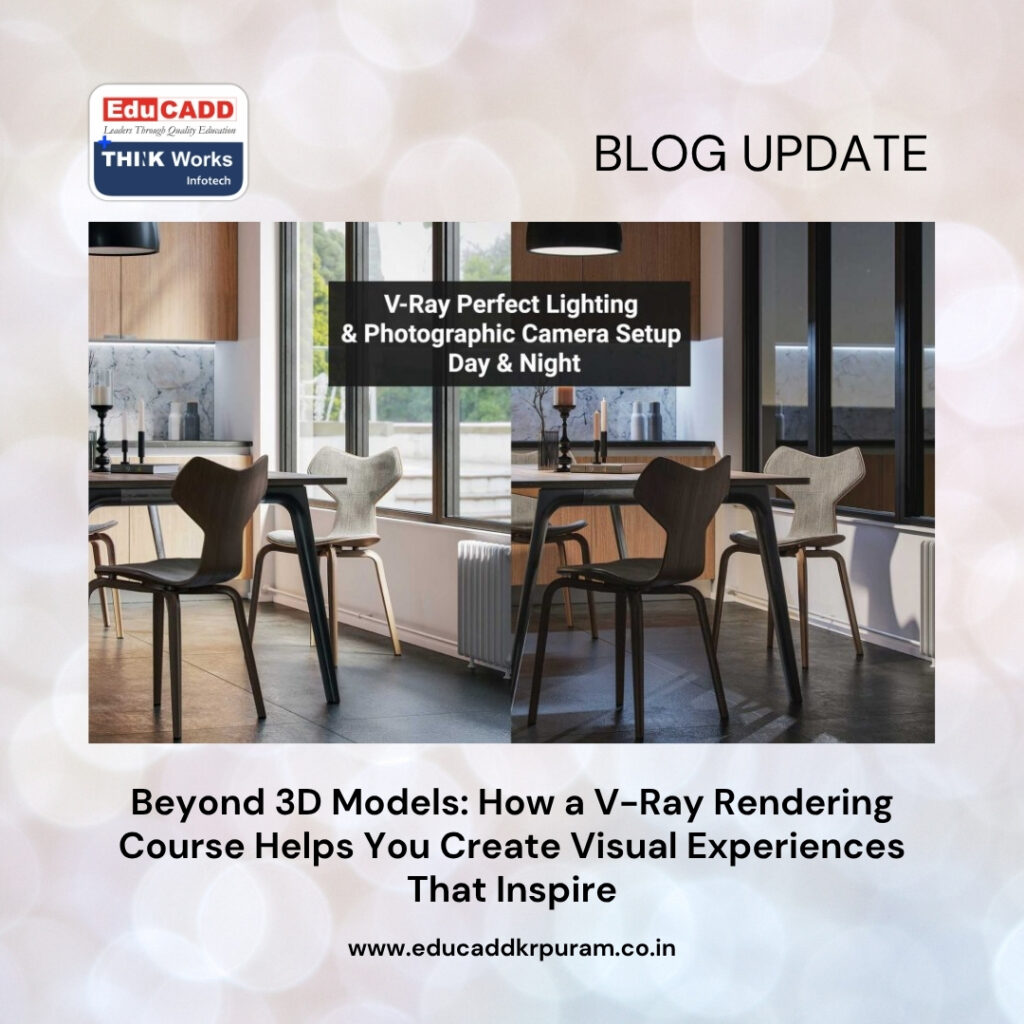
Lighting is one of the most influential elements in digital visualization because it determines the mood, realism, and visual impact of every rendered image. Without proper lighting, even perfectly modeled structures can appear flat and unrealistic. A V-Ray Rendering Course Benefits provides in-depth knowledge of daylight systems, artificial lighting, global illumination, exposure settings, and shadow control.
Students also learn how different lighting conditions affect architectural spaces throughout the day. By mastering these techniques, they produce renderings that feel vibrant, balanced, and visually convincing while highlighting important design features.
Enhancing Every Surface with Advanced Materials and Textures
One of the defining characteristics of photorealistic rendering is the accurate representation of surface materials. Wood, marble, steel, glass, concrete, leather, and fabric all require different material properties to appear authentic. A V-Ray Rendering Course teaches students how to create realistic shaders using reflection, refraction, glossiness, bump mapping, displacement, translucency, and texture adjustments.
Additionally, learners understand UV mapping techniques that ensure textures align naturally with 3D objects. These skills significantly improve rendering quality and create visually compelling design presentations.
Professional Camera Techniques for Better Visual Communication
Rendering is not simply about generating attractive images; it is also about guiding the viewer’s attention toward the most important aspects of a design. Camera positioning and composition play a crucial role in achieving this objective. A V-Ray Rendering Course explains how to use virtual cameras to create dynamic and engaging perspectives.
Students explore focal length adjustments, depth of field, field of view, exposure balancing, and cinematic framing principles. Consequently, they develop the ability to present architectural and interior spaces in ways that maximize visual appeal and storytelling.
Producing Impressive Interior and Exterior Renderings
Architectural visualization involves both interior and exterior environments, each presenting unique creative challenges. A professional V-Ray Rendering Course teaches specialized techniques for handling residential homes, commercial buildings, office spaces, hospitality projects, retail outlets, and landscape developments.
Learners also study HDRI lighting, environmental effects, vegetation placement, realistic skies, weather conditions, furniture arrangements, decorative accessories, and landscaping elements. These comprehensive skills enable them to produce complete visualization packages suitable for client presentations and marketing campaigns.
Optimizing Render Performance for Professional Workflows
Large architectural scenes often require significant computing resources and rendering time. Therefore, understanding optimization techniques is essential for improving productivity. A V-Ray Rendering Course introduces efficient workflows that reduce render times while maintaining exceptional image quality.
Students learn adaptive rendering, denoising, render region testing, memory optimization, GPU acceleration, and scene simplification techniques. As they apply these strategies, they complete projects more efficiently and deliver professional-quality results within demanding deadlines.
Practical Projects That Build Real Industry Experience
Practical learning remains one of the most valuable aspects of professional rendering education. Instead of focusing only on theory, a V-Ray Rendering Course encourages students to complete multiple real-world visualization projects across different design sectors.
These assignments may include luxury villas, apartment interiors, commercial complexes, office environments, product displays, furniture visualization, exhibition spaces, and landscape developments. Working on diverse projects strengthens technical confidence while helping learners build an impressive portfolio that reflects industry expectations.
Career Opportunities for Skilled V-Ray Professionals
The demand for rendering specialists continues to increase as businesses prioritize realistic visualization during project development. After completing a V-Ray Rendering Course, graduates become eligible for positions such as Architectural Visualizer, Interior Rendering Artist, BIM Visualization Specialist, Product Visualization Designer, 3D Rendering Expert, CAD Presentation Specialist, and Freelance Visualization Consultant.
Moreover, architecture firms, engineering consultancies, construction companies, real estate developers, manufacturing industries, furniture brands, advertising agencies, and animation studios actively recruit professionals with advanced rendering expertise. This growing demand creates excellent career prospects for skilled V-Ray users.
Integrating V-Ray with Modern Design Software
Professional designers rarely depend on a single application throughout an entire project. Instead, they combine multiple software platforms to streamline design development and visualization. A V-Ray Rendering Course demonstrates how V-Ray integrates efficiently with AutoCAD, SketchUp, Revit, Rhino, 3ds Max, and several other industry-standard applications.
This integrated workflow enables professionals to move seamlessly from drafting and modeling to rendering and final presentation. Consequently, employers value candidates who possess both modeling and visualization expertise, making them more competitive in the job market.
Choosing a Training Program That Delivers Real Value
Selecting the right institute can greatly influence your learning experience and future career. Before enrolling in a V-Ray Rendering Course, students should carefully evaluate the curriculum, trainer qualifications, software versions, laboratory infrastructure, certification, placement assistance, and project-based learning opportunities.
Institutes that provide industry-oriented assignments, portfolio development guidance, and personalized mentoring often help students achieve better outcomes. Additionally, regular assessments and practical workshops ensure learners develop both technical competence and creative confidence throughout the course.
Continuous Learning Leads to Long-Term Success
Technology evolves rapidly, and rendering software continues introducing innovative features that improve visualization quality and workflow efficiency. Therefore, completing a V-Ray Rendering Course should be viewed as the foundation of an ongoing learning journey rather than the final achievement.
Professionals who continuously practice new lighting techniques, experiment with materials, explore advanced rendering settings, and study industry trends remain ahead of the competition. By consistently refining their skills and embracing emerging technologies, they deliver exceptional visual experiences that exceed client expectations and support long-term career growth.
Conclusion
A V-Ray Rendering Course Benefits is an excellent investment for anyone seeking a successful career in architecture, interior design, engineering visualization, product design, or digital content creation. It combines technical expertise with artistic creativity, enabling learners to produce photorealistic images that communicate ideas with clarity and impact. From mastering lighting, materials, textures, and camera composition to optimizing rendering performance and developing a professional portfolio, every stage of the course contributes to career advancement.
As demand for high-quality visualization continues to rise across industries, professionals with advanced V-Ray skills will remain highly sought after. By choosing comprehensive training, practicing consistently, and staying updated with the latest rendering innovations, you can confidently transform creative concepts into stunning visual experiences that inspire clients, strengthen your professional reputation, and open the door to exciting opportunities worldwide.

