
Best HyperMesh Training in Bangalore for Engineering
The automotive, aerospace, and heavy engineering sectors across East Bangalore are advancing rapidly, making virtual structural analysis an essential stage in modern product development. Engineering graduates, diploma holders, and research specialists looking to build high-growth technical careers must master advanced finite element pre-processing tools. Enrolling in a dedicated HyperMesh training program through a certified Skill development institute provides the exact analytical background required to excel in computer-aided engineering environments.
Altair HyperMesh stands out as the premier CAE pre-processing software used globally for finite element meshing, surface cleanup, material property definition, and solver setup. Industrial simulation hubs near Kammanahalli, Whitefield, Peenya, and Electronic City actively recruit engineers who understand structural mesh quality, crash analysis setups, and fatigue evaluation. Joining a structured Mechanical CADD course allows ambitious engineering candidates to bridge the gap between theoretical solid mechanics and real-world virtual testing.
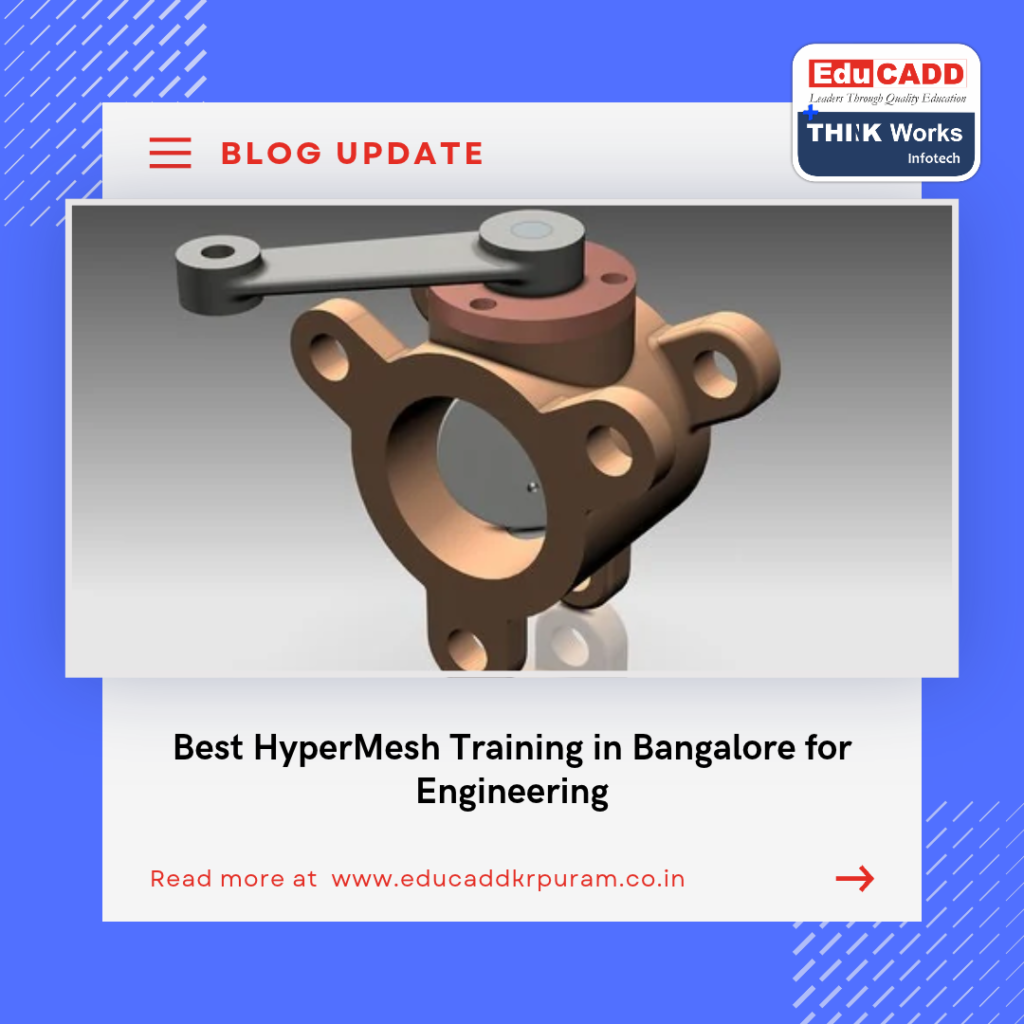
Why HyperMesh Pre-Processing Mastery is Vital for Simulation Engineers
Virtual structural testing relies on accurate geometry cleanup, precise mesh generation, and robust boundary condition setups. HyperMesh handles complex CAD geometry from multiple design platforms without data loss. It empowers CAE engineers to create high-quality 2D shell meshes, 3D solid meshes, and weld connections, making finite element solver calculations faster, stable, and highly reliable.
Enrolling in Job oriented courses helps candidates transition smoothly into practical engineering workflows that local simulation employers demand. Manufacturing enterprises look for analysts who can take complex 3D CAD assemblies, extract mid-surfaces, clean up geometric flaws, generate high-density meshes, and prepare input decks for solvers like ANSYS, Abaqus, LS-DYNA, and Nastran.
Key benefits of acquiring advanced finite element pre-processing skills include:
-
High-Quality Mesh Generation: Build structured quad and hex meshes that yield precise stress, strain, and thermal distribution results.
-
Complex Geometry Cleanup: Effortlessly extract mid-surfaces, suppress minor fillets, and repair damaged surface topologies from imported CAD files.
-
Solver-Neutral Versatility: Export ready-to-solve input decks for multiple industry-standard FEA solvers from a single interface.
-
Direct Career Readiness: Gain practical skills aligned with hiring expectations at leading automotive OEMs, aerospace research labs, and engineering consultancies.
Core Technical Modules Covered in Advanced HyperMesh Classes
A comprehensive simulation curriculum delivered by a leading CADD training institute covers every phase of finite element modeling, from geometry import to solver export.
1. Geometry Cleanup and Mid-Surfacing
Learn foundational CAD geometry import, topology repair, surface stitch operations, and line suppression. Master manual and automatic mid-surface extraction for thin-walled sheet metal parts, plastic components, and structural frames.
2. 2D Surface Meshing and Quality Checks
Master surface meshing techniques using tria and quad elements on sheet metal, plastic casings, and automotive body panels. Learn element quality criteria including aspect ratio, skewness, warpage, jacobian, and interior angle checks.
3. 3D Solid Meshing (Tetra and Hexa Meshing)
Build robust 3D solid meshes for thick structural components, engine blocks, cast iron housings, and forged links. Master automatic tetra meshing, volume tetra controls, and advanced 3D hex meshing using solid map tools.
4. Connectors, Welds, and Fastener Modeling
Simulate multi-body structural joints using specialized 1D and 2D connector elements. Model spot welds, seam welds, bolt pretension, adhesive bonds, and rivet assemblies for full-vehicle crash and durability models.
5. Boundary Conditions and Solver Deck Setup
Define material properties, section cards, contact pairs, constraints, and load vectors. Export clean, error-free input decks for solvers such as OptiStruct, RADIOSS, ANSYS, and Abaqus.
6. Manufacturing Integration with GD&T
Structural mesh parameters must respect actual manufacturing variation limits. Incorporating GD&T training into your learning path ensures your structural models account for feature tolerances, material conditions, and assembly stack-ups.
Expanding Your Technical Stack Across Engineering Disciplines
To maintain a competitive edge in today’s engineering job market, smart analysts expand their technical knowledge across complementary CAD, IT, and business domains.
1. Complementary Mechanical CAD Software
Pairing finite element pre-processing proficiency with an AutoCAD course establishes a baseline for 2D drafting layout verification. Adding specialized CATIA training, a SolidWorks course, or Creo training builds multi-software versatility preferred by global product design consultancies.
2. Civil, Architectural, and Infrastructure System Integration
Engineers expanding into structural civil engineering, building dynamics, plant layout, or infrastructure design often pursue a Civil CADD course, Architectural CADD course, Revit course, BIM course, Interior design course, or ETABS course. Mastering structural design software like a STAAD Pro course or project scheduling tools like a Primavera P6 course opens avenues in heavy infrastructure analysis.
3. Electrical Systems and Software Development
Enrolling in an Electrical CADD course enables analysts to evaluate electro-mechanical packaging, thermal dissipation in control panels, and structural battery enclosures. Furthermore, learning software programming through a Full Stack Web Development course, Java Full Stack course, or Python Full Stack course enables simulation engineers to write custom Tcl/Tk automation scripts, build automated meshing macros, and manage simulation databases.
4. Digital Marketing Skills for Technical Consultants
Independent CAE consultants, simulation freelancers, and engineering service owners frequently leverage digital platforms to market their analytical capabilities. Enrolling in a Digital marketing course at a recognized Digital marketing institute builds strong personal brand visibility. Specialized options like a Job oriented digital marketing course, Professional digital marketing course, or Online digital marketing course cover essential modules including an SEO course, Google Ads course, Social media marketing course, and AI digital marketing course. Choosing a Masters in digital marketing course or a Digital marketing course with placement that offers Digital marketing live project training and a Digital marketing internship allows engineering specialists to secure global clients, launch a successful Digital marketing career, and expand their commercial reach through Digital marketing training.
Career Prospects and High-Growth Engineering Roles
Completing structured CAE pre-processing training at a trusted Technical training institute prepares candidates for diverse simulation roles across major engineering sectors:
FEA Pre-Processing Engineer
-
Core Responsibilities: Cleaning complex CAD geometry, extracting mid-surfaces, generating 2D/3D meshes, and validating mesh quality metrics.
-
Key Tools: HyperMesh, ANSYS, Abaqus.
Structural Crash and Safety Analyst
-
Core Responsibilities: Modeling full-vehicle crash setups, defining dummy contacts, setting up impact boundary conditions, and exporting solver input decks.
-
Key Tools: HyperMesh, RADIOSS, LS-DYNA.
Durability and Fatigue CAE Specialist
-
Core Responsibilities: Meshing cast components, setting up cyclic load cases, defining material fatigue cards, and analyzing structural stress concentrations.
-
Key Tools: HyperMesh, OptiStruct, NCode.
NVH (Noise, Vibration, and Harshness) Analyst
-
Core Responsibilities: Preparing acoustic mesh models, defining body-in-white connections, and setting up modal frequency response analyses.
-
Key Tools: HyperMesh, Nastran.
Criteria for Selecting the Right Training Center
Selecting the right training environment directly impacts your technical development and future employment opportunities. Ambitious engineers should evaluate several key factors:
-
Practical Project Curriculum: Ensure classes focus on real-world industrial case studies, automotive body teardowns, and capstone meshing projects rather than simple software navigation.
-
Industry-Experienced Instructors: Learn under certified trainers who possess real-world industrial simulation experience in automotive, defense, and aerospace sectors.
-
Dedicated Infrastructure: Access high-performance computer lab hardware running licensed CAE software suites.
-
Flexible Learning Options: Choose centers offering weekend or weekday flexible schedules tailored for students and working professionals.
-
Career Placement Support: Confirm the center provides dedicated help with portfolio creation, resume formatting, mock technical interviews, and job placements.
Receiving structured guidance at an established Professional training institute ensures that your finite element modeling practices match corporate standards.
Steps to Launch Your Professional Simulation Career
Transitioning from an engineering graduate to a professional CAE simulation analyst requires a clear, structured approach:
-
Identify Your Technical Goals: Define your target sector—whether automotive crash, aerospace structures, consumer product durability, or NVH—and map out required software skills.
-
Commit to Hands-On Software Practice: Practice geometry cleanup, mid-surface extraction, 2D quad meshing, 3D hex meshing, and quality verification every single day.
-
Build a Professional Digital Portfolio: Compile high-resolution mesh renders, element quality reports, connector models, and solver setup files into a clean digital portfolio.
-
Prepare for Industry Technical Tests: Review core strength of materials, finite element theory, boundary condition physics, and element formulation rules to clear company modeling tests during job interviews.
Conclusion
Mastering finite element pre-processing software is one of the most reliable ways to build a successful, high-paying engineering career. By enrolling in comprehensive CADD training through a top-rated Skill development institute, you gain the hands-on expertise, meshing precision, and portfolio validation required by global simulation employers.
Take charge of your professional future today, build job-ready technical capabilities, and secure your place in structural analysis through Job oriented courses.

