
Unlock a High-Paying Engineering Career with Advanced Mechanical CADD Training with Placement Support
The mechanical engineering industry has entered a new era where digital technology drives innovation, precision, and productivity. Every manufacturing company, automobile manufacturer, aerospace organization, and industrial equipment producer depends on advanced design software to create reliable products before they reach the production floor. As industries continue embracing automation and digital manufacturing, employers actively seek professionals who possess practical Mechanical CADD skills alongside strong engineering fundamentals. This is where Advanced Mechanical CADD Training with Placement Support plays a crucial role in shaping successful engineering careers. Instead of limiting students to theoretical concepts, this specialized program focuses on practical learning, real-time projects, industry-standard software, and career preparation.
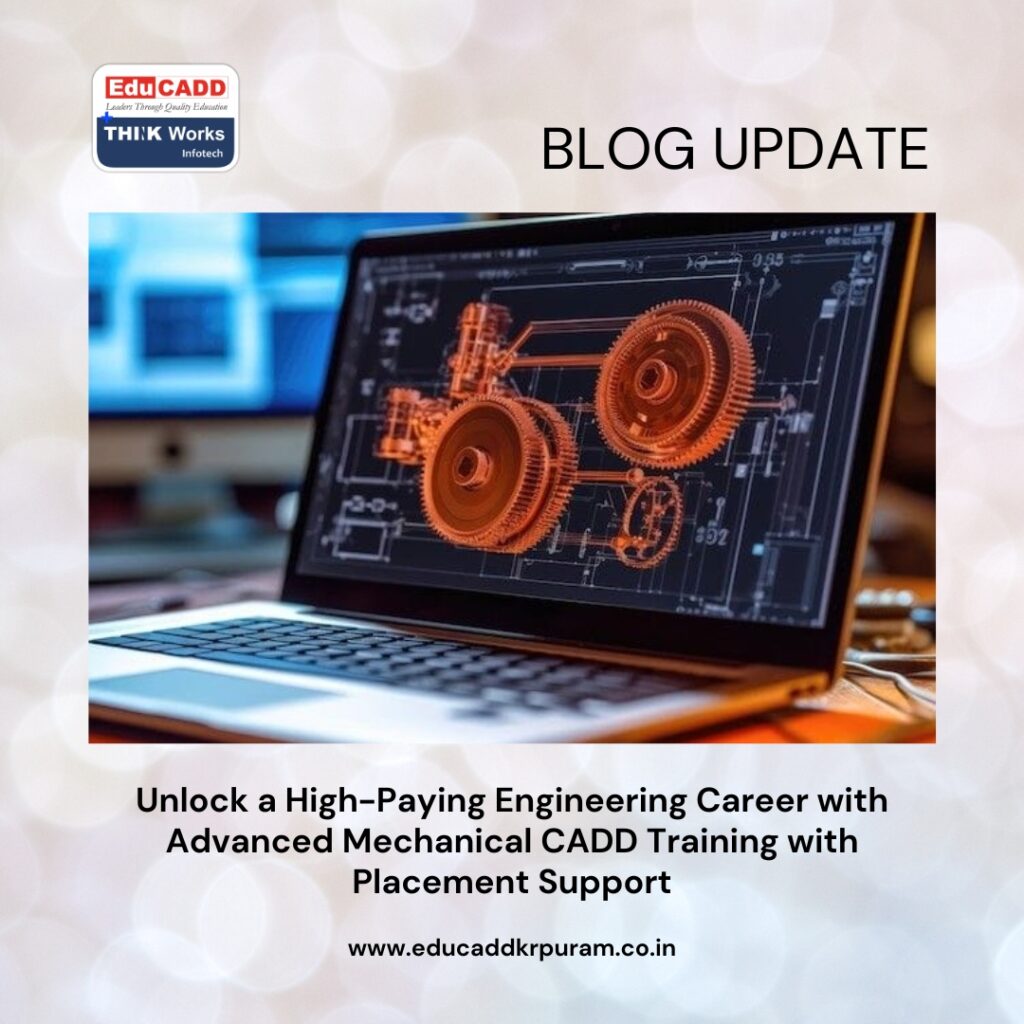
Advanced Mechanical CADD Training
Students gain hands-on experience with professional design tools while learning how engineering teams develop products from concept to manufacturing. In addition, dedicated placement support helps learners prepare for interviews, build professional resumes, and connect with leading engineering companies. Whether you are a fresh graduate, diploma holder, or working professional looking to upgrade your skills, this training program provides the technical expertise and confidence needed to secure rewarding opportunities in today’s competitive engineering landscape.
The Rising Importance of Mechanical CADD in Modern Engineering
Mechanical engineering has evolved significantly over the past decade because industries now rely heavily on digital product development. Every machine, automobile, industrial plant, consumer product, and manufacturing system begins with a digital design before moving to production. This transformation has made Mechanical CADD an essential skill for engineers who wish to remain relevant in today’s rapidly changing industrial environment.
Consequently, organizations prefer candidates who already possess practical software knowledge instead of investing months in internal training. By enrolling in Advanced Mechanical CADD Training, students learn how modern engineering companies approach design, validation, and manufacturing. They also become familiar with industry expectations, enabling them to transition smoothly into professional roles immediately after completing their training.
Build Strong Design Skills with Industry-Standard Software
One of the biggest advantages of pursuing Advanced Mechanical CADD Training with Placement Support is learning multiple software platforms used by engineering companies across different industries. Rather than focusing on a single application, comprehensive training programs expose students to a variety of powerful tools that prepare them for diverse engineering careers.
Furthermore, learners gain practical exposure to sheet metal design, surface modeling, weldment structures, motion analysis, rendering, and basic simulation techniques. Mastering multiple software applications significantly improves employability because different industries prefer different engineering platforms depending on their products and manufacturing processes.
Practical Learning That Mirrors Real Industrial Projects
Engineering cannot be mastered through theory alone. Practical exposure is equally important because employers expect graduates to solve engineering problems with confidence from the very beginning of their careers. Therefore, project-based learning forms the foundation of Advanced Mechanical CADD Training.
Students participate in live design exercises that closely resemble actual industrial assignments. They work on machine parts, industrial equipment, conveyor systems, automotive assemblies, production fixtures, fabrication components, and mechanical subassemblies while following engineering standards. As they complete increasingly complex assignments, their confidence and technical abilities continue growing. By the end of the training program, students possess a professional portfolio containing multiple engineering projects that demonstrate their practical capabilities during recruitment interviews.
Industry-Oriented Curriculum Designed for Future Engineers
A successful engineering career depends on learning skills that industries currently require rather than relying solely on academic knowledge. Since engineering technology evolves continuously, training institutes regularly update their Mechanical CADD curriculum to align with modern industrial practices. This ensures students graduate with relevant knowledge that meets employer expectations.
The curriculum covers engineering drawing standards, geometric dimensioning and tolerancing (GD&T), manufacturing processes, machine design concepts, engineering materials, product lifecycle management, assembly techniques, tolerance analysis, documentation standards, and production workflows. Students also learn how design departments collaborate with manufacturing, procurement, quality assurance, and maintenance teams to deliver successful engineering projects. Additionally, they understand design optimization methods that reduce production costs while improving product performance. Because of this comprehensive approach, Advanced Mechanical CADD Training prepares students not only to operate software but also to think like professional design engineers capable of solving practical engineering challenges.
Learn from Industry Experts Who Bring Real-World Experience
The quality of technical education depends greatly on the knowledge and experience of the trainers. While software tutorials can teach basic commands, they rarely explain how those tools are applied in real engineering environments. Professional trainers bridge this gap by sharing practical insights gained from years of working on industrial projects. Their guidance helps students understand the logic behind every design decision rather than simply memorizing software functions.
During Advanced Mechanical CADD Training, experienced faculty members explain how products move from conceptual sketches to finished manufactured components. They demonstrate industry best practices, engineering standards, quality requirements, and documentation procedures followed by leading manufacturing companies. Since every student learns at a different pace, personalized guidance ensures that individual strengths are enhanced while weaker areas receive additional attention. This mentoring approach builds confidence and prepares learners to face real workplace challenges with a professional mindset.
Develop Practical Expertise Through Continuous Hands-On Practice
Mechanical design is a practical profession where experience plays a vital role in achieving excellence. For this reason, Advanced Mechanical CADD Training emphasizes continuous software practice instead of limiting students to classroom lectures. Every concept introduced during theory sessions is reinforced through practical exercises that help learners apply their knowledge immediately.
Students spend extensive hours creating engineering drawings, developing three-dimensional models, assembling mechanical systems, generating production documentation, and modifying designs according to changing project requirements. By consistently working on practical assignments, learners develop confidence in handling professional projects independently. This strong practical foundation gives them a competitive advantage during technical interviews and enables them to contribute effectively from the very first day of employment.
Placement Support Helps Transform Skills into Career Opportunities
Technical expertise becomes truly valuable when it leads to meaningful employment. Therefore, placement assistance is one of the most significant advantages of enrolling in Advanced Mechanical CADD Training. A well-structured placement program prepares students for every stage of the recruitment process while helping them present their abilities confidently before employers.
Career preparation begins with professional resume development that highlights technical skills, software proficiency, certifications, academic qualifications, and project experience. Students also receive training in aptitude tests, communication skills, group discussions, technical interviews, and human resource interviews. These industry connections create regular interview opportunities for students, significantly improving their chances of securing rewarding positions immediately after course completion.
Wide Range of Career Opportunities Across Engineering Industries
Mechanical CADD professionals enjoy excellent career flexibility because nearly every manufacturing sector depends on skilled design engineers. After completing Advanced Mechanical CADD Training, graduates can pursue careers in organizations involved in product design, industrial manufacturing, automotive engineering, heavy machinery, aerospace systems, renewable energy, consumer products, robotics, and industrial automation. This diversity allows professionals to choose industries that align with their interests and long-term career aspirations.
Fresh graduates commonly begin their careers as Mechanical Design Engineers, CAD Engineers, Product Design Engineers, Drafting Engineers, Tool Design Engineers, Production Design Engineers, or Design Documentation Specialists. Since engineering companies continue investing in product innovation and advanced manufacturing technologies, the demand for qualified Mechanical CADD professionals remains consistently high. This steady demand provides long-term career stability and numerous opportunities for professional advancement.
Professional Skills That Complement Technical Excellence
While technical knowledge forms the core of an engineering career, employers also value candidates who demonstrate excellent communication, teamwork, leadership potential, and problem-solving abilities. Modern engineering projects involve collaboration between multiple departments, making professional skills just as important as software expertise. Therefore, Advanced Mechanical CADD Training focuses on developing well-rounded professionals who can perform effectively in dynamic workplace environments.
Throughout the training program, students participate in technical presentations, collaborative design projects, engineering discussions, and project review sessions that improve their communication and presentation skills. Exposure to professional documentation standards, quality control procedures, and workplace ethics further prepares students for successful engineering careers. These valuable soft skills enhance employability because organizations prefer professionals who can combine technical competence with effective communication and teamwork. As a result, graduates enter the workforce ready to deliver high-quality engineering solutions while building strong professional relationships within their organizations.
Stay Ahead with Emerging Engineering Technologies
The engineering industry continues to evolve with remarkable speed, and professionals must keep learning to remain competitive. Modern manufacturing companies are embracing technologies such as smart factories, digital engineering, automation, and intelligent product development to improve efficiency and reduce production costs. These advancements have transformed the way engineers design, analyze, and manufacture products. As a result, organizations now prefer candidates who are familiar with modern engineering practices in addition to traditional mechanical design concepts.
Advanced Mechanical CADD Training with Placement Support introduces students to the latest engineering trends that are shaping the future of manufacturing. Besides mastering industry-standard design software, learners gain an understanding of parametric modeling, digital product development, collaborative engineering, product lifecycle management, and basic simulation concepts. Furthermore, staying updated with modern technologies increases adaptability, making professionals valuable assets in fast-changing industrial environments. Engineers who continue upgrading their technical knowledge are better prepared to handle future innovations while enjoying stronger career growth and greater professional stability.
Suitable for Fresh Graduates, Diploma Holders, and Working Professionals
One of the greatest strengths of Advanced Mechanical CADD Training with Placement Support is its ability to meet the learning needs of individuals from different educational and professional backgrounds. Fresh engineering graduates often complete their academic studies with solid theoretical knowledge but limited exposure to industrial software and practical applications. This training bridges that gap by combining classroom instruction with extensive hands-on practice, enabling graduates to become industry-ready professionals.
Diploma holders also benefit greatly because the program enhances their technical capabilities and expands their career opportunities within the manufacturing sector. Working professionals who wish to shift from production, maintenance, or quality control into design engineering can use this training to upgrade their skills and qualify for better positions. This flexibility makes the program an excellent investment for anyone seeking long-term success in mechanical engineering.
Build a Strong Portfolio Through Real-Time Assessments and Capstone Projects
Employers prefer candidates who can demonstrate practical abilities rather than simply listing software names on a resume. For this reason, continuous assessments and capstone projects form an important part of Advanced Mechanical CADD Training with Placement Support. These activities help students apply their knowledge while creating a professional portfolio that showcases their engineering capabilities.
Throughout the training, students complete a wide variety of assignments that include detailed drafting, three-dimensional component modeling, assembly creation, sheet metal projects, manufacturing drawings, exploded views, and engineering documentation. These projects become valuable additions to their professional portfolios and significantly strengthen their performance during technical interviews. By presenting real engineering work instead of theoretical knowledge alone, students create a lasting impression on recruiters and increase their chances of securing high-quality job opportunities.
A Smart Investment for Long-Term Engineering Career Success
Choosing the right technical training is one of the most important decisions for anyone planning a successful engineering career. As manufacturing industries continue expanding and adopting advanced technologies, the need for skilled Mechanical CADD professionals is expected to remain strong for many years. Organizations require engineers who can design innovative products, improve manufacturing efficiency, reduce development costs, and contribute to continuous product improvement. Professionals equipped with modern Mechanical CADD skills are therefore well positioned to achieve consistent career growth.
Advanced Mechanical CADD Training with Placement Support provides much more than software education. It develops technical expertise, practical problem-solving abilities, industrial awareness, communication skills, and professional confidence that support career advancement over the long term. With continuous learning and industry experience, the opportunities for growth become virtually limitless, making Mechanical CADD one of the most rewarding career choices for aspiring engineers.
Conclusion
The future of mechanical engineering belongs to professionals who combine technical knowledge with practical digital design expertise. As industries continue adopting advanced manufacturing technologies, the demand for qualified Mechanical CADD engineers will continue to grow across automotive, aerospace, industrial machinery, consumer products, and engineering consulting sectors.
Advanced Mechanical CADD Training with Placement Support offers a complete learning experience by combining industry-standard software training, practical project work, experienced faculty, career-oriented curriculum, professional skill development, and dedicated placement assistance. Whether your goal is to secure your first engineering position, switch to a design-focused career, or accelerate your professional growth, this training equips you with the knowledge and practical exposure required to achieve lasting success. Investing in quality Mechanical CADD education today is an investment in a future filled with exciting opportunities, continuous learning, career stability, and professional excellence.

