
Shape the Future of Structural Engineering with ETABS Certification
The construction and infrastructure industry has entered a new era where digital engineering tools play a vital role in creating safe, efficient, and sustainable buildings. Among the leading structural analysis applications used by engineers worldwide, ETABS stands out for its powerful modeling and design capabilities. An ETABS Structural Engineering Certification enables civil engineering students to master this industry-recognized software while developing practical skills that employers actively seek. Rather than depending only on theoretical calculations, certified learners gain the confidence to analyze complex structures, optimize designs, and solve engineering challenges using modern technology.
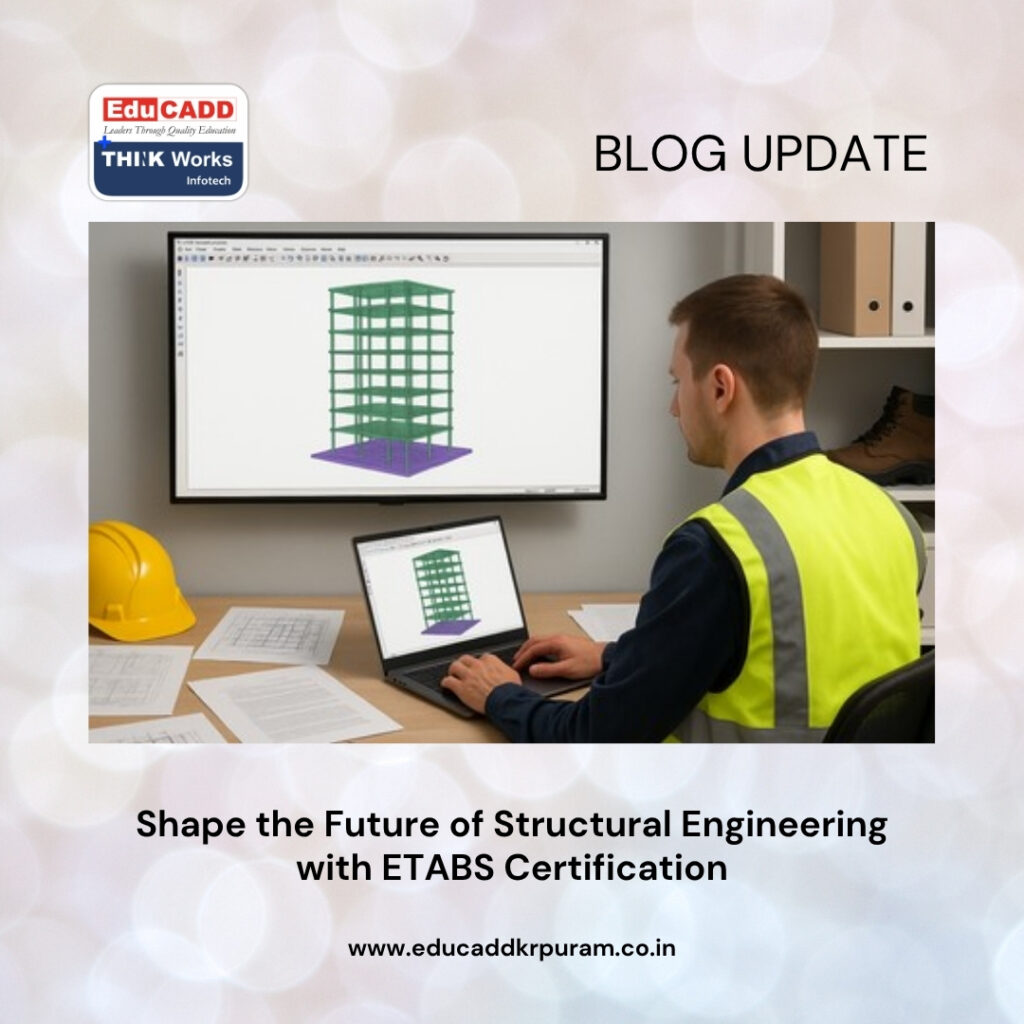
ETABS Structural Engineering Certification
As urban development accelerates and high-rise construction becomes increasingly common, professionals with ETABS expertise continue to enjoy excellent career opportunities. This blog explores how ETABS Certification strengthens technical knowledge, improves employability, and prepares future civil engineers for long-term success in the structural engineering profession.
Why ETABS Certification Is Essential for Civil Engineers
The expectations of today’s engineering industry have changed significantly over the last decade. Employers no longer evaluate graduates solely on academic performance because practical software knowledge has become equally important. ETABS Structural Engineering Certification provides civil engineering students with the opportunity to develop industry-ready technical skills before entering the workforce. Through structured training, learners understand how professional structural engineers analyze and design buildings using internationally accepted engineering practices. This practical exposure allows students to connect classroom concepts with real construction projects.
Furthermore, companies appreciate candidates who require minimal software training after recruitment. As a result, ETABS Certification enhances professional credibility while increasing the chances of securing rewarding positions in structural design organizations.
Exploring the Capabilities of ETABS Software
ETABS is a specialized software application developed specifically for structural analysis and building design. Unlike conventional drafting software, it focuses on evaluating the complete structural behavior of buildings under various loading conditions. During ETABS Structural Engineering Certification, students learn how to create three-dimensional building models by defining beams, columns, slabs, walls, foundations, and other structural components. The software performs complex engineering calculations within seconds while generating highly accurate analytical results.
In addition, ETABS produces graphical representations that make structural behavior easier to understand. These visual outputs help learners identify potential weaknesses in their designs and improve structural efficiency. Consequently, students gain valuable technical experience that reflects real engineering practices followed in professional design offices.
Strengthening Structural Engineering Fundamentals
A successful structural engineer requires more than software knowledge alone. Strong engineering fundamentals remain essential for making accurate design decisions. Therefore, ETABS Structural Engineering Certification integrates theoretical concepts with practical software applications throughout the learning process. Students revise important topics such as structural mechanics, load transfer mechanisms, material behavior, stability principles, and engineering design standards before applying them in ETABS. This balanced approach ensures that learners understand both the reasoning behind engineering calculations and the software tools used to perform them.
Moreover, instructors explain practical examples that simplify difficult concepts and improve overall understanding. Consequently, students develop stronger analytical abilities while preparing themselves for advanced structural engineering responsibilities.
Learning Professional Structural Modeling Techniques
Every reliable structural analysis begins with an accurate digital model. Even small modeling errors can affect the final design results and compromise structural safety. During ETABS Structural Engineering Certification, students receive comprehensive training in professional structural modeling techniques used by experienced engineers. They learn how to establish structural grids, define floor levels, assign material properties, specify member dimensions, and organize structural components correctly. Practical sessions also demonstrate how modeling accuracy directly influences analytical performance and design reliability.
Furthermore, learners understand how to verify their models before beginning structural analysis. This disciplined workflow improves engineering accuracy while developing habits that remain valuable throughout their professional careers.
Understanding Load Calculations and Structural Behavior
Buildings experience different types of loads throughout their service life, and engineers must accurately evaluate their effects before construction begins. ETABS Structural Engineering Certification teaches students how to define and apply dead loads, live loads, wind loads, seismic loads, and additional environmental forces according to engineering codes. Learners also study load combinations that simulate realistic operating conditions for buildings of different heights and purposes.
Through practical analysis exercises, students observe how structural members respond to varying load conditions. They interpret bending moments, shear forces, axial loads, deflections, and stress distributions generated by the software. This practical understanding enables future engineers to make informed design decisions while ensuring structural safety and compliance with modern engineering standards.
Performing Accurate Structural Analysis with Confidence
Structural analysis is one of the most critical stages in building design because it determines how safely a structure performs under different conditions. ETABS Structural Engineering Certification introduces students to various analytical techniques that evaluate the strength, stability, and performance of complete structural systems. Learners perform linear static analysis, nonlinear analysis, modal analysis, and response spectrum analysis depending on project requirements. They also examine structural deformations, story drifts, and force distributions through detailed graphical outputs generated by ETABS.
Additionally, students learn how to identify unusual structural behavior and make appropriate design improvements before project completion. These practical experiences enhance engineering judgment while preparing learners to solve complex structural problems confidently.
Designing Reinforced Concrete Structures Efficiently
Reinforced concrete remains one of the most widely used construction materials because it offers exceptional strength, durability, and versatility. Consequently, ETABS Certification provides detailed training in reinforced concrete building design based on recognized engineering standards. Students learn how to design beams, columns, slabs, shear walls, and structural frames while maintaining safety, serviceability, and economic efficiency. The software automatically verifies structural members against design code requirements and highlights sections requiring modification.
Learners also understand reinforcement detailing principles that improve structural performance and durability. Regular design exercises encourage students to optimize structural members without compromising safety. This combination of theoretical knowledge and software expertise prepares graduates to contribute effectively to modern residential, commercial, and industrial construction projects.
Mastering Earthquake and Wind Load Analysis
Modern buildings must withstand natural forces without compromising structural stability or occupant safety. Therefore, ETABS Certification includes comprehensive training in earthquake and wind load analysis based on national and international design standards. Students learn how lateral forces influence different structural systems and how building height, geometry, and material properties affect structural performance. They perform response spectrum analysis, dynamic analysis, and wind load calculations while interpreting story drift, base shear, torsion, and displacement results.
Furthermore, learners understand the importance of ductility, stiffness, and load distribution in designing earthquake-resistant structures. Regular practice with real engineering scenarios strengthens their ability to create buildings that remain safe under extreme environmental conditions and comply with current engineering regulations.
Building Practical Skills Through Live Engineering Projects
Practical learning is the foundation of every successful engineering career, and ETABS Certification emphasizes hands-on project experience throughout the training program. Instead of working only with sample exercises, students complete full structural design projects that closely resemble professional engineering assignments. They create complete building models, define material properties, assign structural loads, perform detailed analyses, optimize member sizes, and generate comprehensive design reports. Every project improves technical understanding while strengthening software proficiency.
Additionally, instructors provide continuous feedback that helps learners identify mistakes and adopt better engineering practices. By completing multiple residential and commercial building projects, students gain valuable confidence that prepares them for real workplace responsibilities from the very beginning of their careers.
Career Opportunities After ETABS Certification
The rapid growth of infrastructure development has created a strong demand for professionals with structural analysis expertise. As a result, ETABS Certification opens numerous career opportunities across the construction and engineering sectors. Certified civil engineering students can pursue roles such as Structural Design Engineer, Civil Design Engineer, Structural Analyst, BIM Structural Modeler, Project Engineer, Design Consultant, and Technical Engineer.
Engineering consultancy firms, real estate developers, infrastructure companies, government organizations, and multinational construction firms actively recruit candidates with ETABS skills because they can contribute immediately to ongoing projects. Moreover, software proficiency often leads to faster career progression, better salary packages, and opportunities to work on landmark infrastructure developments both in India and abroad.
Preparing Students for Higher Education and Research
Beyond employment, ETABS Certification provides significant advantages for students who wish to continue their academic journey through postgraduate studies or research. Advanced structural engineering programs frequently require software-based simulations, analytical modeling, and performance evaluation of complex building systems. Students with ETABS knowledge can complete dissertations, research projects, and technical publications more effectively by validating theoretical concepts through practical simulations.
Furthermore, software expertise enables learners to investigate innovative structural systems, sustainable construction techniques, and earthquake-resistant designs with greater confidence. Universities and research institutions increasingly encourage students to develop practical software skills because they complement theoretical education and improve the overall quality of engineering research.
Staying Competitive in the Modern Construction Industry
The engineering profession continues to evolve with advancements in digital technology, automation, and Building Information Modeling. Consequently, engineers must continuously upgrade their technical skills to remain competitive in the industry. ETABS Certification demonstrates a commitment to professional development while showcasing practical expertise that employers highly value. Students who complete certification become familiar with current engineering workflows, digital collaboration methods, and industry-standard design practices.
In addition, they develop the ability to adapt quickly to changing project requirements and emerging construction technologies. This readiness gives certified professionals a competitive advantage during recruitment and supports long-term career growth in an increasingly technology-driven engineering environment.
Developing Problem-Solving and Analytical Thinking
Successful structural engineers require excellent analytical abilities to evaluate multiple design alternatives and identify the safest, most economical solutions. Throughout ETABS Certification, students strengthen their critical thinking by solving realistic engineering problems using professional software tools. They analyze structural behavior under different loading conditions, compare alternative design approaches, and optimize structural members for improved efficiency. Each practical exercise encourages logical decision-making while reinforcing engineering principles learned during academic studies.
Furthermore, learners develop confidence in interpreting technical reports and communicating engineering findings effectively. These transferable skills remain valuable throughout their professional careers and enable them to handle increasingly complex structural engineering projects with accuracy and confidence.
Conclusion
The future of structural engineering belongs to professionals who combine strong theoretical knowledge with practical software expertise, and ETABS Structural Engineering Certification offers the perfect pathway to achieve that goal. For civil engineering students, this certification provides a comprehensive understanding of structural modeling, load analysis, reinforced concrete design, seismic evaluation, and professional engineering workflows. Beyond improving technical competence, it enhances problem-solving abilities, increases employability, and prepares learners for the expectations of the modern construction industry.
As infrastructure projects become more sophisticated and technology continues to reshape engineering practices, certified professionals will remain in high demand across the globe. Investing in ETABS Certification is not simply about learning a software application; it is about building a strong foundation for a successful, rewarding, and future-ready career in structural engineering.

