
Master Machine Design Certification and Build a Future-Ready Engineering Career
Modern engineering is moving toward greater precision, smarter production, and faster product development. Companies need professionals who can turn ideas into practical machine components and reliable mechanical systems. This is where Machine Design Certification becomes highly valuable. It helps learners build knowledge in machine elements, design principles, CAD tools, material selection, manufacturing methods, and engineering standards.
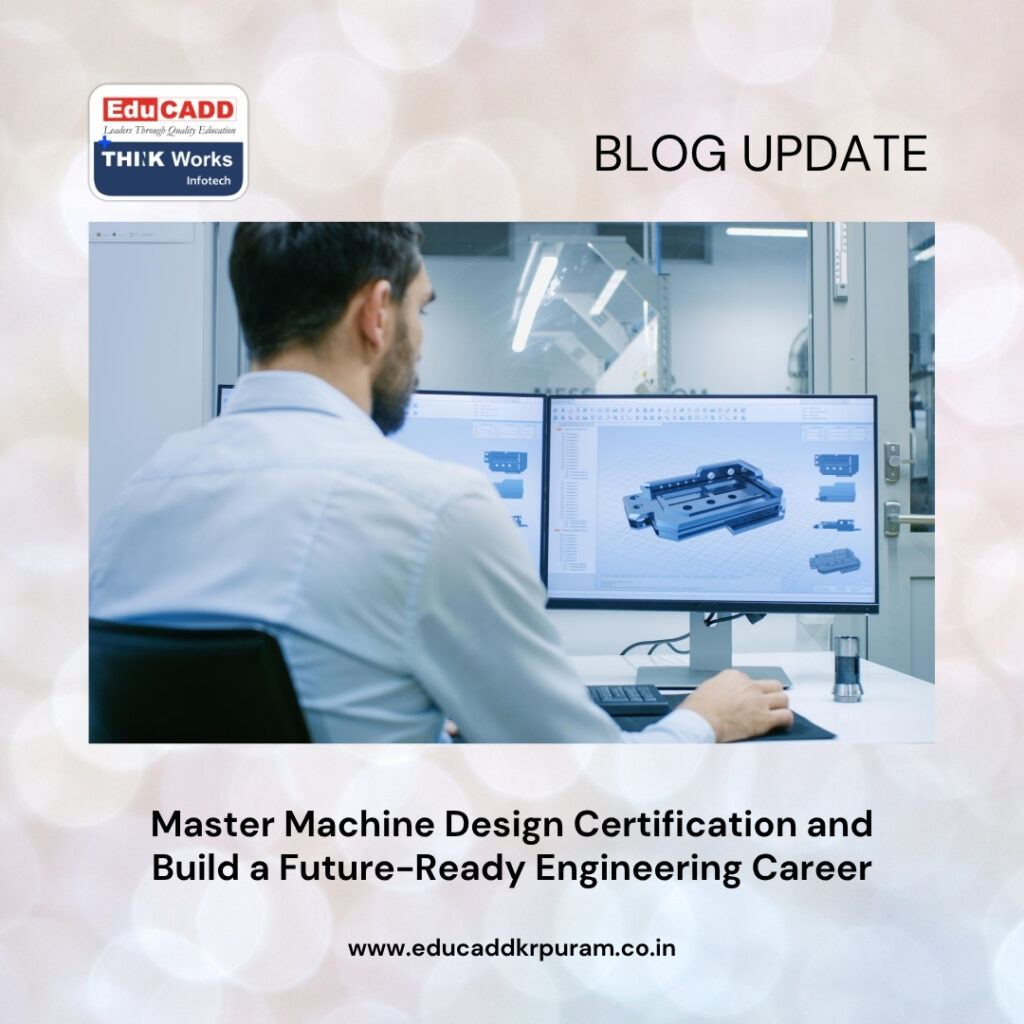
Machine Design Certification
More importantly, structured certification can connect theoretical concepts with practical design applications. For students, fresh graduates, and working professionals, this learning path can strengthen technical confidence and improve career readiness. With the right training, learners can understand how machines are designed, tested, improved, and prepared for real-world manufacturing.
Build a Strong Foundation in Machine Design
A successful mechanical design career starts with strong fundamentals. Machine design involves much more than creating attractive 2D or 3D models. Engineers must understand loads, forces, motion, materials, tolerances, and manufacturing requirements. A Machine Design Certification can introduce these concepts through a structured learning approach. Learners can understand how different machine components work together within a complete system.
They can also explore shafts, bearings, gears, couplings, fasteners, springs, and other mechanical elements. As a result, students develop a clearer understanding of engineering decisions. This foundation becomes important when handling complex design projects. Furthermore, strong fundamentals help professionals identify design problems before they become expensive manufacturing issues.
Turn Engineering Ideas into Practical Designs
Every machine begins with an idea, but an idea must become a workable design before it reaches production. Designers need to convert concepts into accurate drawings, models, and engineering specifications. Through Machine Design Certification, learners can develop the ability to move from an initial concept toward a practical engineering solution. They can learn how to interpret design requirements and select suitable components.
In addition, they can understand how dimensions, tolerances, materials, and operating conditions influence the final product. Practical design exercises can further improve problem-solving skills. Therefore, learners become more comfortable handling real engineering challenges. Instead of focusing only on software commands, they begin to understand the engineering purpose behind every design decision.
Develop Expertise with Modern CAD Tools
Computer-aided design has become an essential part of modern mechanical engineering. Engineers use CAD platforms to create detailed components, assemblies, drawings, and production-ready documentation. A well-structured Machine Design Certification can help learners develop CAD skills alongside mechanical design knowledge. This combination creates a stronger professional profile. Learners can practice creating accurate models and modifying designs based on engineering requirements. They can also understand assembly relationships and design intent.
Moreover, CAD skills allow professionals to communicate technical concepts more effectively with manufacturing and production teams. When mechanical knowledge and digital design skills work together, engineers can develop solutions with greater accuracy and efficiency.
Understand Materials and Manufacturing Requirements
A good machine design must be suitable for manufacturing. Selecting a material only because it has high strength may not always produce the best result. Engineers must consider weight, cost, durability, corrosion resistance, machinability, availability, and operating conditions. A Machine Design Certification can help learners understand how material selection influences component performance. Manufacturing processes also affect design decisions.
Machining, casting, forging, welding, and additive manufacturing each have different requirements. Consequently, designers must consider production methods during the early stages of development. By learning these principles, professionals can create designs that are functional and easier to manufacture. This approach can also reduce material waste, production difficulties, and unnecessary redesigns.
Improve Accuracy Through Engineering Standards
Precision is essential when designing mechanical components. Even a small dimensional error can affect assembly performance, safety, and product life. Engineering standards provide guidelines that help designers maintain consistency and reliability. During Machine Design Certification, learners can become familiar with concepts such as tolerances, fits, surface finishes, and standard component specifications.
These concepts support better decision-making during detailed design work. In addition, understanding standards helps professionals communicate effectively with manufacturers and inspection teams. Proper documentation can reduce confusion during production. Therefore, accuracy becomes part of the entire design process rather than simply the final inspection stage. This professional approach is valuable across automotive, manufacturing, industrial equipment, and product development sectors.
Strengthen Your Mechanical Problem-Solving Skills
Engineering challenges rarely have only one possible solution. Designers often need to compare different approaches before selecting the most suitable option. They must balance performance, cost, weight, safety, reliability, and manufacturing requirements. A Machine Design Certification can encourage learners to approach these challenges systematically. They can study design problems and evaluate possible solutions using engineering principles.
Practical assignments can further develop analytical thinking. For example, learners may need to redesign a component to reduce weight without compromising strength. Similarly, they may need to modify a component for easier manufacturing. Through such exercises, learners gain confidence in making technical decisions. Over time, this process develops the problem-solving mindset expected from professional mechanical designers.
Learn to Design for Safety and Reliability
Machine performance depends heavily on safe and reliable component design. Engineers must consider operating loads, fatigue, vibration, wear, temperature, and other working conditions. A Machine Design Certification can introduce learners to the principles required to create dependable mechanical systems. Safety should remain a priority throughout the design process. Designers must identify possible failure points and consider suitable preventive measures. Reliability also depends on correct material selection, accurate dimensions, suitable tolerances, and appropriate component choices.
Therefore, every design decision should have a clear engineering reason. By developing this mindset, learners can move beyond basic modelling and understand the responsibility involved in creating machines used in real industrial environments.
Prepare for Industry-Oriented Mechanical Design Roles
The mechanical engineering industry increasingly values professionals who can combine theoretical knowledge with practical digital skills. Employers often look for candidates who understand design workflows and can contribute to projects from the early concept stage. A Machine Design Certification can help learners demonstrate their commitment to developing these capabilities. Certification can also provide a structured learning path for people who are unsure where to begin. Instead of studying unrelated topics, learners can progress through connected areas of mechanical design.
Furthermore, project-based learning can help candidates create examples of their technical work. These projects may become useful when preparing portfolios or discussing skills during interviews. As a result, certification can support both learning and career preparation.
Create Better Opportunities Across Industries
Machine design skills are useful across many engineering sectors. Automotive companies require mechanical designers for vehicle components and systems. Manufacturing companies need designers for machinery, fixtures, production equipment, and automation systems. Industrial equipment manufacturers also depend on professionals who can develop reliable mechanical solutions.
Completing Machine Design Certification can therefore open learning pathways across several industries. The exact career opportunity depends on a person’s qualifications, practical skills, software expertise, and experience. However, a strong design foundation can provide greater flexibility when exploring different engineering roles. In addition, professionals can build specialized knowledge in areas such as product development, automation, tooling, robotics, or industrial machinery as their careers progress.
Develop a Professional Engineering Portfolio
A certificate can demonstrate learning, but a portfolio can demonstrate capability. This is why practical project work should become an important part of mechanical design training. During Machine Design Certification, learners can benefit from developing models, assemblies, technical drawings, and design projects. A portfolio can show how a learner approaches engineering problems and applies design principles. It can also demonstrate software proficiency and attention to technical details.
For instance, a portfolio may include a gearbox assembly, machine component, industrial fixture, or mechanical mechanism. Each project can explain the design objective and engineering decisions. Consequently, learners have stronger material to present during interviews, internships, freelance opportunities, or professional discussions.
Upgrade Your Skills as Technology Evolves
Mechanical engineering continues to change as digital technologies become more advanced. Automation, simulation, digital manufacturing, robotics, and smart production systems are influencing modern engineering workflows. Professionals must therefore continue learning throughout their careers. A Machine Design Certification can provide a useful foundation for developing this growth mindset.
Once learners understand fundamental design principles, they can explore advanced tools and technologies more confidently. They can also adapt to new software platforms and evolving industry practices. Continuous learning becomes especially important for professionals who want to remain competitive. By regularly upgrading technical skills, engineers can respond more effectively to changing project requirements and emerging opportunities.
Combine Design Knowledge with Simulation
Modern product development often uses simulation to evaluate designs before physical prototypes are manufactured. Simulation can help engineers study factors such as stress, deformation, thermal behaviour, vibration, and component performance. While simulation requires specialized knowledge, a strong machine design foundation makes the process easier to understand. Machine Design Certification can help learners develop the design awareness needed before moving into advanced analysis.
They can understand why a component requires specific dimensions or materials. This knowledge can improve communication between design and analysis teams. Furthermore, combining CAD modelling with simulation can help engineers identify weaknesses earlier. This can reduce prototype iterations and support more efficient product development.
Learn from Practical Projects and Real Design Challenges
Theory becomes more valuable when learners understand how it applies to actual engineering situations. Practical projects allow students to experience the complete design process. They can begin with requirements, develop concepts, create models, prepare drawings, and evaluate the final solution. A practical Machine Design Certification should therefore encourage project-based learning wherever possible. Realistic assignments can expose learners to common challenges such as space limitations, component selection, assembly issues, and manufacturing constraints.
Moreover, project work can improve communication and documentation skills. Learners begin to understand that successful engineering depends on both technical accuracy and clear coordination. This experience can make the transition from classroom learning to professional projects smoother.
Take the Next Step Toward Mechanical Design Excellence
Choosing the right learning path can make a significant difference in an engineering career. A Machine Design Certification provides an opportunity to strengthen mechanical fundamentals while developing practical design capabilities. However, learners should look beyond the certificate itself. Training quality, software exposure, practical projects, experienced guidance, and industry relevance are equally important.
A strong program should help learners understand both design theory and professional workflows. It should also encourage continuous improvement and independent problem-solving. With consistent practice, learners can develop the confidence needed to work on increasingly complex mechanical projects. Ultimately, the goal is not simply to earn a certificate. The real goal is to become a capable, adaptable, and industry-ready mechanical design professional.
Why Machine Design Skills Matter for the Future
Mechanical products are becoming more precise, efficient, compact, and technologically advanced. This creates a continuing need for professionals who understand how components and systems should be designed. Machine design sits at the intersection of engineering theory, digital modelling, manufacturing, and innovation. Professionals who develop these skills can contribute to product development and industrial improvement.
A strong learning program can provide the starting point for this journey. By combining technical knowledge with practical application, learners can prepare themselves for changing industry expectations. Therefore, investing time in machine design education can be a valuable step for anyone who wants to build a long-term career in mechanical engineering and product development.
Conclusion
A successful mechanical design career requires more than knowledge of CAD software. It requires engineering thinking, accuracy, creativity, practical understanding, and the ability to solve complex problems. Machine Design Certification can help learners build these capabilities through structured education and practical exposure. From understanding machine elements and materials to developing CAD models and considering manufacturing requirements, every skill contributes to professional growth.
Furthermore, project experience can strengthen portfolios and improve confidence when approaching career opportunities. As engineering continues to evolve, professionals who combine strong fundamentals with modern digital skills will remain valuable. If your goal is to develop a future-ready mechanical design career, building strong machine design expertise can be an important step toward achieving that ambition.

