
Electrical Design and Drafting Course: Build In-Demand Skills for a Successful Electrical Engineering Career
Introduction
Electrical systems play an important role in modern buildings, industries, power plants, and infrastructure projects. From lighting and power distribution to electrical panels and industrial control systems, every installation requires careful planning and accurate technical drawings. As construction and industrial projects become more advanced, companies need professionals who can prepare reliable electrical designs and detailed drawings. This creates exciting opportunities for students and engineering graduates who want to develop practical technical skills. An Electrical Design Drafting Course helps learners understand electrical layouts, wiring diagrams, lighting systems, power distribution, and computer-aided design tools.
It connects electrical engineering knowledge with the practical skills used in real projects. Furthermore, students learn how to create clear drawings that engineers, contractors, and technicians can understand and follow. Whether you have recently graduated or want to improve your existing skills, this course can help you prepare for opportunities in electrical design, building services, and industrial engineering.
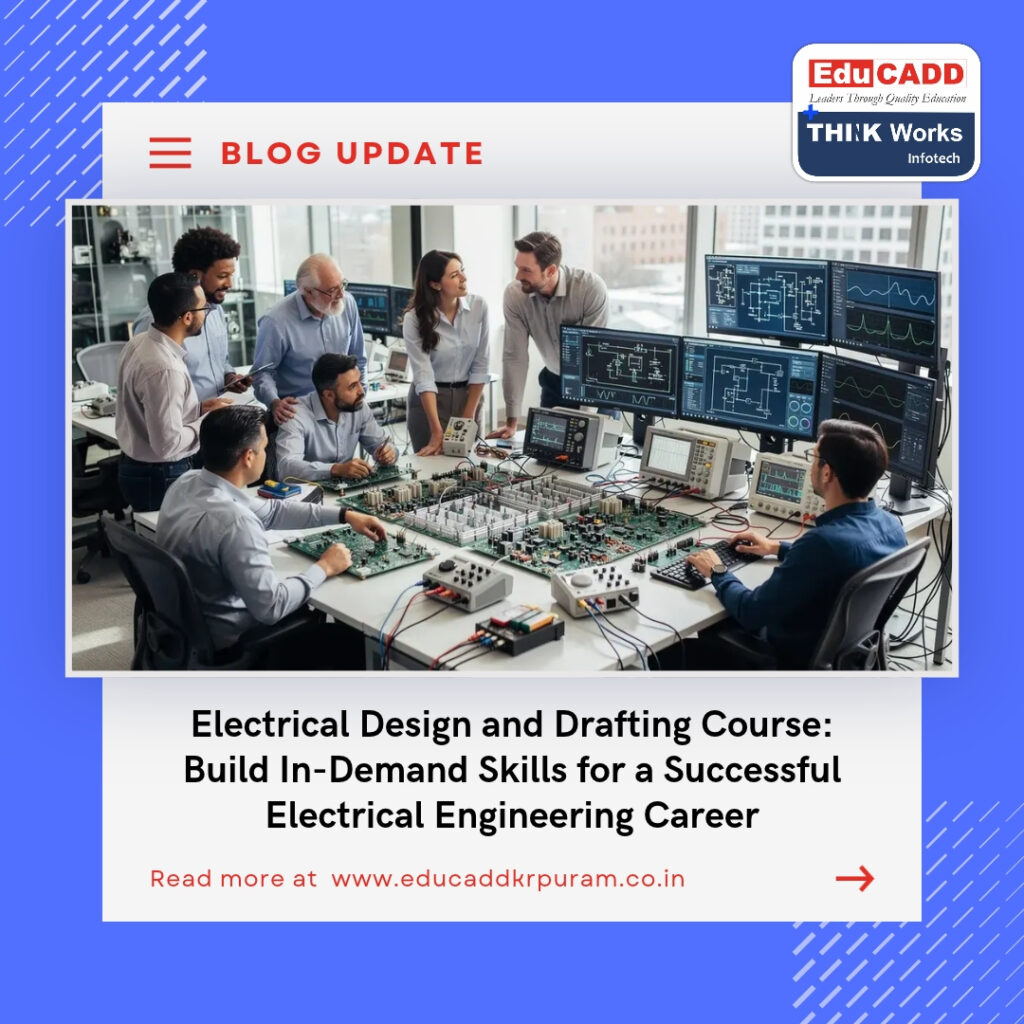
Electrical Design Drafting Course
What Is an Electrical Design and Drafting Course?
An Electrical Design and Drafting Course teaches students how to plan, design, and document electrical systems using technical drawing methods and computer software. Electrical engineers and designers use these drawings to communicate how electrical equipment, wiring, cables, lighting fixtures, and distribution systems should be arranged.
The course combines electrical concepts with computer-aided drafting techniques. Students learn how to prepare electrical layouts, interpret engineering drawings, use standard symbols, and create accurate technical documents. They also understand how electrical design supports construction, manufacturing, maintenance, and industrial operations.
For example, an office building requires separate plans for lighting, power outlets, emergency lighting, and electrical distribution. A designer must identify the requirements of each system and prepare drawings that support safe installation. Similarly, an industrial facility may require motor connections, control panels, cable routing, and equipment layouts.
Through practical training, students develop the ability to translate engineering requirements into usable drawings. As a result, they become better prepared to support electrical design teams and project engineers.
Why Electrical Design and Drafting Skills Matter Today
Electrical design has become increasingly important as buildings, industries, and infrastructure projects depend on reliable electrical systems. Modern projects require accurate documentation, efficient energy use, and careful coordination between different engineering teams. Therefore, companies value professionals who understand both electrical fundamentals and technical drafting.
One major advantage of learning electrical drafting is the ability to work with digital design tools. Instead of preparing every drawing manually, professionals can use computer software to create, edit, and update technical plans. This approach improves drawing consistency and makes revisions easier to manage.
Moreover, electrical designers often work alongside civil, mechanical, architectural, and construction teams. Their drawings help these professionals coordinate equipment locations, ceiling layouts, service routes, and installation requirements.
Electrical design and drafting skills can be useful in several areas, including:
- Residential and commercial building projects.
- Industrial plants and manufacturing facilities.
- Electrical contracting and consulting services.
- Power distribution and infrastructure projects.
- Building services and facility management.
- Engineering design and project documentation.
As a result, learning electrical drafting can provide a practical starting point for individuals who want to enter the engineering design field.
What You Will Learn During the Course
A well-structured Electrical Design Drafting Course should cover the technical knowledge and software skills required to prepare electrical drawings. The exact syllabus varies by training institute, so students should review the course outline before enrolling.
Electrical Engineering Fundamentals
Students begin by understanding the basic principles behind electrical systems. These concepts help them interpret drawings and understand how electrical equipment operates.
Important topics include voltage, current, resistance, electrical power, and basic circuit principles. Students also learn about alternating current, direct current, single-phase systems, and three-phase power.
In addition, the course introduces electrical safety, protective devices, earthing, and the importance of selecting suitable electrical components. These fundamentals help learners understand why designers must follow project specifications and applicable electrical standards.
Electrical Symbols and Technical Drawings
Electrical drawings use standard symbols to represent components and connections. Designers must understand these symbols to read existing plans and create accurate new drawings.
Students learn to identify switches, sockets, lights, circuit breakers, distribution boards, motors, and other electrical components. They also practise reading schematic diagrams, wiring diagrams, and single-line diagrams.
Furthermore, learners develop an understanding of drawing scales, dimensions, annotations, legends, and title blocks. These details make drawings easier to interpret and help reduce confusion during installation.
AutoCAD Electrical Drafting
Computer-aided design software is an important part of modern electrical drafting. Depending on the training syllabus, students may learn general drafting with AutoCAD, specialised electrical design tools, or both.
The training may cover:
- Creating and editing electrical layouts.
- Using layers, blocks, and drawing templates.
- Preparing wiring and schematic diagrams.
- Adding dimensions, labels, and annotations.
- Managing drawing scales and sheet layouts.
- Preparing drawings for printing and documentation.
Through regular practice, students learn how to produce organised and readable drawings. They also understand how to revise designs when project requirements change.
Lighting and Power Layouts
Lighting and power layouts are essential components of residential, commercial, and industrial projects. Students learn how designers position lighting fixtures, switches, sockets, and electrical distribution points.
They may also study lighting calculations, basic load estimation, and the factors that influence fixture selection. For instance, an office requires suitable lighting for workstations, meeting rooms, corridors, and emergency exits.
Power layouts require careful consideration of equipment loads and circuit requirements. Therefore, students should understand how designers organise circuits and coordinate their drawings with electrical specifications.
Electrical Distribution and Panel Design
Electrical distribution systems deliver power from the main supply to different areas and equipment. During training, students may learn how to read distribution diagrams and understand the role of panels, feeders, protective devices, and circuit breakers.
They can also develop familiarity with single-line diagrams, distribution board schedules, and panel documentation. These skills are valuable in building services and industrial design environments.
However, detailed electrical calculations and equipment selection require appropriate engineering knowledge. Students should learn how design decisions depend on load requirements, applicable standards, and qualified engineering review.
Cable Routing and Wiring Diagrams
Cable routing helps designers show how electrical connections travel between equipment and distribution points. Good cable planning supports installation, maintenance, and coordination with other building services.
Students may learn to prepare cable schedules, wiring diagrams, and routing layouts. They also develop an understanding of cable identification, drawing references, and documentation practices.
For industrial projects, learners may encounter motor connections, control wiring, and equipment interconnections. Practical exercises help them understand how these drawings support technicians during installation and troubleshooting.
Software Used in Electrical Design and Drafting
Software knowledge is one of the main reasons students choose an Electrical Design Drafting Course. Digital tools help professionals create accurate drawings, organise technical information, and collaborate with project teams.
AutoCAD
AutoCAD is widely used for technical drafting across engineering disciplines. Electrical designers can use it to prepare lighting layouts, power layouts, wiring diagrams, and other electrical drawings.
Students learn to create precise geometry, manage layers, organise drawing elements, and maintain consistent documentation. These skills are useful for entry-level drafting and design support roles.
AutoCAD Electrical
AutoCAD Electrical provides specialised tools for electrical control design and schematic documentation. Depending on the project, professionals may use it to develop control schematics, manage component information, and organise electrical drawings.
Students interested in industrial electrical design should check whether their chosen training programme includes this software. It can be especially relevant to control panels, machine wiring, and industrial automation documentation.
Revit MEP and BIM
Building Information Modelling, or BIM, supports coordinated digital models of buildings and their systems. Revit MEP can help electrical professionals model electrical equipment, lighting, and related building services.
This knowledge may be useful for projects that require coordination between electrical, mechanical, plumbing, and architectural teams. It also helps learners understand how digital building models support design reviews and project documentation.
Not every electrical drafting position requires BIM software. Nevertheless, familiarity with coordinated building services design can broaden a learner’s technical skills.
Career Opportunities After Electrical Design and Drafting Training
Completing an Electrical Design and Drafting Course can help students prepare for entry-level opportunities in engineering design and documentation. Career options depend on the learner’s qualifications, practical ability, software knowledge, and the requirements of employers.
Potential job roles include:
- Electrical CAD Drafter: Prepares and updates electrical drawings using drafting software.
- Electrical Design Engineer: Develops electrical designs and calculations within the scope of their engineering qualifications.
- Electrical Design Assistant: Supports engineers with drawings, schedules, documentation, and design revisions.
- Electrical Drafting Technician: Creates technical drawings and maintains project documentation.
- MEP Electrical Designer: Supports electrical layouts and building services coordination.
- Electrical Project Documentation Assistant: Organises drawings, schedules, revisions, and technical records.
- Junior BIM Electrical Modeller: Helps develop and coordinate electrical models for building projects.
The responsibilities of these positions differ between companies. Some roles focus mainly on drafting, while others involve calculations, design decisions, site coordination, or compliance checks.
Therefore, students should compare job descriptions and build the skills that employers request. A relevant engineering qualification, a strong portfolio, and practical software experience can improve their prospects.
Who Should Enrol in an Electrical Design and Drafting Course?
This course can suit individuals who want to develop technical drafting skills and understand electrical project documentation.
Engineering students and recent graduates may use the training to gain practical experience beyond classroom learning. Electrical diploma holders can strengthen their drafting and software skills, while working professionals may use it to update their knowledge.
The course may also interest individuals who want to move into electrical CAD drafting or building services design. However, learners should review the eligibility criteria before joining, especially if a programme requires a specific engineering qualification.
To benefit from the training, students should have an interest in electrical systems, technical drawings, and computer-based design. Basic computer skills are helpful, while a willingness to practise regularly is essential.
Benefits of Learning Through Practical Training
Practical training helps students apply theoretical concepts to realistic design tasks. Instead of only studying software commands, learners can practise preparing drawings that reflect common project requirements.
A good training programme should include guided exercises, drawing corrections, and feedback from instructors. Students should also get opportunities to work on sample projects that combine multiple electrical drawing types.
The main benefits of practical learning include:
- Improved software confidence: Regular exercises build familiarity with drafting tools.
- Better drawing accuracy: Students learn to organise dimensions, symbols, and annotations.
- Stronger technical understanding: Project-based work connects electrical concepts with drawings.
- Portfolio development: Completed projects provide examples of practical skills.
- Greater workplace readiness: Familiarity with documentation helps students understand professional workflows.
Furthermore, students should learn how to review drawings before submission. Checking dimensions, labels, drawing references, and revision details helps develop good professional habits.
How to Choose the Right Electrical Design and Drafting Training Institute
Selecting the right institute is an important step in your learning journey. Course quality, software access, practical assignments, and instructor support can influence how effectively you develop your skills.
Before enrolling, review the syllabus carefully. Make sure it covers the electrical drafting topics and software relevant to your career goals. If you want to work in building services, look for lighting layouts, power distribution, and MEP coordination. If you prefer industrial design, investigate training in control schematics, panel documentation, and industrial electrical drawings.
You should also consider the following factors:
- Experienced trainers: Look for instructors who understand electrical design workflows.
- Hands-on practice: Check whether students complete individual drawing exercises.
- Project-based learning: Ask about sample projects and practical assignments.
- Software availability: Confirm which tools the institute teaches and provides access to.
- Portfolio support: Find out whether you can retain suitable samples of your completed work.
- Career guidance: Review the placement assistance and interview preparation services offered.
- Course duration and fees: Compare the schedule, cost, and overall training coverage.
In addition, ask whether the institute explains current industry practices and applicable standards. Avoid choosing a programme based only on promotional claims. A clear syllabus and meaningful practical training are more useful than promises of guaranteed employment.
Tips to Succeed in Electrical Design and Drafting
Success in electrical drafting depends on consistent practice, attention to detail, and a willingness to learn. Even a well-designed course requires effort from the student.
Start by strengthening your understanding of basic electrical concepts. When you know what a symbol or component represents, it becomes easier to create and interpret drawings correctly.
Next, practise software commands regularly. Recreate simple drawings before moving to more complex layouts. Gradually, work on projects that include lighting, power distribution, wiring, and drawing documentation.
You can improve your learning process by following these habits:
- Practise drafting for a fixed period each day.
- Learn common electrical symbols and drawing conventions.
- Review completed drawings and correct mistakes.
- Maintain organised project files and drawing versions.
- Build a portfolio with clear, well-presented examples.
- Read job descriptions to identify skills employers expect.
- Ask instructors for feedback when you encounter technical problems.
It is also helpful to understand that drafting accuracy and electrical safety go together. Never treat a drawing as a substitute for proper engineering checks. Qualified professionals must review design decisions where required.
Electrical Design and Drafting as a Long-Term Career Investment
Electrical design and drafting can provide a foundation for continued professional development. As students gain experience, they may explore specialised areas such as building services, industrial control design, BIM coordination, or electrical project documentation.
The next step depends on personal interests and existing qualifications. Some professionals deepen their CAD skills, while others pursue further engineering education or specialised software training.
Digital construction workflows also create opportunities for designers who can work with coordinated models and structured project information. Therefore, learning new tools and staying familiar with industry practices can support long-term growth.
However, career progress does not depend on software knowledge alone. Communication, teamwork, problem-solving, drawing review, and an understanding of project requirements also matter. Professionals who combine these skills can contribute more effectively to engineering teams.
Conclusion
An Electrical Design Drafting Course can help aspiring professionals develop practical skills in electrical drawings, CAD software, lighting layouts, power distribution, wiring diagrams, and technical documentation. It connects engineering fundamentals with the digital tools used to plan and communicate electrical systems across construction and industrial projects.
For students and engineering graduates, the course can provide a starting point for careers in electrical drafting, design support, MEP services, and related technical fields. The right programme should offer a clear syllabus, hands-on practice, suitable software training, and opportunities to build a portfolio.
Ultimately, your progress will depend on how consistently you practise and apply what you learn. Choose a course that matches your career goals, strengthen your technical foundation, and keep developing your skills. With focused learning and practical experience, you can take meaningful steps towards a rewarding career in electrical design and drafting.

